News
Don Figer
-
December 16, 2021

Multiple RIT scientists contribute to the newest space telescope
When the James Webb Space Telescope (JWST) launches, it will mark the culmination of nearly 30 years of development on the most powerful observational instrument ever made. Numerous members of RIT’s College of Science have been involved in its creation or will work on projects once it becomes operational.
-
December 13, 2021

RIT poised to contribute to NASA’s next great observatory following release of decadal survey
Researchers from RIT’s Center for Detectors are poised to contribute to the top priority outlined in the decadal survey recently released by the National Academies of Sciences, Engineering, and Medicine. The report outlines the American astronomy community’s scientific priorities, opportunities, and funding recommendations for the next 10 years.
-
August 12, 2021
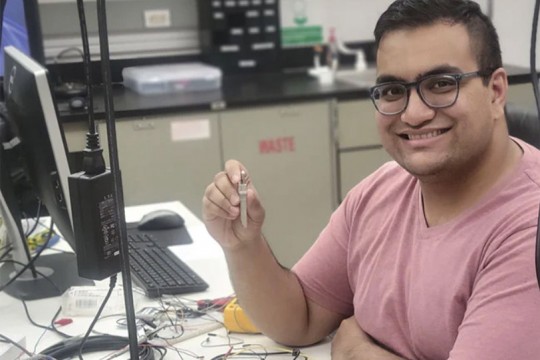
Industry-Academia Partnerships Exceed the Sum of Their Parts
Photonics Media features Don Figer, director of the Center for Detectors, computer engineering BS/MS student Irfan Punekar, and Stefan Preble, professor in the Department of Electrical and Microelectronic Engineering.
-
June 2, 2021

RIT and SPIE partner on 2021 Photonics for Quantum event
SPIE, the international society for optics and photonics, and RIT will present the 2021 Photonics for Quantum Digital Forum July 16-20. Previously an RIT initiative, this year marks a new iteration of this event in the form of a partnership between RIT and SPIE.
-
November 10, 2020

Rethinking black holes: New theory says that something that goes into one won’t be gone for good
WROC-TV talks to Don Figer, professor and director of RIT’s Future Photon Initiative and the Center for Detectors, about black holes.
-
October 13, 2020

Super-massive black hole discovery brings home the Nobel Prize in physics, and an RIT professor helped
WROC-TV talks to Don Figer, professor and director of RIT’s Future Photon Initiative and the Center for Detectors, about this year's Nobel Prize in Physics.
-
August 5, 2020

RIT student Justin Gallagher helps lead NASA-funded project to build single photon detectors
An RIT student is on a mission to help build detectors that could identify individual photons from distant, inhabitable planets. Justin Gallagher, a fifth-year student from Rochester, N.Y., pursuing his BS in physics and MS in astrophysical sciences and technology, is serving as project manager for a nearly $1 million grant funded by NASA to create a single photon sensing and number resolving detector for NASA missions.
-
August 3, 2020

RIT faculty gearing up to apply spring learnings to fall classes
The unexpected transition to remote learning during the spring semester challenged faculty across RIT to experiment, create, and deploy new methods of instruction to ensure student success. As the university gears up for in-person and online classes—or a combination of both—faculty members are applying a wide range of lessons learned from the spring to keep academic momentum moving forward in the fall.
-
June 23, 2020

RIT launching virtual speaker series featuring global leaders in quantum and photonics
RIT is launching an online speaker series that will feature international pioneers in the advancement of photonics for quantum devices. The Virtual Photonics for Quantum Workshop begins June 23 and will feature new invited talks each weekday at 1 p.m. through Aug. 7.
-
March 4, 2020
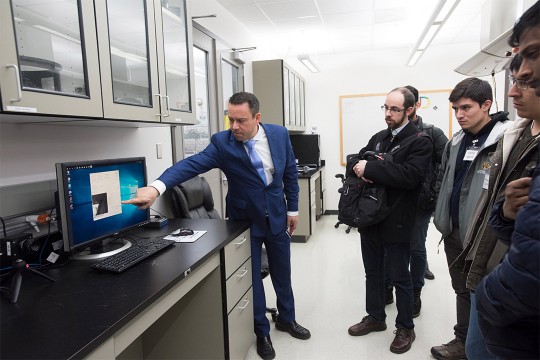
RIT to host workshop exploring the intersection of photonics and quantum technology
RIT will bring international pioneers in the advancement of photonics for quantum devices to campus this summer for a special workshop. The Photonics for Quantum Workshop 2 takes place June 23-25 at the RIT campus.
-
October 4, 2019

New tech at RIT may help find other planets
WROC-TV talks to student Justin Gallagher and Professor Don Figer, director of the Center for Detectors, about a sensor technology that may contribute to finding other planets.
-
September 12, 2019

Scientists developing single photon detector to help search for habitable exoplanets
NASA is awarding a team of researchers from RIT and Dartmouth College a grant to develop a detector capable of sensing and counting single photons that could be crucial to future NASA astrophysics missions. The extremely sensitive detector would allow scientists to see the faintest observable objects in space, such as Earth-like planets around other stars.