Improved phonon laser developed by Rochester researchers
New laser can be used in measuring gravity, testing quantum physics, and making new sources of sound at the microscopic scale
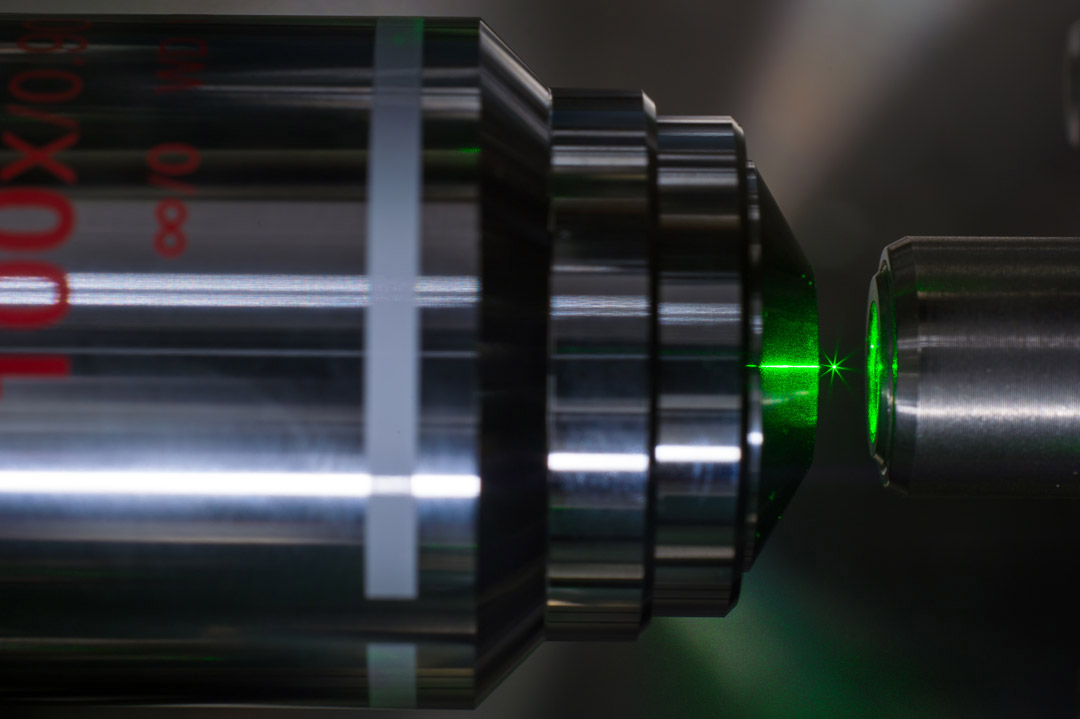
J. Fenster/University of Rochester
Researchers have developed a precise phonon laser that uses particles of sound as opposed to photons, or particles of light.
A joint project between RIT and the University of Rochester has developed a new squeezed phonon laser that provides precise control over individual particles of sound or vibration.
Mishkat Bhattacharya, professor in the School of Physics and Astronomy, and postdoctoral researcher Kewen Xiao are co-authors on a paper published in Nature Communications about how they coax phonons to behave like a laser. Lasers, using photons or particles of light, are used broadly in everyday life and in research, but they come with limitations.
“Light carries noise that reduces the precision of laser operations,” explained Bhattacharya. “Additional processing, called squeezing, has to be performed on laser photons to reduce their noise. However, for optical signals, the process of squeezing is very inefficient.”
The researchers demonstrated a device that puts out sound waves which are both laser-like and squeezed. The device is a mechanical analog of an optical laser, but much more efficient in squeezing. This new phonon laser can be expected to be used in measuring gravity, testing quantum physics, and making new sources of sound at the microscopic scale.
A simpler version of this laser, without squeezing, was announced in 2019 and selected as one of the breakthroughs of the year by Optics and Photonics. As Bhattacharya explained, the laser consists of a nanoparticle levitated optically by a focused laser beam, known as an optical tweezer.
Co-authors on the paper include University of Rochester’s Nick Vamivakas, the Marie C. Wilson and Joseph C. Wilson Professor of Optical Physics, and optics Ph.D. student Kai Zhang. The RIT team focused on the theoretical development of the project while experimental implementation took place at URochester.