John-Paul Takats Headshot

John-Paul Takats

Lecturer, Interactive Games and Media

School of Interactive Games and Media
Golisano College of Computing and Information Sciences

Office Hours

Spring 2026 office hours are currently TBD but will be posted first at this URL: https://people.rit.edu/~jxtadm/. Zoom and in person office hours are available.

Office Location
Office Mailing Address
20 Lomb Memorial Dr. Rochester NY 14620

John-Paul Takats

Lecturer, Interactive Games and Media

School of Interactive Games and Media
Golisano College of Computing and Information Sciences

Education

Information Technology BS '06 RIT, Professional Studies MS '15 RIT

Bio

John-Paul Takats is an experienced IT professional with a career spanning roles as a Solutions Architect at Accelerate Media, a Visiting Lecturer at RIT’s School of Information, an IT Strategist, and Consultant where he blended creative and technical expertise to lead strategic initiatives and deliver measurable results for clients. His expertise centers on full-stack development, agentic AI, database management, and digital accessibility.

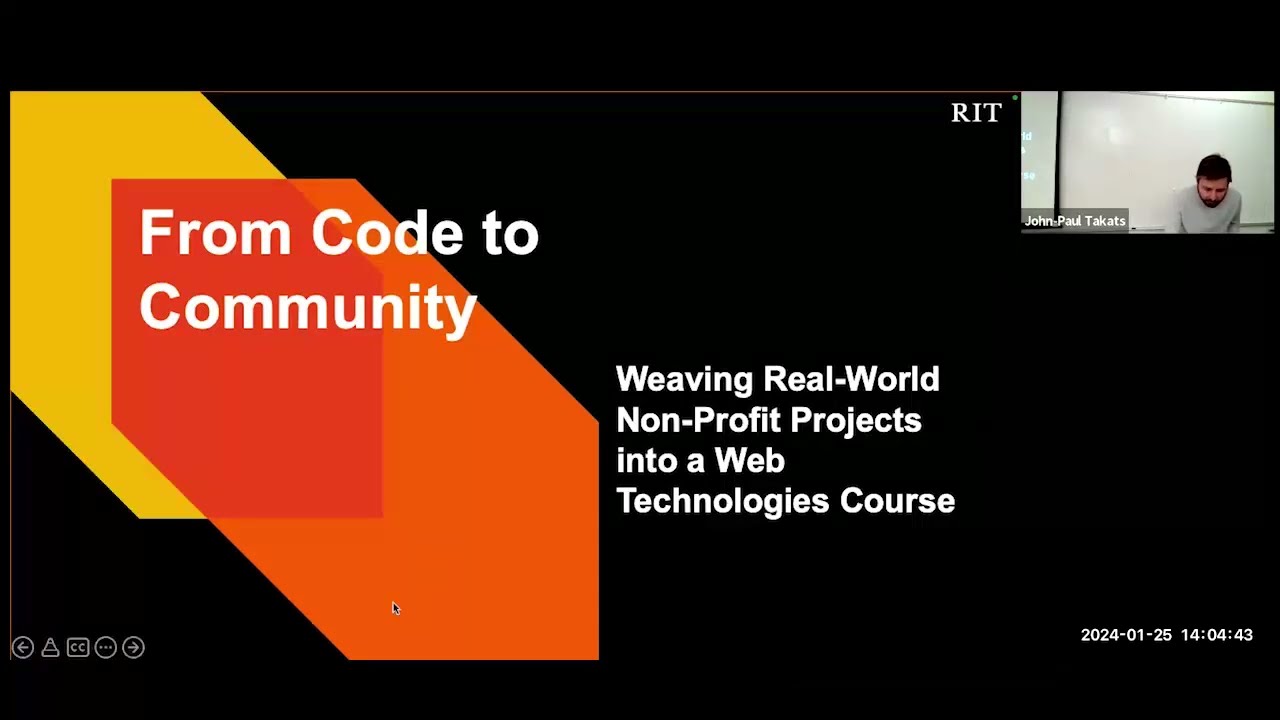
As IT Strategist for RIT’s Enrollment Management Division, John-Paul led projects like The Loop, a social network for 10,000+ students, and FeedMasher, an open-source content aggregator that powered the RIT homepage. A dedicated open-source advocate contributing to projects such as Mozilla Popcorn.js, he also led Code to Community, a class initiative connecting students with Rochester-area nonprofits on real-world web projects.


Areas of Expertise

Currently Teaching

IGME-110
3 Credits
This course provides an overview of media in historical, current and future contexts. Incorporating lectures and discussion with hands on work involving written and interactive media assets, students examine the role of written and visual media from theoretical as well as practical perspectives. The course also provides an introduction to interactive media development techniques, including digital media components and delivery environments. Students will be required to write formal analysis and critique papers along with digital modes of writing including collaborative editing and effective presentation design.
IGME-235
3 Credits
This course introduces web technologies commonly used in the production and distribution of both content focused web sites, and in the creation of interactive applications and games. Students will create web sites and web-native interactive experiences, and publish them to the web. Programming projects are required.
IGME-236
3 Credits
This course examines the concepts of interface and interaction models in a media-specific context, with particular emphasis on the concept of the immersive interface. This course explores concepts such as perception, expectation, Gestalt Theory, interactivity, Semiotics, presence, and immersion in the context of media application development and deployment. In addition, underlying concepts of cognitive psychology and cognitive science will be integrated where appropriate. These theories are then integrated in the exploration of the immersive interface, and with related concepts such as user-level-interface modification, augmentation of identity, and the interface as a social catalyst.
IGME-330
3 Credits
This course provides students the opportunity to explore the design and development of media-rich web applications that utilize both static and procedurally manipulated media such as text, images and audio. This course examines client and server-side web development and features common to such applications. Issues explored include framework characteristics, information management, presentation, interactivity, persistence, and data binding. Programming projects are required.
IGME-340
3 Credits
Interactive media applications are no longer restricted to personal computers. They can now be found on many distinct hardware platforms including mobile, tablet, wearable, and large-screened computing devices. In this course, students will learn to design, prototype and develop media rich interactive experiences that can be deployed to a wide variety of hardware devices. Programming projects are required.
IGME-430
3 Credits
This course provides students the opportunity to continue the exploration of Web technologies as they relate to the creation of media rich applications and experiences. Topics include backend server development, creation of Web APIs, modern web ecosystems, practical application of database management systems, Internet communication protocols, and investigations of large-scale full-stack Web development. These skills are portable to a wide variety of applications including interactive Web experiences, desktop applications, video games, and real-time communications.

Featured Work