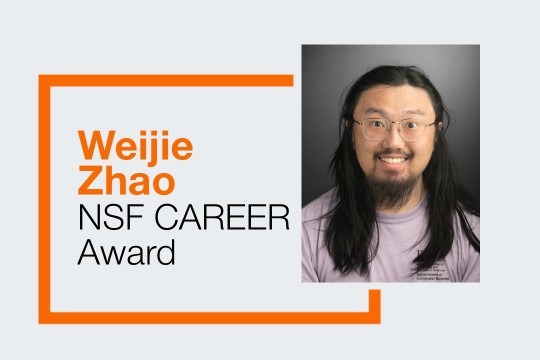
NSF CAREER Awards spotlight RIT research shaping the future of AI
Three researchers recently received the prestigious funding
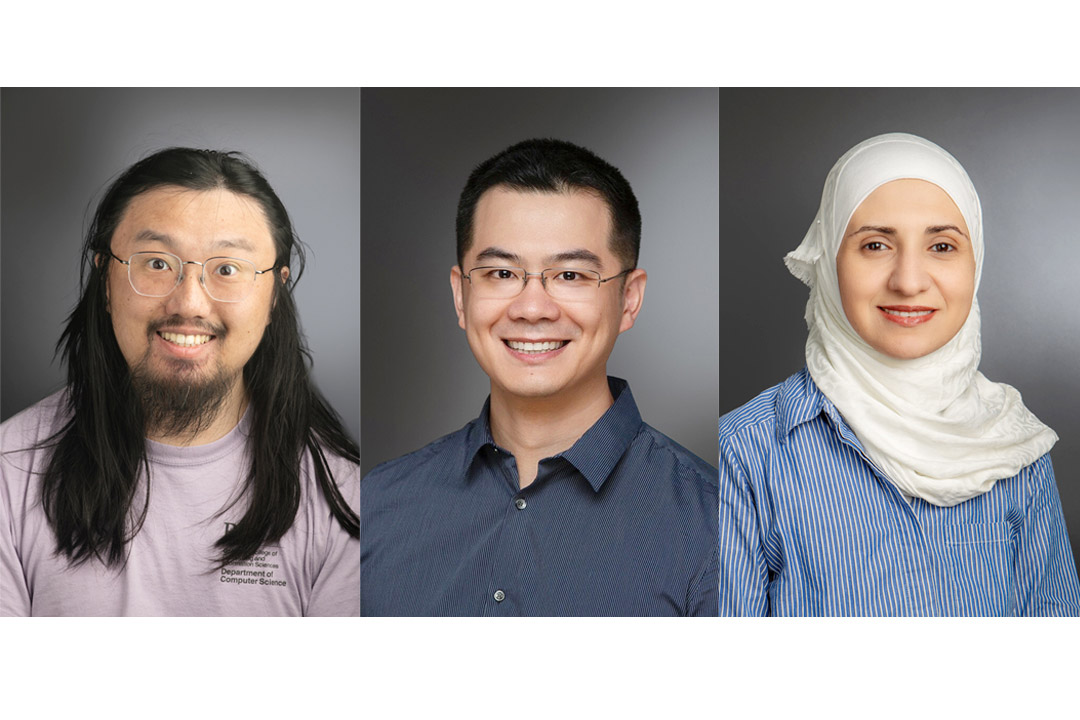
From left, Weijie Zhao, Ke Xu, and Dimah Dera are recent NSF CAREER Award winners.
As artificial intelligence becomes more deeply embedded in everyday life—from medical diagnostics to autonomous devices—the need for systems that are trustworthy, resilient, and efficient has never been greater.
At RIT, faculty researchers are tackling some of AI’s most pressing challenges with support from the National Science Foundation’s prestigious CAREER Award program, which recognizes early-career scholars who integrate cutting-edge research with student education.
One of those faculty members is Dimah Dera, Frederick and Anna B. Wiedman II Professor in the Chester F. Carlson Center for Imaging Science, who is focused on developing AI models that can adapt over time while remaining transparent and reliable. Dera’s work addresses a fundamental limitation of current AI systems—their inability to continuously learn without retraining—while also emphasizing uncertainty awareness and trustworthiness. Read more about Dera’s research.
Another CAREER Award recipient, Ke Xu, assistant professor in the School of Physics and Astronomy, is rethinking how and where AI computations take place. Rather than relying on energy-intensive cloud data centers, Xu is advancing edge computing technologies that allow AI systems to process information locally, closer to the data source. This approach enables faster decision-making, reduces environmental impact, and supports critical applications like wearable health monitors and autonomous sensors. Read more about Xu’s research.
Security and accountability are the focus of a third CAREER Award project led by Weijie Zhao, assistant professor of computer science. As AI systems grow more complex and influential, Zhao is working to defend machine learning models from adversarial attacks and hidden vulnerabilities. By making AI decision-making more interpretable and traceable, Zhao’s research aims to protect high-stakes systems from manipulation and misuse. Read more about Zhao’s research.