
RIT Croatia duo conquers Dubrovnik Hackathon with "Flow": The story of the traffic "hive mind"
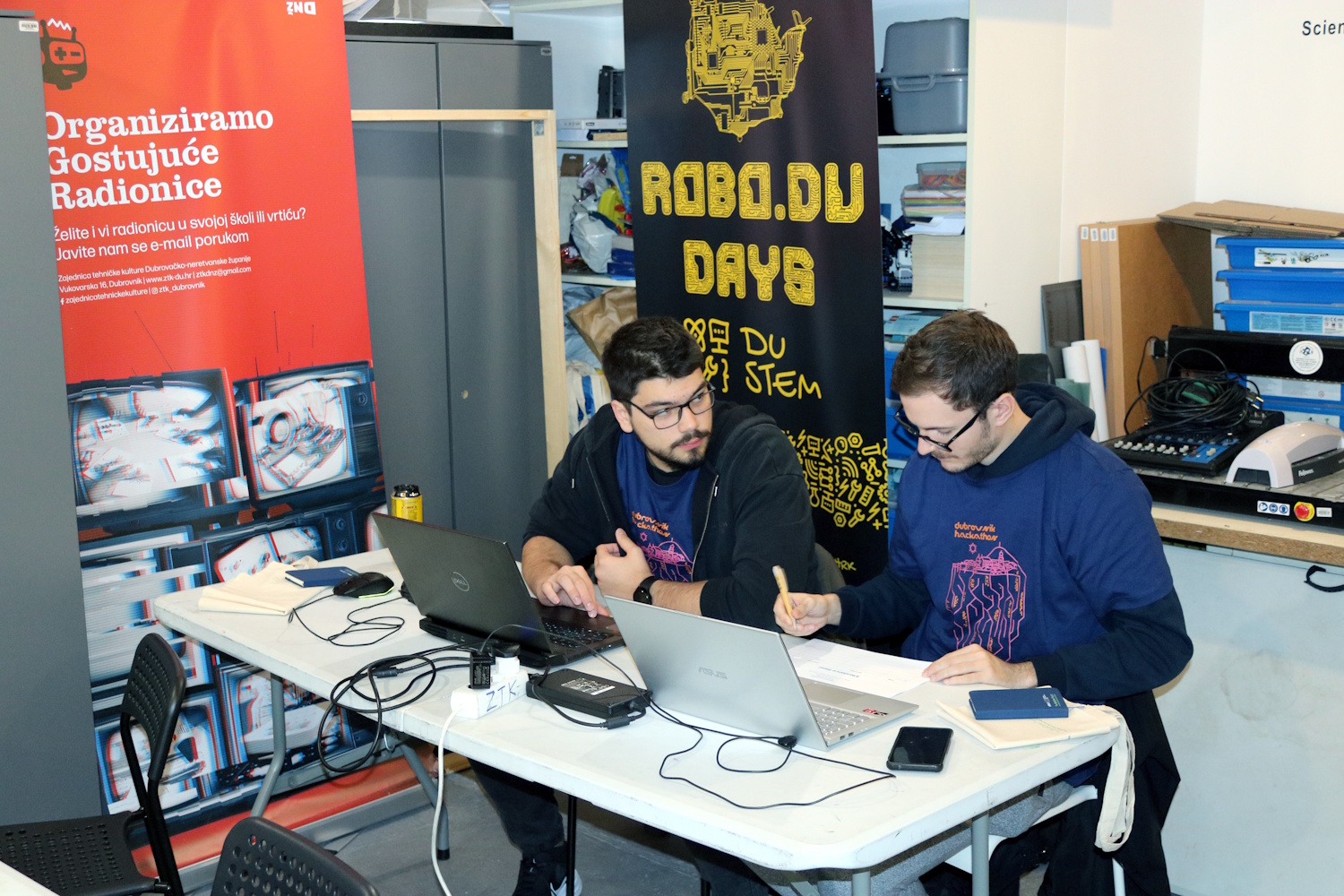
Photo: DURA
Dušan Gluščević and Igor Mišić at the Dubrovnik Hackathon 2025
The clock was ticking, the pressure was immense, but RIT Croatia students Dušan Gluščević and Igor Mišić prevailed at the Dubrovnik Hackathon 2025, organized by Dubrovnik Development Agency (DURA), in collaboration with RIT Croatia and University of Dubrovnik. These Web and Mobile Computing students didn't just win; they unveiled "Flow," a radical solution for "Smart Solutions in Sustainable Mobility" that could revolutionize city driving.
The Spark: What If Cars Could Talk?
The core concept behind "Flow" goes beyond simple navigation. It’s about collective intelligence. Dušan explained their ambitious vision: "Flow is not just an application. It's a device added to each vehicle. Our program creates a kind of ‘hive mind’ that connects all the cars."
This system uses cameras, location data, and destination details, continuously sharing information between vehicles. "Our algorithm continuously analyzes this real-time data and shares it... Based on that, it finds the best route and calculates the optimal speed profile each vehicle should follow," Dušan elaborated.
The immediate impact is significant. Instead of cars starting sequentially at a light, "With Flow, all cars could start moving at the same time, with safe distances automatically maintained. That would allow more cars to pass through a green light than usual." This seamless coordination reduces "stop-and-go driving," prevents jams, and ultimately leads to "lower fuel consumption and emissions," making it a perfect fit for sustainable mobility.
The All-Nighter: Sacrificing Sleep for Victory
The duo’s initial goal was simpler: to coordinate cars at a light for a quick start. But they realized the potential for the full "hive mind" was too great to ignore. "That idea changed our plan completely. We decided to sacrifice our sleep and build the hive mind system within the hackathon time," Dušan confessed.
The intense development sprint was chaotic: "We went through a lot of effort, many car crashes and traffic accidents in our simulations, unexpected problems, errors, and even more unexpected problems. But in the end, we managed to get everything working just minutes before our presentation."
To achieve this in 24 hours, they relied on Python (core logic), Kotlin/Android Studio (app), and Unity with C# (realistic simulations).
RIT Croatia and the Call to Innovate
For Igor, the success was rooted in the practical, application-focused approach of their RIT Croatia program. "I would say that the most influential thing that helped us make the application was the approach. At RIT Croatia, most of the things we do are for applications." He noted that the solution relied on fundamental skills: "It used some logic that we were taught in the first year of programming when it comes to algorithms."
Looking ahead, Igor stressed the need for caution: "To make an application fully functional, it would require a lot more time to make sure it would be safe to use... first thing that we would do is make it 100% safe and functional in traffic before commercial use."
Finally, he extended an invitation to fellow students: "I would highly recommend going to the Hackathon. If you're considering whether to go or not, because you might think you won't win... I would advise you to go, and maybe you will see some other ideas that might inspire you tomorrow for something new. It really helped us to see what we know and what we don't know as programmers."
Dušan and Igor’s victory proves that combining sharp technical skills with the courage to innovate—values fostered at RIT Croatia—can truly drive the future of our cities.