RIT student’s designs will help power world’s first Electron-Ion Collider
Internship led to a design of magnet storage stands expected to save Brookhaven National Laboratory $420,000
Scott Hamilton/ RIT Photography
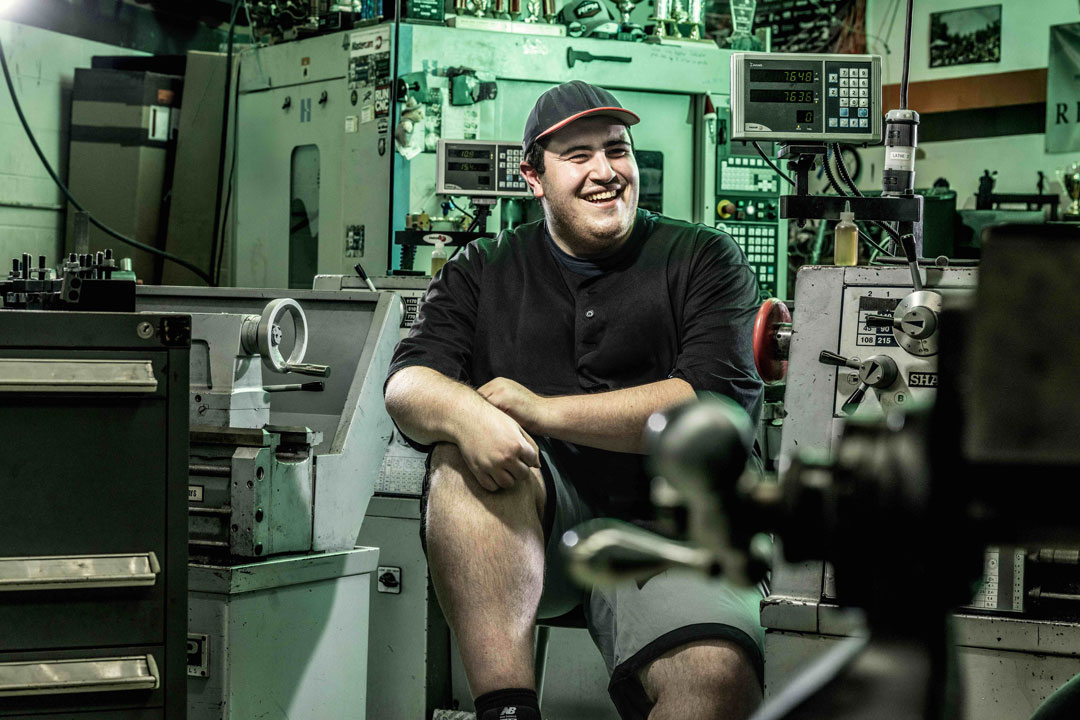
RIT student Robert Desjardins designed the four-tiered storage system to hold the superconducting magnets that will be installed in the new Electron-Ion Collider at Brookhaven Laboratory.
When the U.S. Department of Energy’s Brookhaven National Laboratory needed multiple stands that could each support up to 45,000 pounds of superconducting magnets in limited space, a Rochester Institute of Technology student designed the solution.
Fourth-year mechanical engineering technology student Robert Desjardins spent his summer internship redesigning storage stands that will help Brookhaven prepare for the world's first Electron-Ion Collider (EIC), a next-generation particle accelerator that will help scientists understand the building blocks of matter.
During his 10-week internship, Desjardins developed a four-level design capable of safely storing 20-foot-long magnets weighing more than 10,000 pounds each. The stands will allow magnets being removed from the Relativistic Heavy Ion Collider (RHIC), in service for more than 26 years at Brookhaven, to be stored for reuse on the new Electron-Ion Collider, which is expected to become operational in the mid-2030s.
“The original stands were designed in the 1990s, and at the time they could hold only three of the magnets. They wanted to up the capacity to four,” said Desjardins. “I had to get my project fully designed, look at blueprints, revise computer-aided models, and start talking to the manufacturers and simulate some of the strength tests required.”
RIT alumnus and Brookhaven mechanical engineer Jonathon Greene '15 (mechanical engineering), who helped oversee the project, served as Desjardins’s mentor during the internship.
David Rahner/Brookhaven National Laboratory
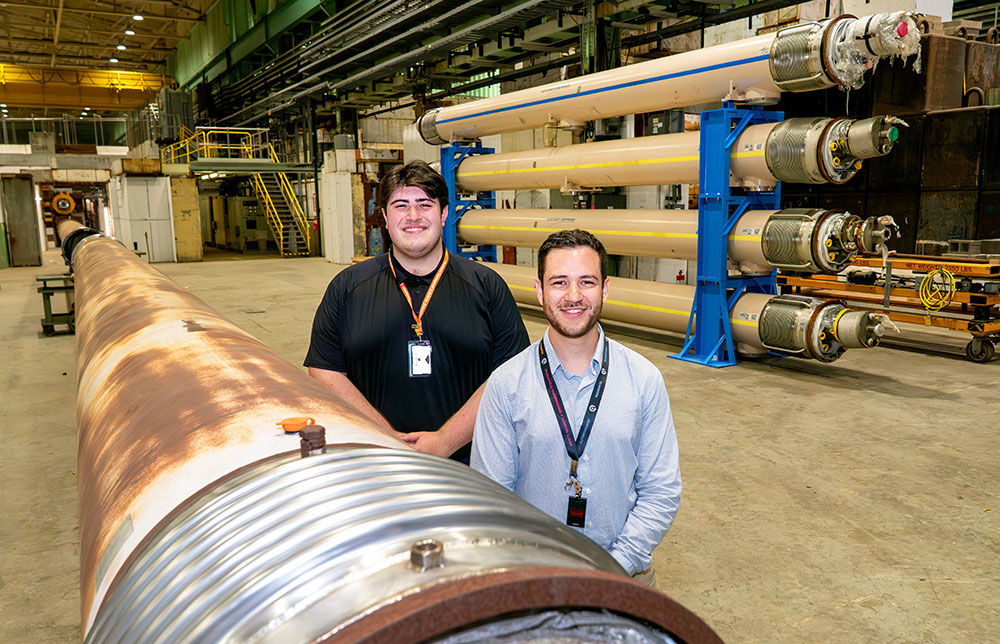
RIT alumnus Jonathon Greene, right, and Desjardins are pictured in front of the new four-tier magnet storage stand Desjardins designed. Greene, who has been at Brookhaven National Laboratory since 2022, mentored Desjardins through his internship. They are standing next to a superconducting magnet.
In an article written by the lab, Greene credits Desjardins’s work with significant project savings. “Rob costed down the original design while increasing the height. We saved about $420,000 by doing so.”
Greene said he expects about 80 magnets will come out of RHIC and need to be stored for the EIC using Desjardins’s design.
During the prototype development, Desjardins met regularly with Greene and presented status information to the larger group of project engineers and scientists, fielding tough questions about materials, status of safety reviews, and results of simulations testing for load capacity and even seismic analysis.
“In engineering you have to simulate for the worst at all times. I did so many simulations; the design was half the project. The other half was performing the simulations and checking my work,” said Desjardins, who is from West Sayville, N.Y., and is also working on a master’s degree in mechatronics and mechanical systems in RIT’s College of Engineering Technology.
Both Greene and Desjardins attribute some success in the field to participating on co-ops and internships that provide students with real-world experience. Technical coursework in 3D modeling, strength of materials, and load tolerance are foundational concepts for engineers. These were the skills Desjardins said he learned at RIT and brought to the Brookhaven project.
RIT’s renowned internship and co-op program, one of the oldest and largest in the nation, allows students to learn on the job and define their career paths. More than 4,000 RIT students completed co-ops or internships last year, engaging in paid work experience at national and global companies and organizations in nearly every industry.
“This was such a great experience, to learn and hear feedback on a project from experienced engineers, experts at their craft, and to be part of such a huge international project,” said Desjardins. “This was all real teamwork and it was great.”