Biomedical Engineering Master's Capstone: AbsolElute Beads
Downstream purification of recombinant therapeutic proteins currently accounts for nearly 80% of total biopharmaceutical production costs, contributing to the high cost and limited accessibility to this class of pharmaceutical solutions. RIT Master's students developed a strategy to implement antibody-tethered beads specific to the target protein as a product addressing this concern.
Downstream purification of recombinant therapeutic proteins currently accounts for nearly 80% of total biopharmaceutical production costs, contributing to the high cost and limited accessibility to this class of pharmaceutical solutions. While Protein A affinity chromatography is the industry standard for monoclonal antibodies, it is ineffective for “Next-Generation Biologics” such as antibody fragments (Fab, scFv) and nanobodies that lack an Fc region. Without a universal affinity ligand, manufacturing of these molecules currently relies on complex multi-step procedures, each step with limited specificity, and a multiplicative loss of product that significantly diminishes the final recovery of high-value therapeutics.
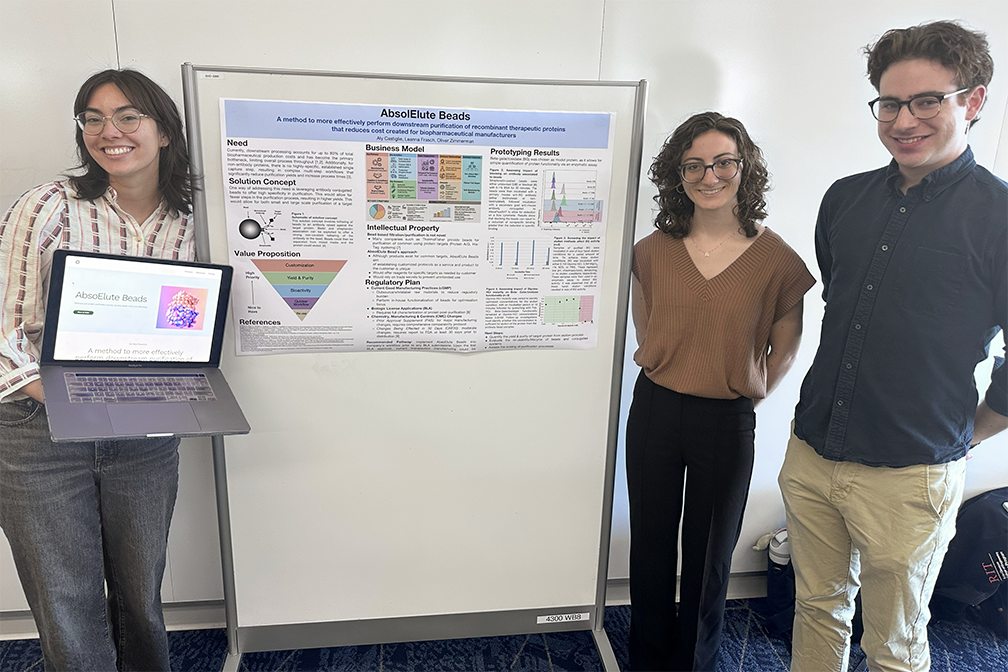
A Biomedical Engineering MS Capstone team - Aly Castiglie, Leanna Frasch, and Oliver Zimmerman - developed a strategy to implement antibody-tethered beads specific to the target protein as a product addressing this concern. The overarching goal of their AbsoElute Beads business model targets an unmet market demand, shifting the industry from rigid “one-size-fits-all” resins to an adaptable affinity model that reduces developmental timelines. Additionally, by consolidating multiple chromatography steps into a single high-specificity capture step, this strategy could significantly reduce the ‘yield tax,’ where a percentage of the target protein is typically lost at each successive step. This transition not only maximizes total product recovery but also significantly reduces the workflow timeline and total buffer consumption required for processing. The physical purification kit would be designed to meet rigorous industrial standards, targeting > 98% purity in a single capture step and a yield of at least 50%.
Initial prototyping focused on characterizing Beta-Galactosidase (BG), an enzyme naturally encoded by the LacZ gene in E. coli. BG was selected as a model protein because its enzymatic activity can be quantified through a colorimetric assay, providing a direct measure of protein integrity. Prototyping revealed that standard harsh elution conditions (low pH, chaotropic/ionic, or denaturants) significantly diminished BG activity, necessitating the identification of an optimized elution condition range. Furthermore, flow cytometry experiments identified a technical “sweet spot” where beads could be effectively blocked to prevent nonspecific binding while retaining a stable coating of antibodies via biotin-streptavidin interaction. This characterization provides a reproducible framework for optimizing ligand density, ensuring that the 'made-to-order' kits provide maximal binding capacity without compromising the structural integrity of the target protein.
Future experimentation could focus on quantifying yield and purity from heterogeneous mixtures, evaluating the reusability of the bead-conjugated system, and assessing how scale-up impacts the process. AbsoElute Beads holds promise for a significant impact on the purification market by fulfilling the R&D burden for specialized targets, providing a streamlined path from the laboratory to the clinic.
More Featured Profiles and Work