Electrical and Computer Engineering Doctor of Philosophy (Ph.D.) Degree

The electrical and computer engineering Ph.D. gives engineers the tools to transform the world by leading trailblazing research that expands and creates knowledge.
Overview for Electrical and Computer Engineering Ph.D.
STEM-OPT Visa Eligible: The STEM Optional Practical Training (OPT) program allows full-time, on-campus international students on an F-1 student visa to stay and work in the U.S. for up to three years after graduation.
Forming Independent Researchers to Transform the World: World-class researchers in: (1) architectures and devices for computing; (2) communications, networking, and security; (3) machine learning and artificial intelligence; and (4) cyber-physical and embedded systems.
Knowledge and Skill to Form Successful Researchers: A plan of study that consists of course work and research. Do research under the guidance of the world-class researchers that comprise our faculty.
An Apprenticeship in Research: Graduates who thrive and enjoy successful careers in academia, industry, or government research laboratories as creators of new knowledge in the discipline of electrical and computer engineering.
Why Pursue an Electrical and Computer Engineering Ph.D. at RIT?
This is an exciting time in electrical and computer engineering. Harnessing electricity not only provides humanity with a transformative form of energy but also leads to the development of digital technologies, which have forged our Information Age as a time of revolutionary advances developed at an unprecedented pace.
The 21st century has witnessed such advances as the Smart Grid, ubiquitous fast internet access through wireless networks, artificial intelligence and machine learning technologies that rival humans in performance, the Internet-of-Things, cloud computing, fiber-optic networks capable of transmitting trillions of bits per second, new computing paradigms such as quantum or neuromorphic computing, and many more. None of these advances would have happened without the dedication of researchers in electrical and computer engineering.
Offered jointly by the department of electrical and microelectronic engineering and the department of computer engineering, students in RIT’s Ph.D. in electrical and computer engineering learn to become independent researchers by conducting research under the guidance of the world-class researchers that comprise our faculty. This research is often associated with some of the many centers and laboratories across RIT, including the Center for Human-aware AI (CHAI) and the Global Cybersecurity Institute.
The curriculum for the electrical and computer engineering graduate program provides the knowledge and skills to form successful independent researchers by providing disciplinary and interdisciplinary courses, research mentorship, and seminars.
-

Discover how graduate study at RIT can help further your career objectives.
Virtual Admissions Webinars | Recordings available
Virtual Academic Sessions | October 20 - October 29
On-Campus Open House | November 20
Research
Advancement of world-class impactful research is the ethos of the Ph.D. in electrical and computer engineering. The program forms a dynamic and collaborative environment where our students and faculty are developing the next wave of transformational technologies for our society by conducting research in the following areas:
- Architectures and Devices for Computing
- Communications, Networking and Security
- Machine Learning and Artificial Intelligence
- Cyber-physical and Embedded Systems
Are you a doctoral student interested in participating in our research? Learn more about research assistantship opportunities across the Kate Gleason College of Engineering and how you can apply.


Featured Work and Profiles
-

RIT Research Minute: DNA Computing
Amlan Ganguly DNA molecules and computing? RIT computer engineering department head, Amlan Ganguly and his research team are working to change DNA for more sustainable and effective computing.
Read More about RIT Research Minute: DNA Computing -

Ph.D. Student Pioneers Future of Computing with Memory-Centric Tech
Purab Sutradhar is leading the charge in developing innovative memory-centric computing solutions that promise to make AI and data processing faster, cheaper, and more energy-efficient, with his work...
Read More about Ph.D. Student Pioneers Future of Computing with Memory-Centric Tech -

Student Develops New Methods to Analyze E-Cigarette Usage Patterns
Edward Hensel Qutaiba M. Saleh is pioneering research on Electronic Nicotine Delivery Systems by creating new techniques to measure device performance and track long-term usage patterns, aiming to improve health...
Read More about Student Develops New Methods to Analyze E-Cigarette Usage Patterns -

RIT Research Team Enhances Cybersecurity Training with AI Innovations
Shanchieh Yang Professor Yang and his team are creating a cutting-edge training program using the Cyber Range to integrate Large Language Models into cybersecurity operations, aiming to dispel myths and improve...
Read More about RIT Research Team Enhances Cybersecurity Training with AI Innovations -

Dr. Dongfang Liu Pioneers AI Solutions to Tackle Society Challenges
Dongfang Liu Assistant professor Dr. Dongfang Liu is advancing the field of AI with his research on human-like perception models and practical AI solutions, focusing on applications from autonomous drones to...
Read More about Dr. Dongfang Liu Pioneers AI Solutions to Tackle Society Challenges -

Faculty Spotlight: Dorin Patru
Dorin Patru Associate professor at RIT since 2002, Dorin Patru teaches digital and computer, circuits and systems courses. He joined the department in fall 2002. He received a B.S. and M.S. in Electrical...
Read More about Faculty Spotlight: Dorin Patru
Related News
-
March 30, 2026
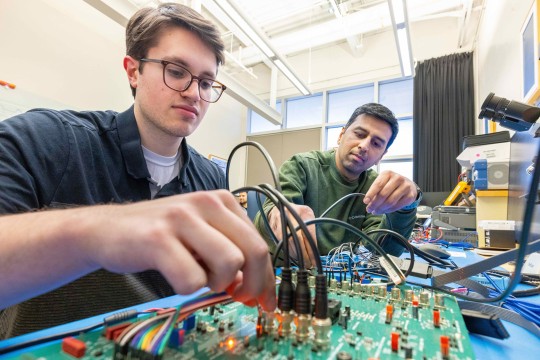
RIT researchers create adaptive computer chip design that saves power in everyday electronic devices
Researchers at RIT have developed a new computer chip design approach that allows electronic systems to automatically adapt to real-world conditions, improving how devices manage power in everyday use.
-
November 19, 2025

Manifesting quantum: How RIT researchers are navigating the next frontier of physics
RIT researchers are zeroing in on quantum photonics, the creation, control, and detection of light. Photonics has long been a specialty of the university. RIT led the team that developed the first quantum photonic wafer, which is key to the future of mass-produced quantum communication systems.
-
May 13, 2025

RIT showcase offers glimpse of early tech innovation cycle
TechTarget speaks to Paloma Hamilton, fifth-year mechanical engineering student; Geoff Twardokus, electrical and computer engineering Ph.D. student; and Christopher Collison, director of RIT's AI Hub and Initiatives, about the innovative developments featured at Imagine RIT.


Curriculum for 2026-2027 for Electrical and Computer Engineering Ph.D.
Current Students: See Curriculum Requirements
Admissions and Financial Aid
This program is available on-campus only.
| Offered | Admit Term(s) | Application Deadline | STEM-OPT Visa Eligible |
|---|---|---|---|
| Full‑time | Fall | December 15 priority deadline, rolling thereafter | Yes |
Full-time study is 9+ semester credit hours. International students requiring a visa to study at the RIT Rochester campus must study full‑time.
Application Details
To be considered for admission to the Electrical and Computer Engineering Ph.D. program, candidates must fulfill the following requirements:
- Learn tips to apply for a doctoral program and then complete a graduate application.
- Submit copies of official transcript(s) (in English) of all previously completed undergraduate and graduate course work, including any transfer credit earned.
- Hold a baccalaureate degree (or US equivalent) from an accredited university or college. A minimum cumulative GPA of 3.0 (or equivalent) is recommended.
- Submit a current resume or curriculum vitae.
- Submit a statement of purpose for research which will allow the Admissions Committee to learn the most about you as a prospective researcher.
- Submit two letters of recommendation.
- Entrance exam requirements: GRE optional but recommended
- Submit English language test scores (TOEFL, IELTS, PTE Academic, etc.), if required. Details are below.
English Language Test Scores
International applicants whose native language is not English must submit one of the following official English language test scores. Some international applicants may be considered for an English test requirement waiver.
Duolingo (DET): 135
IELTS: 7.0
LanguageCert Academic: 78
PTE Academic: 66
TOEFL: 94/5
International students below the minimum requirement may be considered for conditional admission. Deaf and hard-of-hearing test takers with significant hearing loss do not need to take the listening and speaking sections for the TOEFL and IELTS. Each program requires balanced sub-scores when determining an applicant’s need for additional English language courses.
How to Apply Start or Manage Your Application
Cost and Financial Aid
An RIT graduate degree is an investment with lifelong returns. Ph.D. students typically receive full tuition and an RIT Graduate Assistantship that will consist of a research assistantship (stipend) or a teaching assistantship (salary).
Resources
Access resources for students including student manual and research resources.
- ECE Ph.D. Student Manual
- KGCOE Graduate Student Manual
- ECE Ph.D. Request for Qualifying Exam
- ECE Ph.D. Advisory Committee Formation form
- ECE Ph.D. Request for Candidacy Exam
- ECE Ph.D. Request for Research Review Meeting form
- ECE Ph.D. Request for Dissertation Defense
- ECE Ph.D. Request for Independent Study form
Research Resources
- RIT Libraries
- RIT Libraries InfoGuides
- Our librarian
- Remote access to publications with RIT Account

