Launching Aerospace Innovation: An Alum's Journey to Leadership at Northrop Grumman
Casey, '17 Electrical Engineering Technology, reveals the hands-on education and crucial soft skills that paved her way to leadership in aerospace innovation.
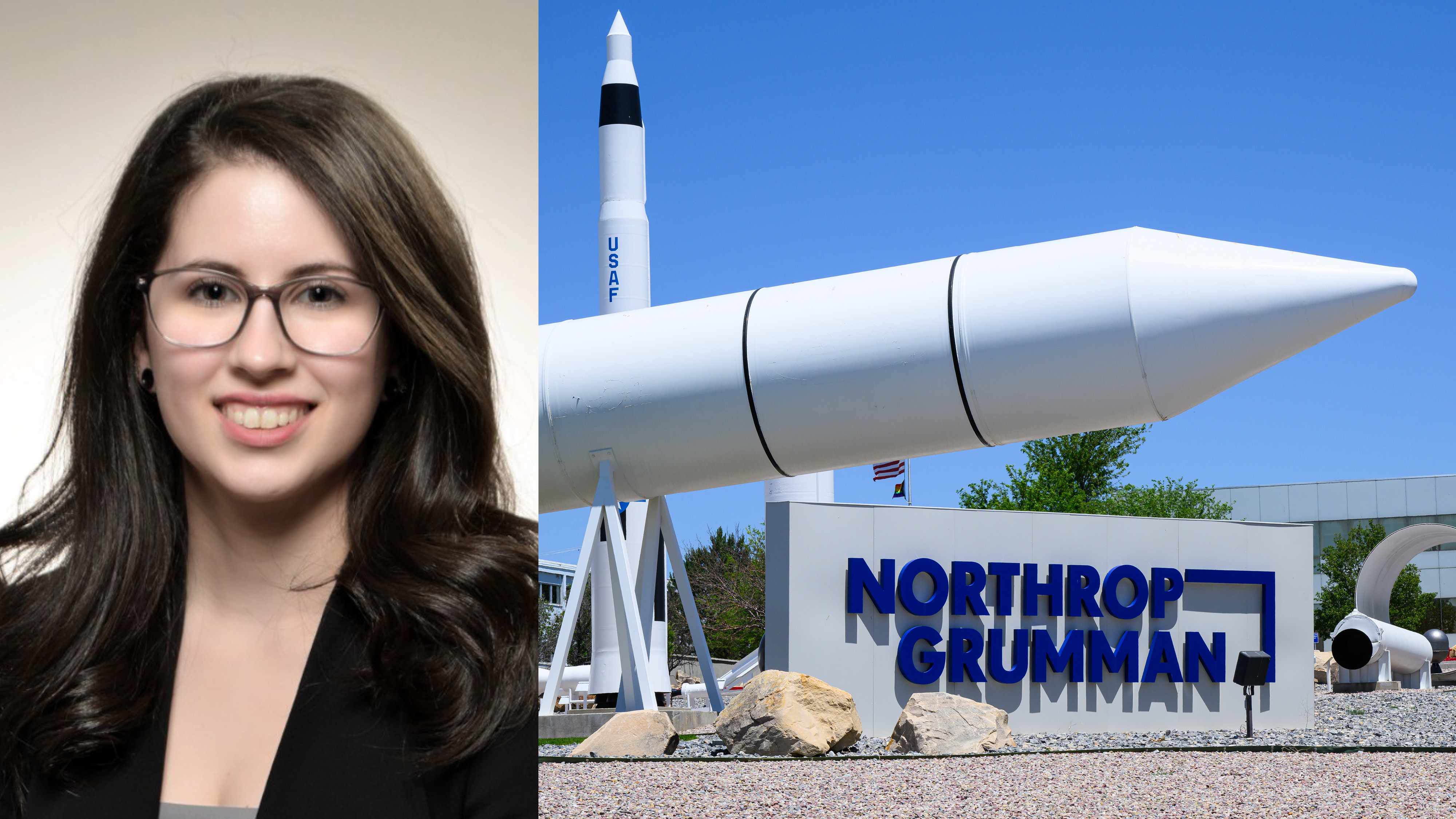
I am currently employed at Northrop Grumman, Mission Systems in Baltimore, Maryland; I am an RF Microwave Engineer within the Hardware Subsystems Engineering group. I started at Northrop Grumman in the Professional Development Program, now called their Pathways program, which afforded me the opportunity to rotate around the company and find the best fit. While I started in RF design, I realized that wasn’t what I wanted long-term. My second rotation was in Integration and Test which involved more hands-on engineering, which was a much better fit for me, especially with my Engineering Technology degree. I loved it almost immediately and decided my search was over and went permanent in the department.
While I have also explored RF Analysis roles at different times in the past, I mainly focus on the integration and testing of our systems which involves running a team of engineers and technicians and, for me right now, multiple specialized labs. I am responsible for the day-to-day integration and testing for a very large program which means I am not only responsible for my own work but tasking and assisting a large team across multiple testing facilities. The work is difficult and I never get to sit in one place for very long but it is challenging and very enjoyable.
What do you think are the most important skills/abilities to have for this kind of work? Are there skills you learned at RIT that you apply to your job today?
Specifically for this type of work, soft skills (leadership, communication skills, time management, etc.) are just as important as technical skills. Obviously, the technical skills I learned at RIT gave me a great base to start learning my specific job skills. Since my work tends to be pretty niche, testing complex products in specialized chambers, there was a fair amount of learning on the job for me; still learning to this day. The knowledge I came in with though provided the base skills required to help me learn what I need to know to do my job effectively. Then, because I’m running a team, I need to be able to communicate effectively with the people I task as well as with upper management. Though RIT is known as a technical school, I believe they also did an excellent job of teaching soft skills by requiring group labs and projects which reinforces things like working on a team and learning to communicate effectively with others. The soft skills cannot be overlooked as a career necessity.
What do you love about your current job? How did you discover the Electrical ET program at RIT? What intrigued you about the program?
My current job affords me a number of different opportunities which is why I love it. I have interaction with all types of people and disciplines, and it allows me to split my time between hands-on, group work and independent work. That’s one of the reasons the Engineering Technology program appealed to me as much as it did. I didn’t want to do one thing all the time; I wanted variety and a good balance between studying theory and actually applying that theory to real life.
Thinking back to your time at RIT, what are the top 2-3 things from RIT that led you to where you are today? Were there any faculty that inspired you?
Thinking back on my RIT experience, there were a number of things that got me to where I am today. Things like the friends that I made that helped me through the stress of classes and exams, to the co-ops that helped me to discover what I did and did not want in a career. No doubt though, one of those things was the faculty in the Electrical and Computer Engineering Technology department. Faculty like Dr. Eastman, now Senior Associate Dean I believe, Dr. Christman and Professor Cliver were huge influences on me. I specifically remember going to Dr. Eastman the day of my last career fair and chatting with him about everything from my last semester’s classes to how to go about finding my full-time position. He gave me advice and wisdom which definitely gave me confidence walking into the fair in which I would find my full-time position with Northrop Grumman.
What made RIT stand out from other schools you could have gone to? Why the College of Engineering Technology?
RIT immediately made a striking impression on me. Once I started researching schools, I went to one of my advisors at the time and we went through every school that offered Engineering Technology as a major. He helped me narrow down the schools that seemed a good fit and from there I started my immense research.
There are two specific things that made RIT stand out as a school; the co-op program and the culture. The co-op program, unsurprisingly, was a major draw. I thought, and still think today, that the fact that full-time work in one’s field prior to graduation is the best preparation for the work force one can have. It immediately seemed like a school that cared and would focus on the applicability of one’s degree instead of strictly awarding said degree. The culture definitely factored in as well though. The school offered all kinds of different social clubs as well as being a good size. The school is small enough to give the individual help if required, yet large enough that there are different perspectives and activities around campus.
I specifically chose the College of Engineering Technology because I knew before attending RIT that Engineering Technology was for me. I wanted a hands-on approach to engineering and ET allowed for it. One thing I specifically loved about the college and my department though was that the faculty is dedicated to their students. Nearly every class I took was taught by the professors themselves, not grad students, and office hours were plentiful and well attended. The faulty also all had worked in industry prior to being professors which made them a great resource for us students.
Were there any co-op or career services at RIT that helped you get started on your career? What were they? How did you learn about them?
I was able to find all my co-ops by attending the career fairs so the only interaction I had with the career services at RIT was the co-op prep class that was required for every student. The class was immensely helpful and to this day, maybe my most reflected-back-on course I took. The class taught us how to interview, write a resume and network. These skills are invaluable in the work force and not a given to be taught at other schools.
Using the skills learned in the prep course, I was able to get my first co-op at a Rochester company which produced complex medical devices for a summer. I worked in reliability at this company and though the work was interesting, I learned that the medical field was not for me. Just as valuable as finding out what you do like via a co-op, is finding out what you don’t like. I knew from there on out, I wanted a different career path.
My second co-op was a year-long RF engineering co-op at a defense subcontractor in Syracuse. Having prior work experience and a more focused path of what type of work I was looking for, I was able to better prepare for career fair and truly target the companies I was interested in. I landed the co-op and immediately knew it was a better fit for me.
What did you like in high school? How did you choose your RIT degree? What advice would you give to high school students who would like to pursue this field?
I actually had a bit of a different path to RIT than maybe most. Graduating high school I actually didn’t have any idea what I wanted to do as a career. I knew I liked math and science but at the time I didn’t know what opportunities were really open to me in the STEM world; this was before different STEM programs came to my school district. Due to not knowing what path I wanted to take, I chose to go to my local community college on scholarship and work while I figured it out. Two years and an Associate of Arts degree later, I finally landed on Electronics Engineering Technology. Unfortunately, it wasn’t in the cards to go away to school right away so I went to another local community college for two years and earned my Associate of Applied Science in Electronics Engineering Technology. I applied to a handful of schools and ultimately decided RIT was the best fit for me.
Anyone who would like to pursue a similar field, the best advice I could give would be to do your research. I wouldn’t jump into a specialized career right away if you are unsure (I do know RIT has a great engineering technology exploration program which sounds like a fantastic option). Though I am jealous of people who knew right away what they wanted to do with their lives, it took me longer to figure out my path but I have no regrets about it. Your future career is a big decision and not one that should be taken lightly. Explore your options and make sure that what you pick will make you happy in the long-run.
No matter what path you choose, I wish all the current students and prospective students luck in their futures. I will never forget my time at RIT and I hope everyone has as great of an experience as I did.
More Featured Profiles and Work

Milton Walker
Yangming Lee
Sungyoung Kim
Yangming Lee