RIT alumna finds balance in science, sawdust, and chainsaw carving
Biomedical sciences influenced Liz (Federici) Spry
Liam Myerow
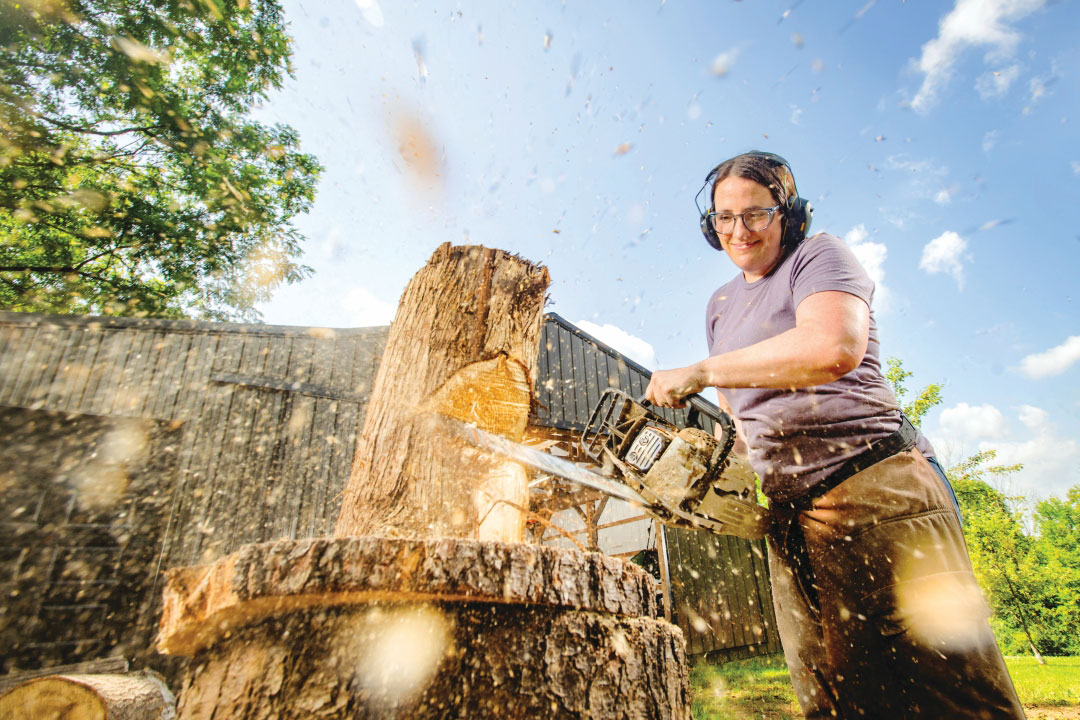
Science and sawdust are mainstays for Liz (Federici) Spry ’09, who likes to carve whimsical animals with her chainsaw.
Work-life balance for high school science teacher Liz (Federici) Spry ’09 (biomedical sciences) involves a chainsaw and a lot of sawdust.
A self-described “science nerd” and lifelong artist, Spry reenergizes on the weekends and during school breaks by carving bears, birds, dogs, and more at her Palmyra, N.Y., studio.
From her first lopsided pumpkin 15 years ago to the detailed birds she carves today, Spry’s finesse with the chainsaw has turned her hobby into a microbusiness called Spry Carvings.
“Once you get that confidence in creating something the way you envision it, then you can make it your own,” Spry said. “I’ve been enjoying making birds over anything else, and the vision I have in my mind is to make them mostly realistic but a little bit whimsical at the same time.”
Her approach is different for custom orders of people’s pets. “I want it to look like their pet, and so I’ll draw it out and sketch it on the log and constantly reference pictures.”
Spry spends most of July and August creating inventory for fall art and vendor shows. She also prepares for an annual chainsaw competition held in Pennsylvania in October alongside lumberjack sports, such as chopping and sawing wood.
Chainsaw carving is associated with men and, at festivals, Spry sometimes is met with doubt and cognitive dissonance.
“People will ask me, ‘Oh are you selling these for your husband or for other male carvers in the area?’ or ‘Is your chainsaw pink?’—I get that every once in a while,” Spry said. “It’s frustrating in this day and age that people just can’t believe it, but I see more and more women carving, and I think it’s great.”
Liam Myerow
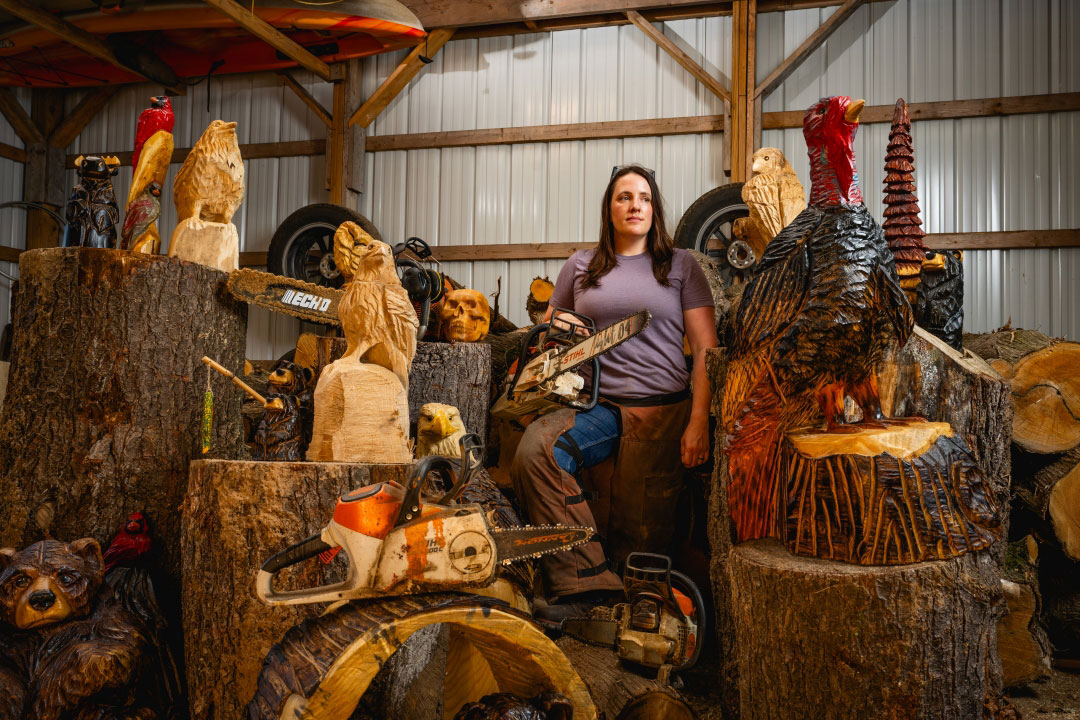
Spry’s carvings are often of wildlife, such as birds and bears.
Today, women carvers find community via social media and share process videos online. That support didn’t exist when Spry started carving.
Her husband, Rob, introduced Spry to lumberjack sporting events when they were dating, and she was intrigued by the vendors’ chainsaw carvings. After a safety lesson, Spry began honing her craft.
Her career and hobby coincided and developed into parallel paths. As a high school science teacher at the Penfield (N.Y.) Central School District, Spry teaches anatomy and physiology, chemistry, and forensic science—a dual-credit program through Syracuse University Project Advance.
“My biomedical sciences degree was a huge influence on my science teaching,” Spry said. “It helped me realize my fascination in science, especially for anatomy and physiology and biological sciences.”
While “anatomy and physiology” is her favorite class to teach, Spry rarely makes anatomical carvings—except for a skull candy dish for Halloween. She would rather carve animals.
Sourcing wood is unpredictable for Spry. Instead of buying from lumber mills, she relies on arborist friends who cut trees for a living. “I feel better environmentally if the tree is already going to come down anyway.”
Spry’s artistic talent and affinity for science have given her a hobby-turned-small business and a professional focus that enriches her life.
“I’ve always used art as a creative outlet,” Spry said. “When I was at RIT, I would draw and paint as a hobby and a brain break, and I realized what an important part of my routine it became. Now, my medium is different, but the habit really took hold back then.”