From smartwatches to emojis—RIT graduate researchers explore uses of popular technology
Carlos Ortiz/RIT
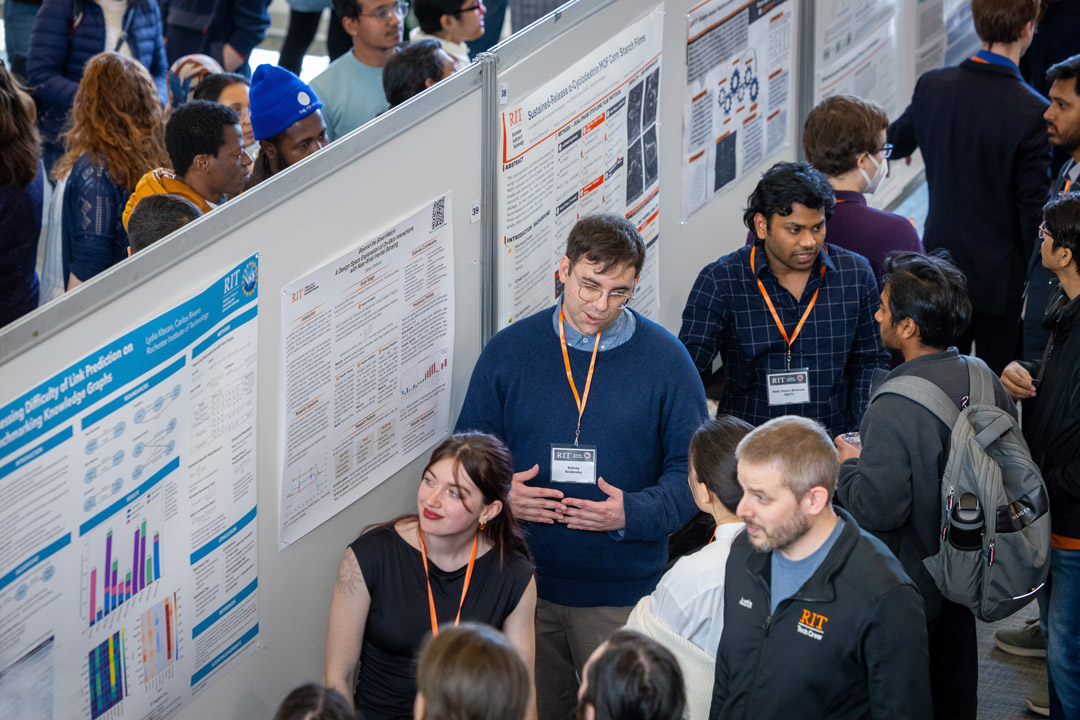
RIT graduate student Sidney Grabosky, center, talks about how people might use smartwatches in the future at the RIT Graduate Showcase, April 9.
Making the most of your smartwatch in the future could start with a flick of the wrist or a subtle tap to the forearm to navigate the controls.
RIT graduate student Sidney Grabosky’s thesis research for his human-computer interaction MS degree looks to extend the smartwatch interface to one’s skin and use motion-based gestures to bypass the touchscreen or other physical controls.
“Smartwatches are incredible and unique devices, but they are underutilized due to how awkward it is to interact with their tiny screens and controls,” said Grabosky, who is a 2016 alumnus from the computing and information technologies BS program.
His research looks at user-centered design to establish intuitive and easy to remember gestures for navigating workout controls, media controls, wallet/payment actions, scrolling, zooming, switching between apps, and adjusting the volume, for instance.
Carlos Ortiz/RIT
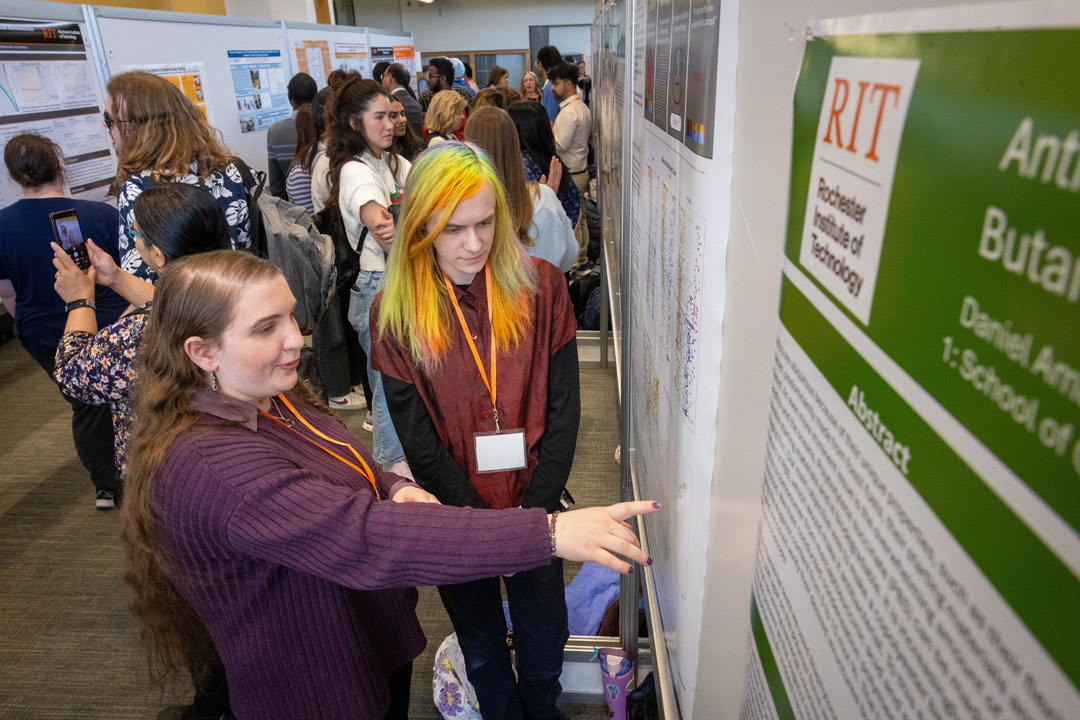
The RIT Graduate Showcase gave students like Gwynneth Buckton, left, practice designing and presenting a research poster. Here, she talks to Daniel Amburgey, a fellow presenter and materials science and engineering MS student.
Grabosky, originally from Rochester, N.Y., presented his research at the RIT Graduate Showcase, hosted annually by the Graduate School, on April 9. He gave a 3-minute “elevator pitch,” to convey the gist of his thesis project, and presented a poster to go deeper into his study methods, prototype development, and machine learning.
The Graduate Showcase gave Grabosky experience presenting his research. He also enjoyed seeing his peers’ scholarship.
“It led to some good conversations and maybe a research connection, so I’m happy,” he said.
For Gwynneth Buckton, a master’s student in experimental psychology, the Graduate Showcase gave her practice in designing a research poster. She talked about her early research and making connections between emojis and color cues.
“Understanding how emojis are interpreted through color association can improve interpersonal communication through the Internet,” said Buckton, a 2025 alumna from the individualized study BS program, who grew up near Seattle.
Her inspiration comes from an undergraduate research experience coding data for professors in the psychology and color science programs. The professors’ collaboration, focused on emojis and color association, intrigued Buckton, and she has continued working on the project ever since.
While Buckton will begin collecting data in the fall for her graduate thesis, Grabosky, this summer, will defend his research on “epidermal” interfaces for smartwatches.
Before returning to RIT for his master’s degree, Grabosky worked as a software engineer at SmugMug/Flickr in the San Francisco Bay Area. He looks forward to rejoining the tech industry with new skills and career goals.
“I wanted to pivot more towards interaction design development, and human computer interaction,” Grabosky said. “I’ve gotten to do all that, but I’ve also had the great opportunity to dive into research at RIT’s Accessible and Immersive Realities Lab and the Center for Accessibility and Inclusion Research Lab, and do a study abroad program in France about creative generative AI.”
