College of Science News
Chester F. Carlson Center for Imaging Science
-
April 18, 2020

Student to Student: Artificial intelligence/machine learning
During an internship, Tyler Hayes used computer vision and machine learning techniques to estimate the quality of images taken from airborne image sensors. It sparked her interest to learn more about machine learning, so she applied to the Imaging Science Ph.D. program at RIT.
-
March 31, 2020

Alumni Update: Returning to guide the next generation of imaging scientists
Karen Braun had a clear picture of what she wanted to do with her life at a young age. As Braun grew up, she developed a wide variety of interests including photography, psychology, and physics. She ultimately found a new cross-disciplinary Ph.D. program in imaging science at RIT that let her pursue those interests all at once.
-
March 9, 2020

RIT professor designated as an American Astronomical Society Fellow
An RIT professor is being honored as one of the first American Astronomical Society Fellows. Joel Kastner, a professor in RIT’s Chester F. Carlson Center for Imaging Science and School of Physics and Astronomy, is part of an initial group of more than 200 Legacy Fellows recently named by the society.
-
March 4, 2020

Weekly Space Hangout: Did RIT Scientists Find A Baby Giant Planet?
Universe Today features Joel Kastner, professor in the Chester F. Carlson Center for Imaging Science, and astrophysical sciences and technology Ph.D. students Annie Dickson-Vandervelde and Emily Wilson.
-
February 20, 2020

Global lemur expert to speak at RIT about technology in conservation
Patricia Wright, a world-renowned conservationist, will give a talk, “Building Forests and Saving Lemurs with Technology in Madagascar,” on Feb. 27 at RIT. Wright has long been a pioneer in using new technologies to solve conservation problems, and partnerships with RIT, the Seneca Park Zoo Society and others will advance these efforts further.
-
February 17, 2020

Strong presence by RIT faculty and alumni at Imaging Science symposium
Chester F. Carlson Center for Imaging Science at RIT had a strong presence during a recent symposium including a newly established conference organized by former Ph.D. students.
-
February 10, 2020

RIT scientists discover the nearest-known ‘baby giant planet’
Scientists from RIT have discovered a newborn massive planet closer to Earth than any other of similarly young age found to date. The baby giant planet lies only about 330 light years from our solar system. The discovery, published in the Research Notes of the American Astronomical Society, provides researchers an exciting new way to study how gas giants form.
-
January 24, 2020

RIT professor Zoran Ninkov tapped to support NSF as a program director
The National Science Foundation is bringing in RIT Professor Zoran Ninkov, an expert in imaging and astrophysics, to help the government agency evaluate future research opportunities.
-
January 17, 2020

Glass-color science crossover underscores RIT's collaborative setting
A multidisciplinary research project saw RIT Glass students team up with the Munsell Color Science Laboratory to investigate how color — beyond its tangible application — can be incorporated into their practice.
-
December 27, 2019
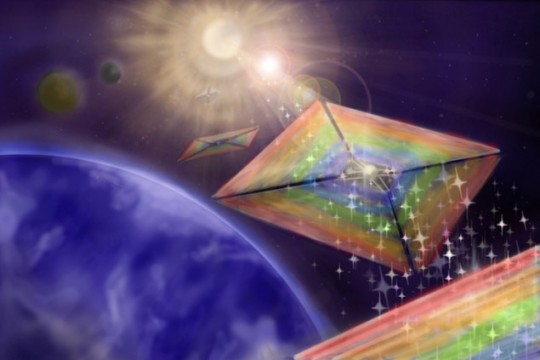
‘Beam rider’ technology keeps solar sails aligned
Physics World cites work by Grover Swartzlander, professor in the Chester F. Carlson Center for Imaging Science.
-
November 14, 2019

Alumni reflect 30 years after Chester F. Carlson Center for Imaging Science opened its doors
The Chester F. Carlson Center for Imaging Science became the only place in the world where students could pursue degrees in the interdisciplinary field of imaging science when it opened its doors in 1989. Thirty years later, alumni returned to campus for a celebration and interactive open house during Brick City Homecoming and Family Weekend.
-
October 28, 2019
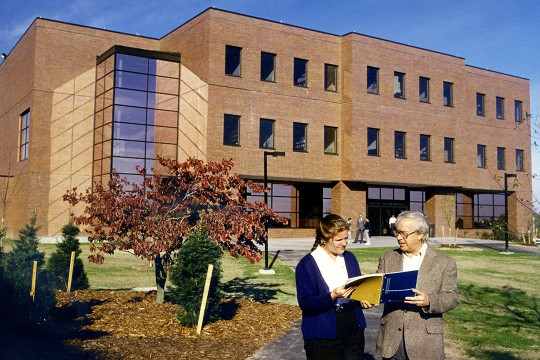
‘Coming of Age’ describes how a signature program shaped RIT’s future
A new book published by RIT Press documents RIT’s trajectory from a teaching institute to a research university with an expanding portfolio of doctoral programs. Coming of Age: The Center for Imaging Science at Rochester Institute of Technology describes the university-wide impact of the center and first Ph.D. program.