College of Science News
Chester F. Carlson Center for Imaging Science
-
January 31, 2022

Scholars earn coveted early career awards
Three faculty members who chose to start their research careers at RIT received prestigious National Science Foundation CAREER Awards in 2021. Their research aims to advance the foundations of machine intelligence, artificial intelligence, and clean energy.
-
January 31, 2022

Tait Preserve becoming hotbed for interdisciplinary research
RIT has an emerging new hotspot for interdisciplinary research about 25 minutes from the main campus. The Tait Preserve includes a 60-acre lake and a private mile of Irondequoit Creek adjacent to Ellison Park, offering endless opportunities for research, education, and conservation activities.
-
November 11, 2021

Alumnus Jeffrey Harris named chair of RIT Board of Trustees
Jeffrey Harris has been named the 21st chairperson of RIT’s Board of Trustees. Harris, who has served on the RIT board for nearly 15 years, graduated from RIT in 1975 with a Bachelor of Science degree in photographic sciences.
-
October 25, 2021

Roger L. Easton Jr. ’72 Presents Multispectral Imaging Technology at Haverford
Haverford College features Roger Easton, professor, and Tania Kleynhans, researcher/engineer II, both in the Chester F. Carlson Center for Imaging Science.
-
October 4, 2021
RIT Providing Discoverability and Accessibility of Historical Documents to Museums and Libraries
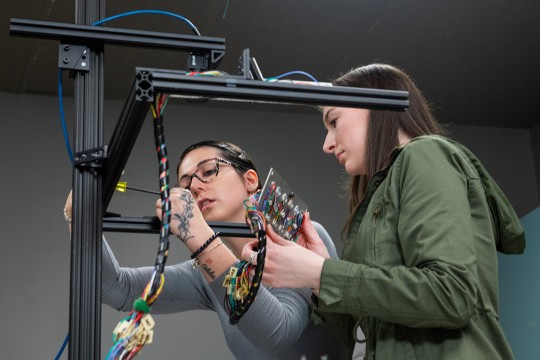
The Museum Association of New York features imaging science and museum studies students for developing an affordable imaging system to help museums and libraries preserve and expand access to their collections department.
-
September 21, 2021

RIT awarded nearly $2 million for NSF Research Traineeship Program, AWARE-AI
To help address a lack of diversity, as well as gaps in AI curricula, RIT was awarded a grant of nearly $2 million by the NSF to create a new research traineeship program for graduate students
-
September 16, 2021

Christopher Kanan earns NSF CAREER Award to develop brain-inspired AI systems
Christopher Kanan, an associate professor in the Chester F. Carlson Center for Imaging Science, received an NSF Faculty Early Career Development (CAREER) award and grant for his five-year project to expand the capabilities of artificial intelligence systems using new brain-inspired methods.
-
July 27, 2021

First-year students create imaging system that uses lasers to paint caricatures
A team of first-year RIT students developed a system that uses imaging technology and lasers to produce artistic caricatures. Three of the students will showcase the system at the Undergraduate Research Symposium.
-
July 13, 2021

NGA funds RIT researchers to explore the limits of spectral remote sensing imaging systems
The National Geospatial-Intelligence Agency is funding a team of RIT imaging scientists to study the limits of spectral remote sensing imaging systems. The team received a grant of up to $1 million to conduct fundamental research on imaging systems over the next two to five years.
-
May 5, 2021

Imaging science student makes dream job at Facebook a Reality
Jared Gregor is about to graduate with a degree in imaging science and take an exciting new job at Facebook Reality Labs, but he never would have found his college major without a happy accident.
-
April 28, 2021

Rochester Rising: RIT is helping make Rochester a next-generation technology hub
Move over, Silicon Valley. Rochester, N.Y., can be the next great American technology hub.
-
April 23, 2021

RIT researchers using drones and artificial intelligence to help assess crop growth
The National Science Foundation awarded Guoyu Lu, an assistant professor in RIT’s Chester F. Carlson Center for Imaging Science, more than $583,000 to spearhead the project.