RIT students, scientist work toward ear infection vaccine
RIT undergraduates work alongside a Rochester Regional Health research scientist, a nursing student, and a high school student for a collaborative research effort
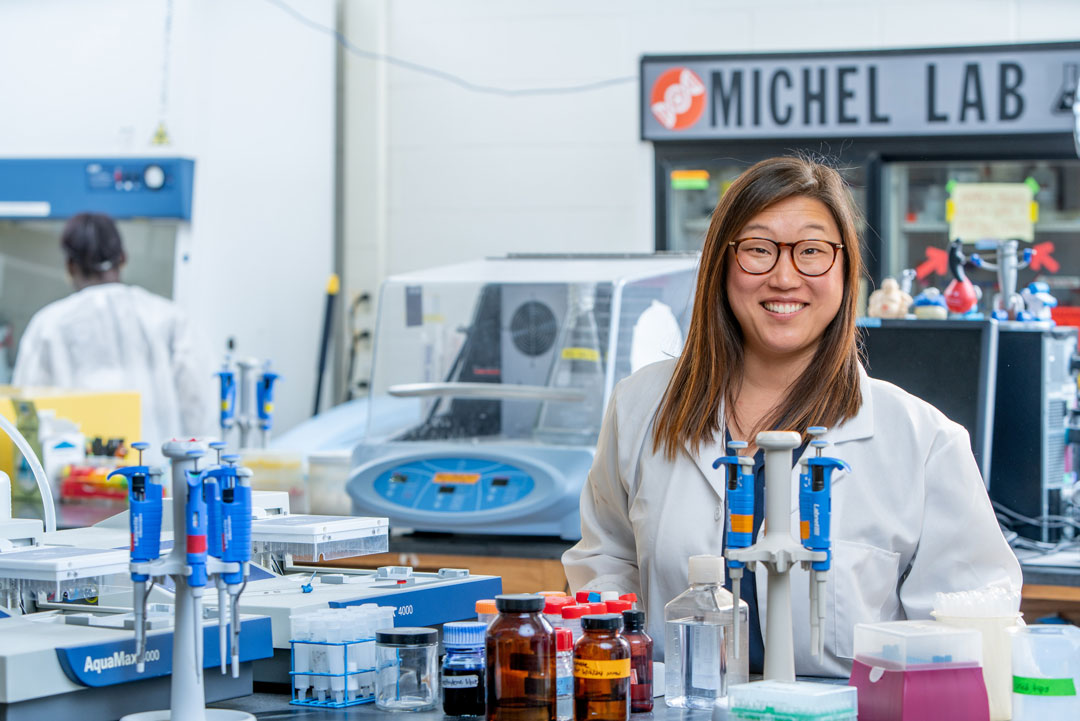
Scott Hamilton/RIT
RIT Professor Lea Michel is working alongside student researchers to develop a vaccine to prevent ear infections.
A college student, a high school student, a nursing student, and a senior research scientist walk into a lab. It’s not a joke; it’s a diverse group of people working to develop a vaccine to prevent ear infections.
That is the kind of collaborative, real-world research Rochester Institute of Technology (RIT) students like Ian McMullen get to do. McMullen, a biochemistry major, led a research project this summer looking to develop an extracellular vesicle-based vaccine targeting a bacteria that causes ear infections in children and that can also cause chronic obstructive pulmonary disease in adults. The work is based out of the lab of Lea Michel, professor in RIT’s School of Chemistry and Materials Science.
The project is one of many that McMullen has had the opportunity to work on in more than a year as a student researcher in Michel’s lab. The experience has built a strong foundation for his future in medical school.
Ear pain, hearing changes, and fever can be signs of an ear infection. The Center for Disease Control recommends children to receive pneumococcal vaccines to help such infections, but other bacteria exists that can also cause ear infections in children and chronic obstructive pulmonary disease (COPD) in adults.
“I’ve been on quite a few different projects at this point, learning all the different techniques,” said McMullen. “Across all these projects, I’m getting a full scope of biochemical research. It’s been really awesome.”
This ear infection vaccine invented by Michael Pichichero at Rochester Regional Health (RRH) includes Michel’s lab. She collaborated with RRH because its research center hosts immunologists and medical doctors that have direct access to samples.
Ravinder Kaur is a research scientist at RRH and a friend of Michel’s from when they earned their Ph.D.s together. The duo has been collaborating on this project for the past 17 years.
“The work done in our lab can help better understand the proteins that they want to put into these vaccines at a structural level and we can characterize them,” explained Michel. “Ravinder is a protein biochemist, so we really collaborate a lot. We look at the tools and instruments that we have at RIT that are unique and that RRH doesn’t have access to so we can perform these really cool experiments.”
Another member of the research team is Kaitlyn Sheinhartz, a nursing student from Rochester General College of Health Careers, which is part of RRH. While she was taking prerequisite courses at Monroe Community College, she heard about the research opportunity in Michel’s lab through the Collegiate Science and Technology Entry Program (CSTEP).
“Research was not something I really ever considered, but I think it blends really nicely with what I’m learning,” said Sheinhartz. “As a nursing student, I work a lot with people who might come into this infection, and I thought that this would be an interesting piece of research to take along with me as I go through this process.”
Even newer to the world of research is Hilton High School senior Meghan Nardone. She joined the team this past summer through a paid internship awarded by Project Seed of the American Chemical Society. Nardone wants to study chemistry in college and thought the vaccine project sounded interesting. She now has advanced research experience before graduating high school.
“It was a little hard to comprehend at first,” said Nardone, “But after the first week, with the help from Dr. Michel and other people in the lab, I was able to comprehend it better.”
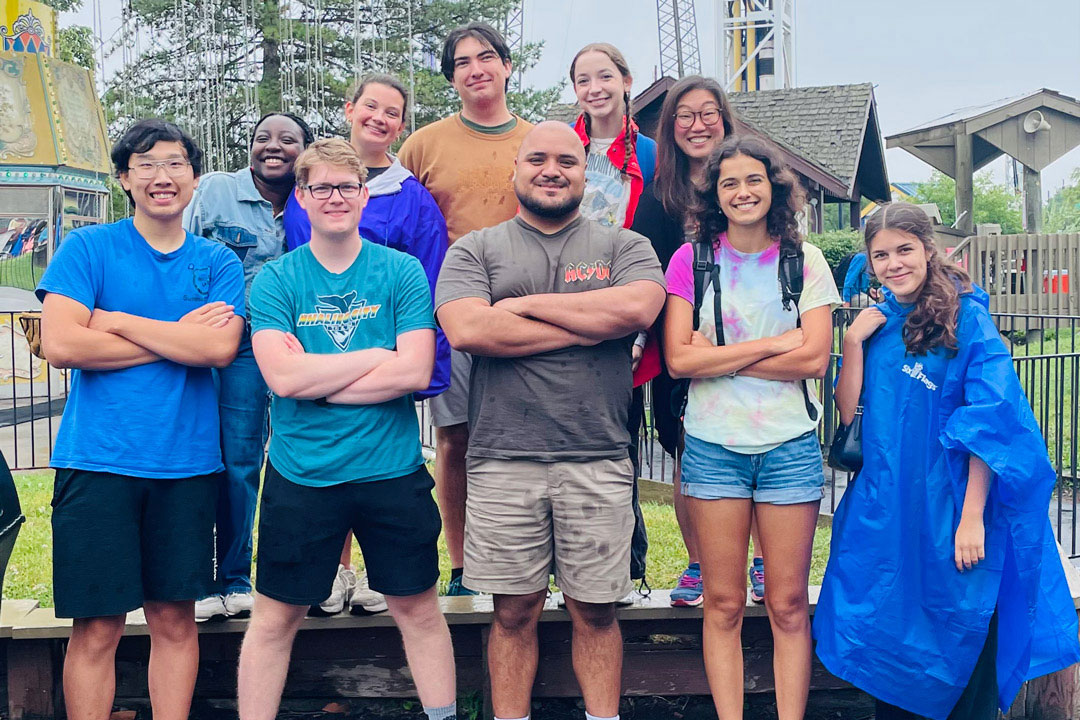
Lea Michel/RIT
Students in RIT Professor Lea Michel’s summer research group pose for a photo while on a team-building event. The mix of scientists and students provide a unique opportunity for world-changing vaccine research.
Collaboration has been the key to the project’s success. The group held roundtable discussions throughout the summer to talk about the research and how they could change or improve any of the methods. The students also had the chance to present to RRH partners, including renowned leaders in immunology.
“Everyone in the lab was welcoming,” said Sheinhartz. “It’s such a great culture and we all really learn from one another. How much freedom we get as research students, going into the lab every day, critically thinking about what we’re doing, what we can improve, it’s all super collaborative.”
Michel explained that the group is producing proteins and characterizing them to see what they look like. When they are put into mice and then eventually humans, scientists will need to know everything about them. The team is using samples from RRH to study and understand ear infections from an immunological and bacteriological standpoint. The end goal is to have a vaccine available to work against the specific bacteria they are studying.
“The vision is to bring this vaccine to market,” said Kaur. “Our next goal is to work with the National Institutes of Health closely to go to the next phase, which is to look for the toxicity.”
Such a grand goal requires a strong team, and that’s exactly what Michel and Kaur have built through their collaboration.
“I think all the different backgrounds and experiences are what really made this team so strong,” said Michel. “We’re able to troubleshoot and come up with what we’re going to do next. I love how everyone cares about the project for different reasons because they come from such different motivations.”
RIT’s College of Science promotes novel ways of thinking and implementation in a rapidly changing world, providing scholars with hands-on experience and multidisciplinary research. Faculty and staff mentor students to become the next generation of problem solvers to expand and explore the frontiers of science and mathematics.
