Scientists reveal new details about dark matter’s influence on the universe
RIT Associate Professor Jeyhan Kartaltepe co-authors paper from COSMOS-Web survey
NASA/STScI/J. DePasquale/A. Pagan
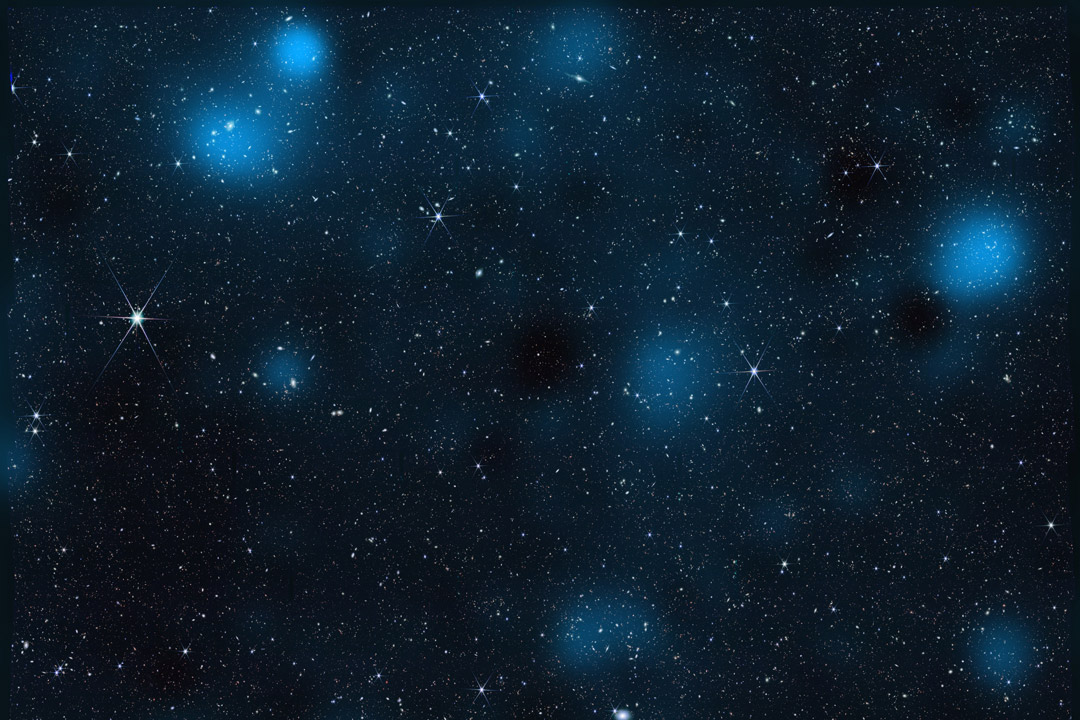
Containing nearly 800,000 galaxies, this image from NASA’s James Webb Space Telescope is overlaid with a map of dark matter, represented in blue. Researchers used JWST data to find the invisible substance via its gravitational influence on regular matter.
Scientists using data from NASA’s James Webb Space Telescope (JWST) have made one of the most detailed, high-resolution maps of dark matter ever produced. It shows how invisible, ghostly material overlaps and intertwines with “regular” matter that makes up stars, galaxies, and everything we can see.
Jeyhan Kartaltepe, associate professor in the School of Physics and Astronomy and director of the Laboratory for Multiwavelength Astrophysics, is a co-author on the research published in Nature Astronomy. The map builds on previous research to provide additional confirmation and new details about how dark matter has shaped the universe on the largest scales — galaxy clusters millions of light-years across — that ultimately give rise to galaxies, stars, and planets like Earth.
“The exquisite resolution and sensitivity of JWST have enabled us to create the most detailed map of dark matter in our universe to date,” said Kartaltepe, principal investigator of the COSMOS-Web survey. “COSMOS-Web is the largest area JWST survey to date and thus this is the largest dark matter map that has been created at this resolution.”
The area covered by the new map is a section of sky about 2.5 times larger than the full moon. A global community of scientists have observed this region with at least 15 ground- and space-based telescopes for the Cosmic Evolution Survey (COSMOS), of which Kartaltepe is a co-leader. The goal of the COSMOS-Web group is to precisely measure the location of regular matter here and then compare it to the location of dark matter. The first dark matter map of the COSMOS field was made in 2007 using data from NASA’s Hubble Space Telescope.
JWST peered at this region for about 255 hours and identified nearly 800,000 galaxies, many of which were detected for the first time. The COSMOS-Web map contains about 10 times more galaxies than maps of the area made by ground-based observatories and twice as many as Hubble’s. It reveals new clumps of dark matter and captures a higher-resolution view of the areas previously seen by Hubble.
When the universe began, regular matter and dark matter were probably sparsely distributed. Scientists think dark matter began to clump together first and that those dark matter clumps then pulled together regular matter, creating regions with enough material for stars and galaxies to begin to form.
In this way, dark matter determined the large-scale distribution of galaxies in the universe. By prompting galaxy and star formation to begin earlier than they would have otherwise, dark matter’s influence also played a role in creating the conditions for planets to eventually form. That’s because the first generations of stars were responsible for turning hydrogen and helium — which made up the vast majority of atoms in the early universe — into the rich array of elements that now compose planets like Earth. In other words, dark matter provided more time for complex planets to form.
“Dark matter, how it behaves, and what it is made out of, is one of the biggest unsolved mysteries in astrophysics. Maps like this provide important clues about its nature,” said Kartaltepe.”
The full paper can be found on the Nature Astronomy website and a full release on NASA’s Jet Propulsion Lab website.