Research News
-
December 4, 2020

RIT Professor Seth Hubbard receives DOE grant to develop low-cost, high-efficiency solar cells
Professor Seth Hubbard is an expert in designing, growing, and fabricating solar cells and said that if the cost of these highly efficient solar cells can be reduced enough, they could be used to help devices ranging from smartphones to drones to cars.
-
December 4, 2020

RIT begins development of saliva testing for spring semester
RIT is developing saliva testing protocols for campus as part of its plan to monitor the prevalence of the SARS-CoV2 virus, the causative agent of COVID-19. Development of the testing process will be done by André Hudson and Julie Thomas, both faculty-researchers in the Thomas H. Gosnell School of Life Sciences.
-
November 18, 2020

RIT students discover hidden 15th-century text on medieval manuscripts
RIT students discovered lost text on 15th-century manuscript leaves using an imaging system they developed as freshmen. By using ultraviolet-fluorescence imaging, the students revealed that a manuscript leaf held in RIT’s Cary Graphic Arts Collection was actually a palimpsest, a manuscript on parchment with multiple layers of writing.
-
November 11, 2020
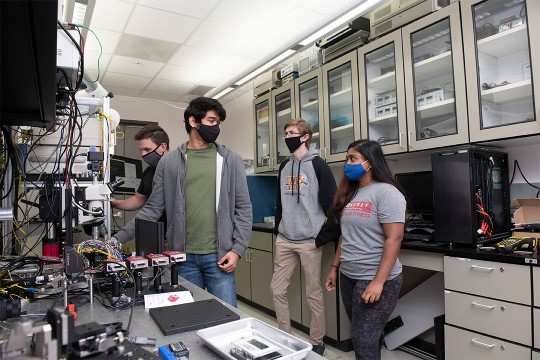
New study outlines steps higher education should take to prepare a new quantum workforce
Three researchers, including RIT Associate Professor Ben Zwickl, suggested steps that need to be taken in a new paper in Physical Review Physics Education Research after interviewing managers at more than 20 quantum technology companies across the U.S.
-
November 5, 2020

New black hole merger simulations could help power next-gen gravitational wave detectors
Scientists have developed new simulations of black holes with widely varying masses merging that could help power the next generation of gravitational wave detectors. RIT Professor Carlos Lousto and Research Associate James Healy from RIT’s School of Mathematical Sciences outline these record-breaking simulations in a new Physical Review Letters paper.
-
October 29, 2020

LIGO and Virgo announce 39 new gravitational wave discoveries during first half of third observing run
The LIGO Scientific Collaboration and Virgo Collaboration released a catalog of results from the first half of its third observing run (O3a), and scientists have detected more than three times as many gravitational waves than the first two runs combined. Several researchers from RIT’s Center for Computational Relativity and Gravitation were heavily involved in analyzing the gravitational waves and understanding their significance.
-
October 21, 2020

Professor Emeritus Linda Barton honored for laboratory instruction by American Physical Society
Professor Emeritus Linda Barton is the 2021 recipient of the Jonathan F. Reichert and Barbara Wolff-Reichert Award for Excellence in Advanced Laboratory Instruction.
-
October 21, 2020

RIT scientist receives NSF funding to explore cellular compartmentalization in bacteria
Moumita Das, an associate professor in RIT’s School of Physics and Astronomy, received funding from the National Science Foundation to better understand the fundamental rules that allow bacteria to compartmentalize the functions within their cells.
-
October 14, 2020

L3Harris becomes industry partner for RIT’s Future Photon Initiative
RIT’s Future Photon Initiative (FPI) and L3Harris have entered into a new industry partnership to develop quantum technologies. The partners will begin developing next steps for experiments and analysis focused on quantum information processing for communication, sensing, and computing.
-
October 7, 2020

RIT’s Carmala Garzione awarded Society for Sedimentary Geology’s William R. Dickinson Medal
RIT Associate Provost for Faculty Affairs Carmala Garzione received the 2020 William R. Dickinson Medal, which honors a mid-career research geoscientist who is significantly influencing the sedimentary geology community with innovative work.
-
September 30, 2020

RIT Professor Scott Franklin named American Physical Society Fellow
RIT Professor Scott Franklin has been elected a fellow of the American Physical Society. The fellowship is a selective and prestigious recognition by peers for outstanding contributions to physics.
-
September 30, 2020
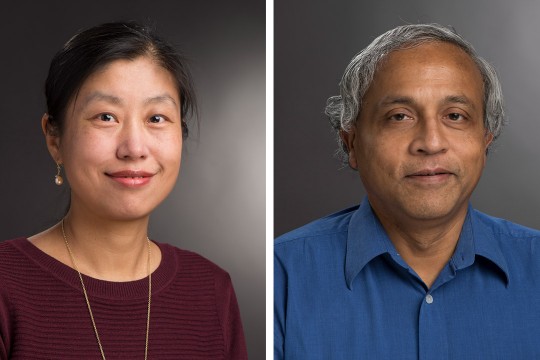
NSF award helps professors develop a data science course for non-computing majors
Professor Rajendra Raj and Associate Professor Xumin Liu have received a National Science Foundation award to develop a hands-on data science course for non-computing majors. The course will first be offered at RIT and then across the country, in an effort to promote computing for all.