Using Mathematical Modeling to Guide Global Health Decisions
RIT alum Kimberly Dautel ’23 shares how her training in mathematical modeling led to a CDC role where data-driven insights shape global vaccination strategies.

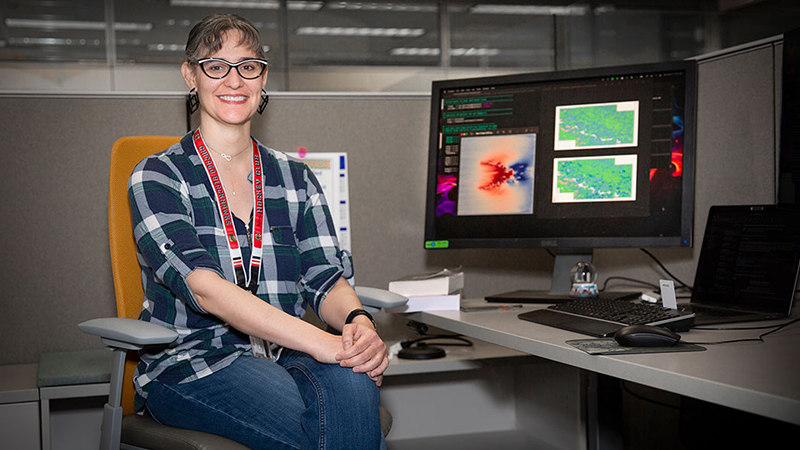
Kimberly Dautel ’23 turned her RIT math experience into a career shaping global health decisions. In her role at the Centers for Disease Control and Prevention (CDC), she focuses on vaccine-preventable diseases, using data-driven insights to guide immunization strategies around the world.
Much of Kimberly’s work supports critical public health decisions about rubella. This highly contagious viral infection can cause significant health problems during pregnancy and fetal development. There is a vaccine that protects against the virus, but it has not yet been implemented globally. Kimberly’s work helps countries prepare to introduce the rubella vaccine by modelling disease transmission, developing population immunity profiles, and conducting economic analyses.
Her economic analyses include tools that evaluate how cost-effective introducing a new vaccine will be in a particular area. In many parts of the world, countries make vaccine implementation decisions with limited or incomplete data. “Structural, operational, and technological challenges can make accurate reporting difficult,” Kimberly explains. “Mathematical modeling often provides the most reliable estimates of rubella and congenital rubella syndrome burden.”
Those prevalence estimates then guide critical vaccine implementation decisions, including where and when to launch vaccination efforts. “These decisions ultimately help to prevent rubella and congenital rubella syndrome, protect infants, reduce the threat of outbreaks, and save lives,” she says. “Being part of that evidence-to-action pathway is deeply meaningful to me.”
Kimberly’s path into applied public health research took shape during her time at RIT, when she earned a competitive fellowship with the U.S. Food and Drug Administration (FDA). There, she developed a regulatory science tool to evaluate COVID-19 epidemiological models and medical resource demand models. This work strengthened her ability to assess model performance and translate findings into decision-relevant insights. That experience became a direct bridge to her work at the CDC. She continues to design analytic frameworks, evaluate models, and communicate results that inform public health decision-making. “One of the biggest shifts in moving from my FDA fellowship to my current role at CDC was transitioning from the structured, linear pace of academic-style projects,” Kimberly explains. “I moved into an environment where I manage multiple projects simultaneously.”
“The scope and pace increased, and I had to develop stronger systems for prioritization, balancing timelines, and taking full ownership of deliverables.”
For students interested in applied research or public health, Kimberly emphasizes gaining real-world experience. “Seek opportunities that expose you to real-world problems,” she advises. “Working with real and often messy data teaches you how to navigate uncertainty and adapt your methods to meet practical needs.” She also highlights the importance of communication alongside technical expertise. “In applied research settings, your ability to communicate complex analyses to diverse audiences is just as important as the analysis itself.”
For those considering careers in government or public health, fellowships offer a valuable entry point. “Fellowships are one of the most effective ways to get hands-on experience inside agencies and see firsthand how analytic work contributes to decision making.”
From graduate research to global impact, Kimberly’s path reflects how mathematical modeling can extend beyond theory, helping shape decisions that improve health outcomes and save lives.
More Featured Profiles and Work
Dr. Tony Wong