Where Applied Mathematics Meets the Business World
D’asia Johnson ’25 uses applied mathematics, data, and analytics to solve business challenges at Avangrid while drawing on the technical and communication skills she developed through her experiences at RIT.
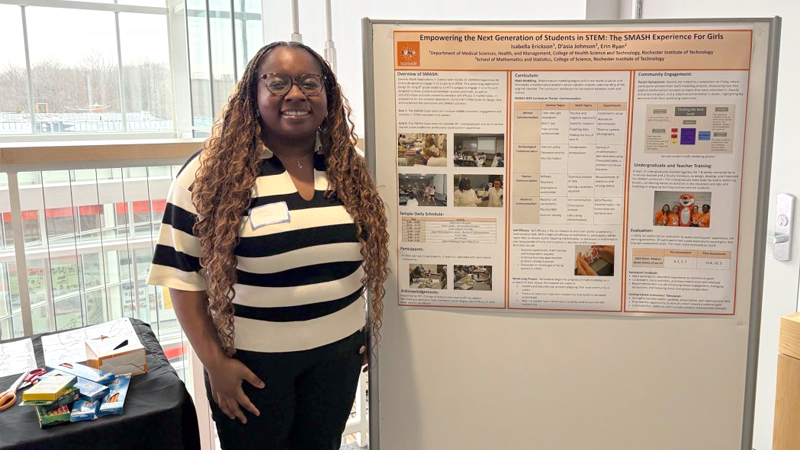
An applied mathematics degree can lead in more directions than you might expect. For D’asia Johnson ’25, it led to Avangrid, where she uses math, data, and analytics to solve real-world business challenges.
In her role as a Local Rotational Graduate, D’asia moves into a different department about every six months, applying her analytical background across different areas of the company. So far, she has worked in Meter Services, Credit and Collections, and Quality Assurance.
D’asia uses data and analytics in these departments to help teams make informed decisions, improve processes, and identify opportunities for improvement. Her work has included forecasting customer service metrics, developing dashboards and reporting tools, automating manual processes, and turning data into actionable insights for stakeholders.
The rotational program also gives D’asia the opportunity to learn how different parts of the business work while continuing to develop her technical, analytical, and communication skills.
“When I started, I didn’t realize how many careers combine mathematics, analytics, business, and technology,” she said.
At RIT, research projects and opportunities to work closely with faculty and other students had some of the biggest impacts on D’asia. Beyond developing her technical skills, those experiences taught her the importance of collaboration and building connections.
“It can be intimidating at first, but connecting with professors, classmates, and professionals helped me learn about opportunities I may not have discovered otherwise,” she said.
Those lessons continue to shape her work at Avangrid, where she regularly collaborates with people across different departments.
D’asia also continues to draw on what she learned at RIT, including programming, statistical analysis, mathematical modeling, and data visualization. Just as importantly, RIT taught her how to learn new technologies quickly, helping her pick up tools such as Power BI, VBA, and business analytics platforms.
She encourages students to build their technical skills while also learning how to communicate their ideas and explain complex information in ways others can understand.
“The relationships and communication skills I developed at RIT have been just as valuable as the technical skills I learned in the classroom,” she said. These skills can also help you plan your next steps, D’asia advises. “Reaching out to people who were willing to share their experiences helped me better understand my options and think about what I wanted to do after graduation.”
Her advice to current College of Science students is to keep an open mind about where their degree might take them.
“Don’t give up and keep an open mind. Some of the opportunities I’ve enjoyed the most are things I never would have predicted when I started college,” she said. “Be curious, take advantage of the resources around you, talk to your professors, and get involved in projects or research that interest you. The connections you make and the skills you develop can open doors you didn’t even know existed.”
More Featured Profiles and Work