It’s OK to ask for help at RIT’s computing tutoring center
Liangxiao Zhu Tutoring Center in GCCIS offers tutoring for introductory programming courses
Carlos Ortiz
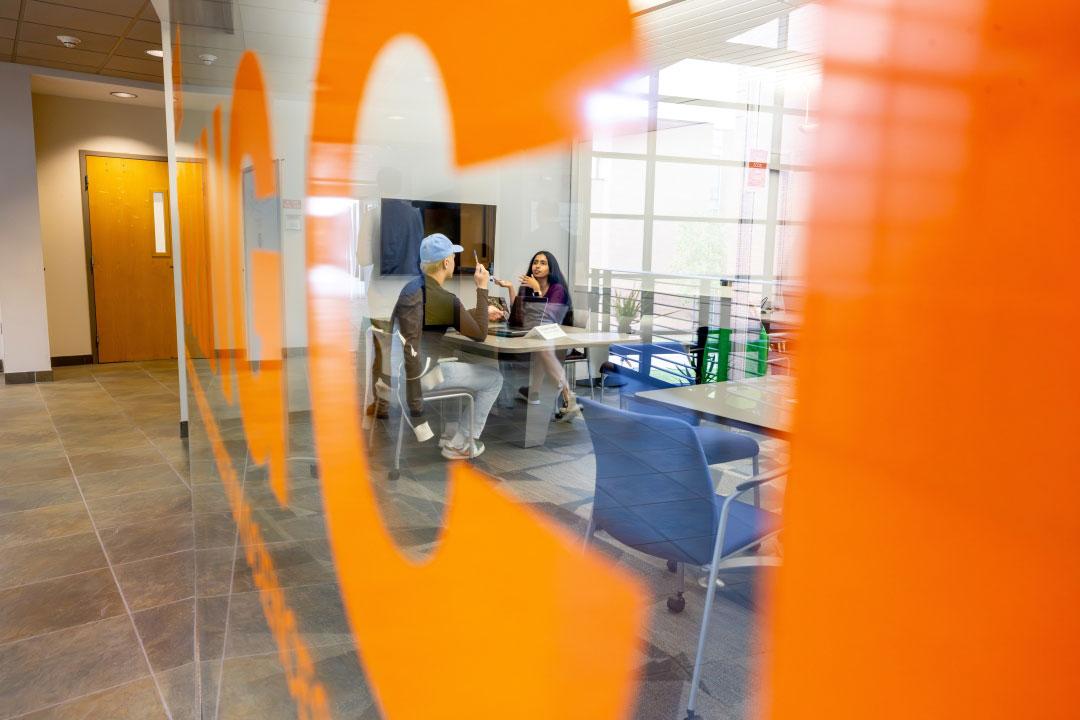
RIT offers several free tutoring resources, including the Liangxiao Zhu Tutoring Center in the computing college. Jahnavi Kaja, right, a front desk assistant and student tutor, welcomes students to stop by the computing tutoring center.
Avery Ford, a first-year computer science student, was struggling with his lab assignment for his Computer Science 1 course. The goal was to create a program that can draw a forest scene with various pine trees, maple trees, and a house.
“I couldn’t get the math down for the house and some parts of the function weren’t aligning properly,” said Ford, who is from Brewerton, N.Y. “So, I decided to stop by the tutoring center and get some help. It’s working great now.”
The Liangxiao Zhu Tutoring Center, in RIT’s Golisano College of Computing and Information Sciences (GCCIS), is open to any student taking introductory programming courses offered in the computing college. It’s one of RIT’s many free tutoring centers where students can drop in for help, among other Academic Support services that the university offers.
“RIT has many resources to support student success in courses—finding the right one for you begins by asking for help,” said Lynn Wildman, assistant director for student success in GCCIS. “Visiting the tutoring center to ask questions and check your understanding of concepts could save you hours of frustration.”
The computing tutoring center is staffed by GCCIS students and it’s open seven days a week. It’s a collaborative space with tables, whiteboards, and wall-mounted monitors.
Caleb Naeger ’26 (computer science) is a software engineering master’s student and a tutor in the center. He said the idea is to drop in, sign in at the front desk, and sit down with a tutor—whether it’s for help with an assignment, studying for an exam, or figuring out why some code might not be working.
“Getting through the door is the hardest part,” said Naeger, who is from Pittsburgh.
Each semester, the student tutors typically help with more than 10 courses in computer science, introductory software development, and interactive games and media. Having completed the courses themselves, the tutors often have insight into labs and assignments and understand how to break down concepts.
Jahnavi Kaja, a software engineering master’s student and tutor/front desk assistant in the center, said that she understands how daunting programming can be at first. It can be scary to ask a professor a question in front of the whole class and feel judged, she said.
“Don’t be afraid or hesitant to come into the tutoring center,” said Kaja, who is from Ghaziabad, India. “You can ask any small question or just talk it out with us.”
What’s in a name?
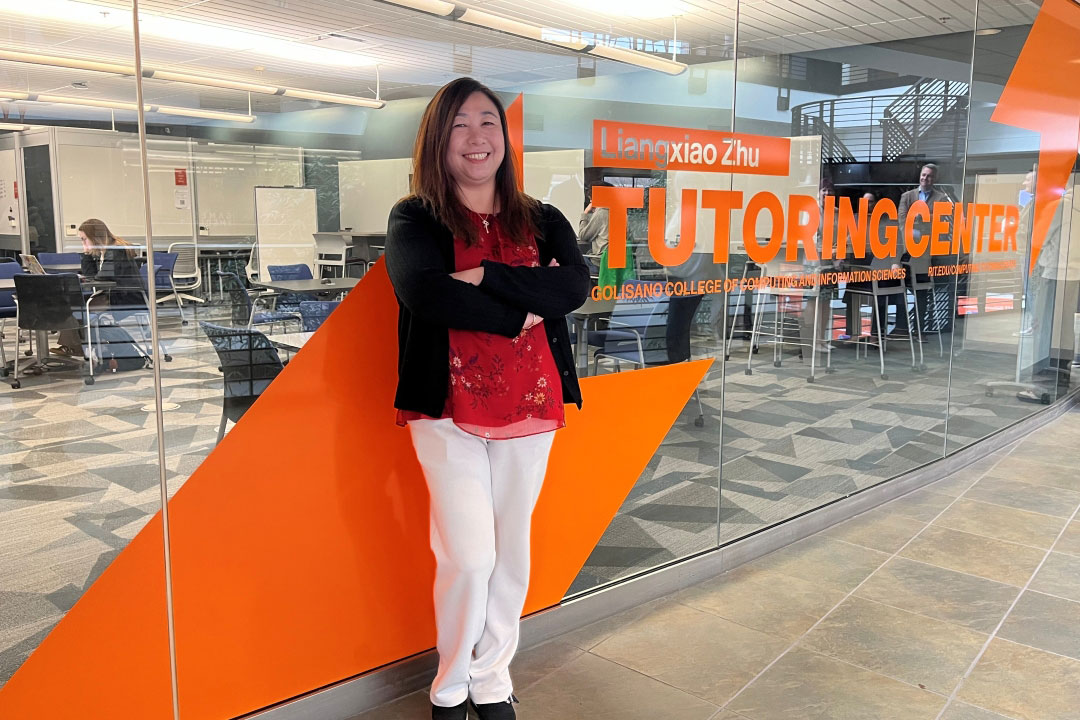
The GCCIS Liangxiao Zhu Tutoring Center is named after RIT alumna Liangxiao Zhu ’02 MS (computer science). Zhu, who resides in Seattle, is vice president of engineering at DoorDash, and formerly worked at Meta and Microsoft.
In 2026, she established a fund to support the tutoring center and created the Liangxiao Zhu Endowed Scholarship for women in computing.
As an RIT master’s student, Zhu also worked as a teaching assistant. She remembered when her professor asked if Zhu could help a student who was struggling in a computing foundations class. Zhu didn’t have experience with tutoring but was happy to help.
“We found a space in the library to talk, and our deep discussions truly helped her grasp the concepts and pass her test,” recalled Zhu. “And it was just as meaningful for me too.”
“Being a tutor, you get a deeper understanding of the problem space, and it taught me soft skills to communicate in ways that different people can understand. This helped me in my career with alignments building and bringing people along for new ideas.”