RIT computing Ph.D. graduate honored for contributions to supercomputing
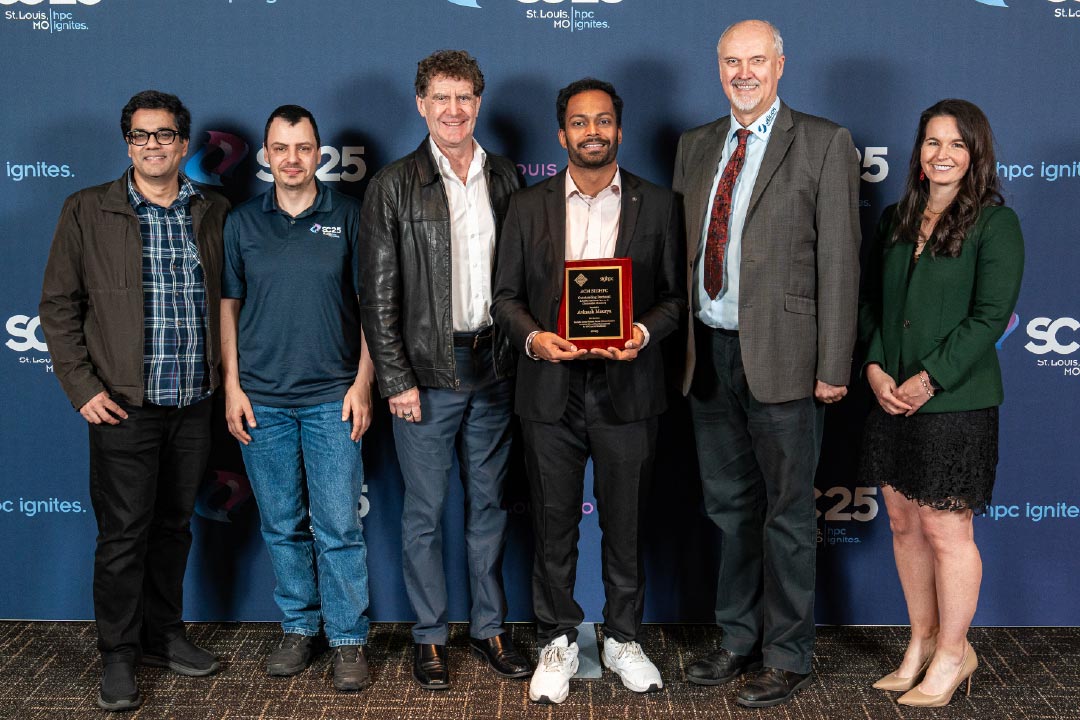
Photo taken at SC’25 in St. Louis, MO, USA. Left to right: Prof. M. Mustafa Rafique (Rochester Institute of Technology), Prof. Bogdan Nicolae (Illinois Tech Chicago, Argonne National Laboratory), Prof. Allen Malony (University of Oregon, Dissertation Committee Chair), Avinash Maurya (Rochester Institute of Technology), Dr. Ing. Bernd Mohr (ACM SIGHPC Awards Chair), and Dr. Christine Harvey (ACM SIGHPC Chair).
Dr. Avinash Maurya, a recent computing and information sciences Ph.D graduate from the Golisano College of Computing and Information Sciences (GCCIS), has been recognized with the international 2025 ACM SIGHPC Doctoral Dissertation Honorable Mention award, for his dissertation, "Scalable Access-Pattern Aware I/O Acceleration and Multi-Tiered Data Management for HPC and AI Workloads." This award recognizes outstanding contributions to the field of High-Performance Computing (HPC), and is awarded based on the significance of the research contribution, the potential impact on theory and practice, and overall quality of work.
“The SIGHPC Doctoral Dissertation Award nominations received this year were exceptionally strong, with each dissertation contributing state-of-the-art results in different areas of HPC,” remarked Christine Harvey, SIGHPC Chair.
Maurya’s dissertation addresses one of the most persistent bottlenecks in modern computing: the widening gap between the speed at which processors can compute data and the speed at which memory systems can move it. Thanks to multiple contributions made throughout his dissertations, HPC simulations and AI computations are able to run 3x faster on leading supercomputers.
Maurya was presented with the award at Supercomputing 2025 (SC25); the international conference for high performance computing, networking, storage, and analysis. “The research guidance provided by my advisors, professor. M. Mustafa Rafique (RIT) and professor Bogdan Nicolae (Argonne), has been instrumental for this dissertation recognition”, says Dr. Maurya.
In addition to receiving the ACM SIGHPC Outstanding Doctoral Dissertation Honorable Mention Award, Maurya’s research has earned Best Paper Awards at IEEE/ACM HiPC 2022 and ACM HPDC 2024, an Outstanding Graduate Student Award from RIT, and additional nominations and distinctions at top HPC venues. His research has contributed to production-grade projects at Argonne National Laboratory, Saudi Aramco, and Microsoft DeepSpeed.
Accelerating Science and AI in the Age of Exascale
As supercomputers reach exascale speeds – capable of a quintillion calculations per second – traditional methods of managing data have struggled to keep pace. Dr. Maurya’s research provides a unifying solution that serves two rapidly converging worlds: classical scientific simulations and modern artificial intelligence. His work introduces novel “access-pattern aware” algorithms that fundamentally rethink how data moves through the complex memory hierarchies of modern supercomputers. At its core, his dissertation leverages asynchronous pipelines and “lazy” data movement strategies to allow massive workloads to run seamlessly without stalling while waiting for data to be written to storage.
The impact of this research is already being felt in high-stakes environments. Maurya's techniques for optimizing "checkpointing"-- the process of saving the state of a running program– have been integrated into VeloC, a checkpointing runtime developed as part of the U.S. Department of Energy’s Exascale Computing Project. These contributions have directly influenced seismic imaging workflows used in the oil and gas industry, including the seismic frameworks at Saudi Aramco, enabling faster and more accurate subsurface modeling.
On the AI side, Maurya’s DataStates-LLM framework rethinks how LLMs are checkpointed at scale. By overlapping checkpointing with immutable phases of the forward and backward passes and reusing pinned host buffers across iterations, DataStates-LLM achieves 4x faster checkpointing and up to 3x faster training iterations, leading to a 2.2x faster end-to-end LLM pre-training even under aggressive checkpointing frequencies, enabling fault-tolerance, forensics, migration, and continuous model evaluation at large scales.
To enable resource-constrained fine-tuning and pre-training of LLMs, Dr. Maurya’s dissertation also contributes with Deep Optimizer States, a runtime that targets the dominant memory bottleneck– multi-terabyte optimizer states – by interleaving CPU-GPU computation and offloading with just-in-time prefetching. Together, these systems deliver up to 2.5× faster LLM pre-training and checkpointing of multi-terabyte models, making previously impractical training regimes feasible on constrained GPU clusters.
“Avinash has demonstrated exceptional breadth and depth of research in his dissertation, and he continues to show deep commitment and enthusiasm for excellent research in his mentorship of junior Ph.D. students,” says Prof. M. Mustafa Rafique, Maurya’s doctoral advisor.
For more information on the ACM SIGHPC awards, visit the SIGHPC website.