Creative Collisions turn the classroom into a design studio
What happens when you replace a week of regular classes with an intensive creative sprint built around real-world challenges?
For one week in October, regular classes in RIT Croatia’s New Media Design BS program stopped. In their place came Creative Collisions, a five-day project that brought together more than 100 students from all four years of the program. Students were divided into 20 mixed-year teams, each led by a senior student, and challenged to develop creative solutions for one of four projects spanning very different fields and audiences.
The briefs included Ej aj na forum, a project developed with the Faculty of Humanities and Social Sciences, University of Zagreb (FFZG) and centered on events and discussions about artificial intelligence; Domitran Novitas, a company specializing in the development and production of composite products and structures; NMDx, an internal RIT Croatia project showcasing the work of New Media Design students; and F Slip, an acoustic duo.
Rethinking how students learn together
Inspired by a similar project of the same name at RIT’s School of Design in Rochester, the idea behind Creative Collisions in Croatia came from the New Media Design program faculty: Dr. Ante Poljičak, Department Chair, and lecturers Dr. Jurica Dolić, Dr. Petar Branislav Jelušić, and Mia Klemenčić. For the faculty, the experiment also offered an opportunity to rethink what the classroom can look like.
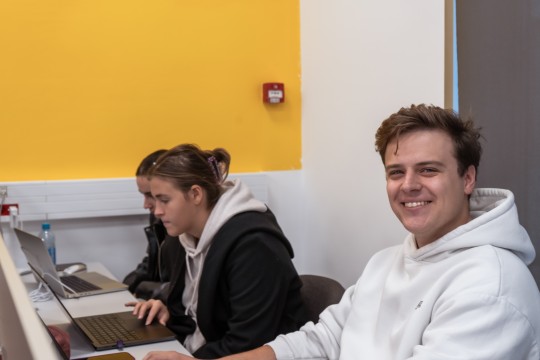
Each brief presented a different type of creative problem, requiring students to think beyond a single discipline or familiar context. During the week, teams moved from interpreting the brief and developing concepts to building visual identities, 3D elements and other design outputs. “For one week, the usual boundaries between courses and years disappeared. Students were learning from faculty, but also from one another. They had to negotiate ideas, divide responsibilities, respond to feedback, and bring everything together under real-time pressure. That kind of experience is difficult to create through a traditional assignment,” said Dr. Poljičak.
Beyond the skills they developed, the week also gave students a chance to connect, collaborate, and enjoy the process of creating something together. As Dr. Petar Branislav Jelušić put it, “Once things got rolling, our students showed just how capable they are. They seemed to enjoy the week and the time spent working with their peers. That was the real point of Creative Collisions.”
Choosing the winners
On the final day, all teams presented their work within their project groups. Students then voted to select two teams from each challenge to advance to the final round. What impressed the faculty most was not simply how much the students produced in five days, but the level and quality of thinking behind the work. The intensive format required students at different stages of the program to work together, make decisions quickly, and take ownership of the outcome.
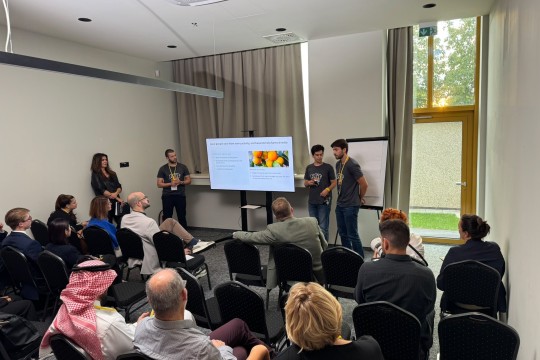
The eight finalist teams presented their concepts that afternoon to a packed audience of fellow students and faculty and to a jury that included both RIT Croatia representatives and external guests. The jury evaluated solutions developed for four very different briefs and highlighted the quality and depth of the students’ work, noting that choosing the winning teams was anything but easy. With several strong concepts in each category, the final decisions often came down to details.
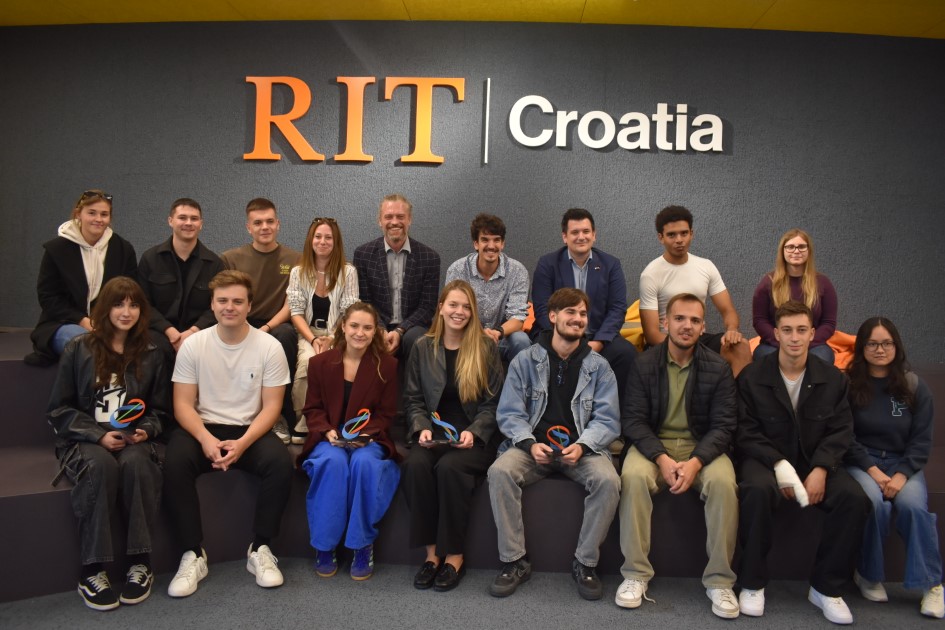
And the winners are...
Ej aj na forum:
- Tia Dizdarević
- Dushan Mishkovski
- Tomislav Grdjan
- Mateo Kitin
- Sima Prša
- Fran Mikulčić
Domitran Novitas:
- Aleksandar Deskoski
- Laura Matić Zbiljski
- Typhaine Iriana Ranjeva
- Robertina Krupa
NMDx:
- Đivo Vidak
- Tea Jurčić
- Lucija Matković
- Paula Jurjević
- Mario Tadinac
F Slip:
- Ira Butula
- Luka Matej Lukač
- Ivana Bratanić
- Isabelle Lim Goquingco
- Filip Marić
Changing the way students learn can change what they are capable of producing
The strongest outcome of Creative Collisions was bigger than the competition itself. In five days, an entire program became one collaborative studio, giving students the opportunity to apply what they know, learn from peers at different stages of their studies and see how their creative decisions hold up outside the boundaries of a single course.
For its first edition at RIT Croatia, Creative Collisions also gave the faculty team plenty to build on. The experience and feedback from this year’s students will now help shape how the format develops in the future.
For now, one thing is clear: sometimes changing the way students learn can change what they are capable of producing.