Ph.D. candidate uses 3D-printed metals to improve reconstructive surgery
Valeria Marin Montealegre’s process and material improvements could impact lives
Scott Hamilton/RIT
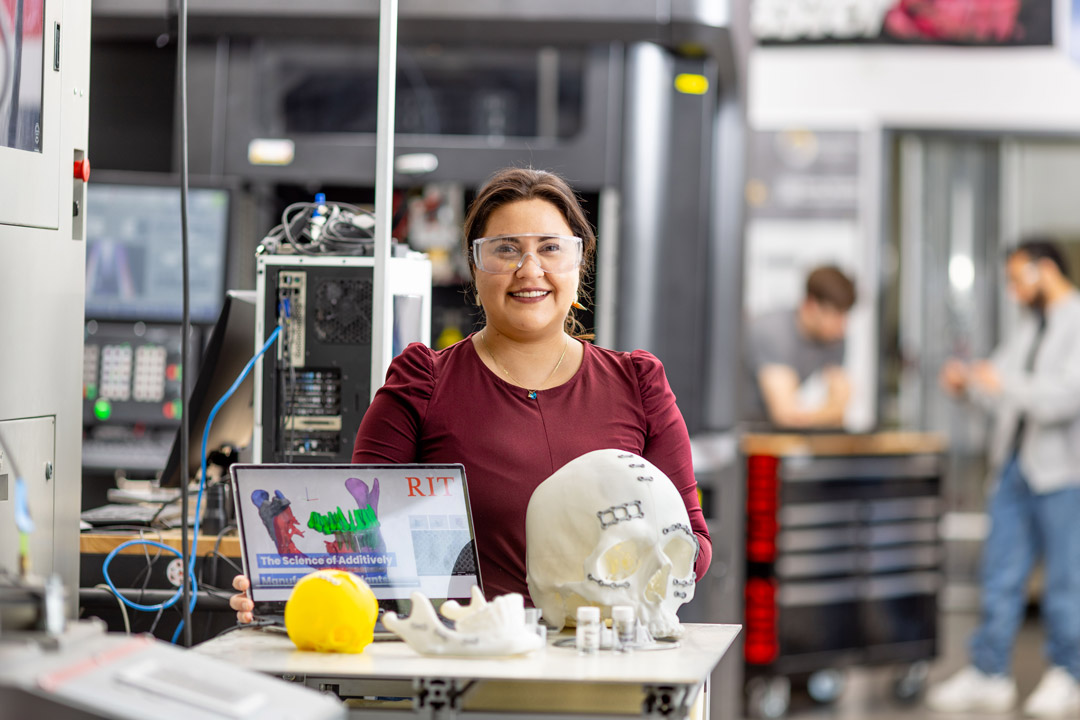
Ph.D. candidate Valeria Marin Montealegre has been working on new options in 3D printed bio-metals for facial bone implants.
While a graduate student in Colombia in 2020, Valeria Marin Montealegre was also an entrepreneur. She observed surgeons doing reconstruction surgeries with the prosthetics she designed for HumanBX—a custom, implantable device company she co-founded.
The work was impactful, providing patients, some young pediatric patients, with prosthetic solutions that could change their lives.
But Marin Montealegre wanted to do more and enrolled at RIT. Now she is working on completing her Ph.D. in mechanical and industrial engineering.
Her research is about an interesting application using 3D-printed metals that are also bio-compatible and absorbable for craniofacial implants. She’ll contribute to the cutting-edge science, enhance her business, and continue on her path to use technology that benefits people.
“I was working in research, but coming back to academia with the knowledge I had from industry was a very impactful thing,” she said. “I was involved in the manufacturing process. But I wasn’t deep on the materials science side. I just knew what it was. But then when I came here that is when everything transformed.”
Marin Montealegre was taking graduate classes in product development at the Universidad Autónoma de Occident evenings and working at her newly established company HumanBX during the day. She participated in surgical case planning and designing implants.
“I wanted to explore more about the manufacturing aspects of product development and additive manufacturing. 3D printing was my main focus,” she said.
Scott Hamilton/RIT
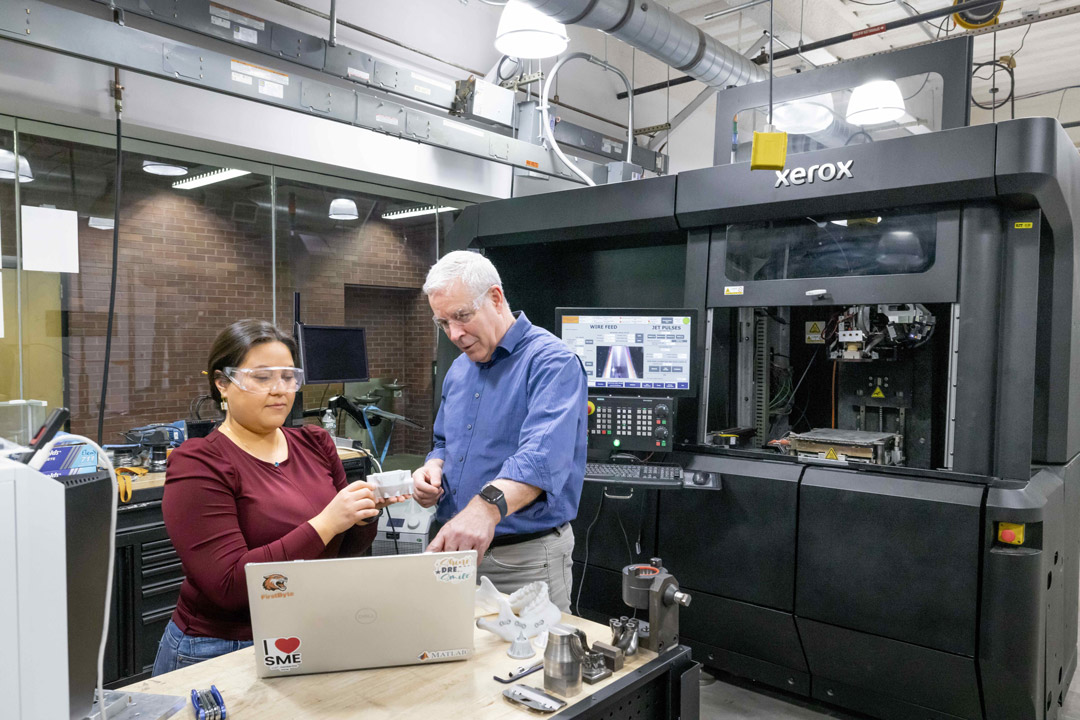
Valeria Marin Montealegre worked closely with Professor Denis Cormier, right, director of RIT’s AMPrint Center and the Brinkman Machine Tools and Manufacturing Laboratory. Both areas have extensive manufacturing equipment including high-tech metal 3D printers for teaching, research, and production.
To acquire more 3D-printing experience, her adviser, Alvaro Rojas Arcinieagas ’08 MS (industrial engineering), ’13 Ph.D. (imaging science) recommended RIT. She’d enrolled in the university’s Global Scholars Program and started in 2021 as an exchange student in the Kate Gleason College of Engineering. Classes to complete her master’s degree ranged from manufacturing to fine arts.
“If you saw my transcripts, you’d think I did another undergraduate degree. I just enjoyed them,” said Marin Montealegre. “I was good at designing, listening to the doctors’ requirements. I had good understanding of the applications, but when I came here, I discovered an entire world about manufacturing processes, materials science, and production.”
She applied to RIT’s Ph.D. program in the engineering college, starting the program in 2022.
By 2023, she started researching aspects of molten jet printing using zinc. Her adviser is Denis Cormier, RIT professor and director of the university’s AMPrint Center.
“Dr. Cormier is the pioneer in molten metal jet printing and also a leader in the use of a lattice design for 3D printing. That structural technology is being used in multiple areas, but in this instance, it can be used to engineer bone,” she said. “It is very deep science in how to print with zinc, a bio-metal that can be used for bone healing regeneration. There is a huge gap in the knowledge.”
She’ll help fill that gap.
“There’s a trend now for bio-metals, those that can be absorbed in your body such as magnesium, iron, and zinc,” she explained.
The long-term goal with 3D-printed zinc-based implants using MMJ is to enable devices that provide temporary mechanical support during healing while gradually degrading as new bone and tissue regenerate. The significance of metals for implants is some are bio-compatible and most can be conductive if needed. This is new territory for manufacturing customized medical devices, and the research into this unique alternative is exciting and motivating.
“There are few places in the world that are working with molten metal jetting, none working with bio-metals—yet. We recognized an opportunity to explore these materials using a different technology, and we are helping pioneer in this space,” she said. “My lab mates are even more impressive, as they are developing the technology from its conception through manufacturing to make this possible. I think this is awesome.”
After she defends her dissertation this summer, Marin Montealegre is looking to expand her company, possibly relocating some of the clinical research and manufacturing processes to the U.S. because she believes 3D-printed biomedical solutions are needed everywhere, not just Colombia.
“The possibilities are huge! I’ve had the privilege of being in this lab. I just feel we are helping the world.”