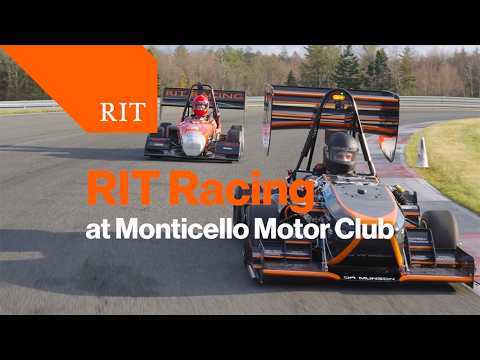
Students race toward real-world success
How the Formula SAE, Baja SAE, and Hot Wheelz Solar Racing teams give students an edge
Scott Hamilton/RIT
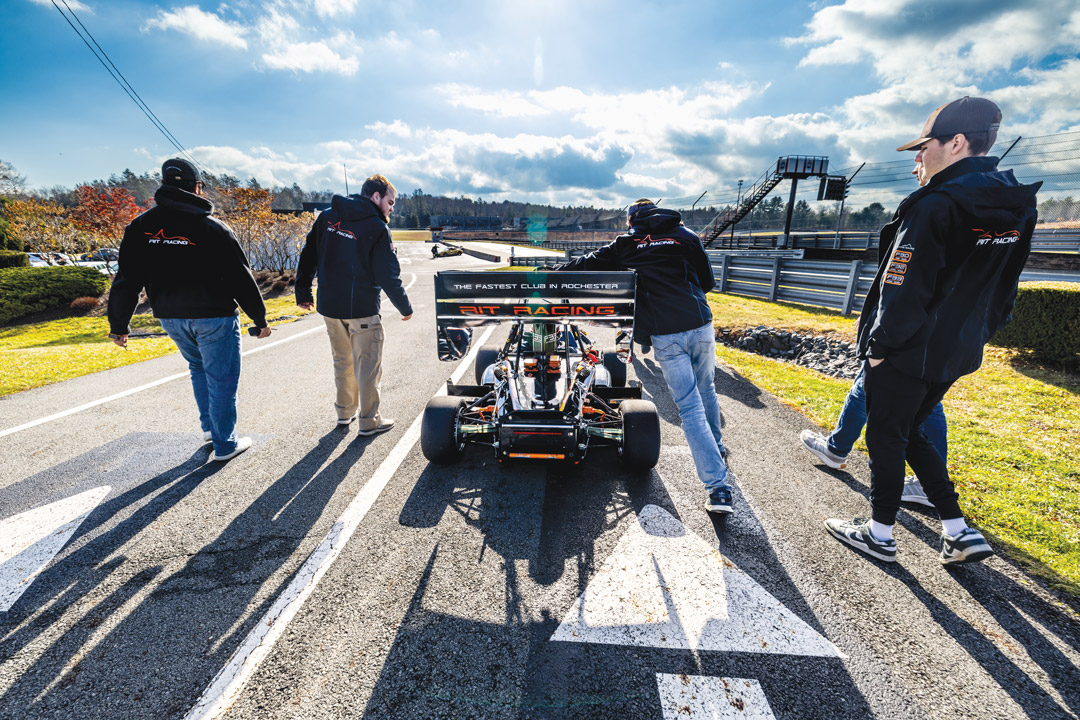
RIT Trustee Andrew Jacobson ’90, ’96 MS hosts RIT’s performance teams at Monticello Motor Club, providing groups like Formula SAE Racing, shown here, important track time before race season.
Sam Stone made a strategic pitstop to the Hexcel company table during RIT’s fall University-Wide Career Fair. As part of RIT’s Formula SAE Racing Team, the third-year mechanical engineering student used Hexcel’s composite materials to build part of the team’s sleek race car.
“That got me in the door for an interview,” said Stone. “When I told them I was using their products, they were super stoked. They were excited to see a student-based team getting experience with a real-world aerospace product.”
The Hexcel company is best known for using the lightweight composite materials to produce commercial and defense aerospace equipment. Stone used the same materials to help design the Formula team car’s rear wing, an aerodynamic element required for balance when making tight turns.
Testing new systems and designs takes place on and off campus, including at the annual Racing Fun Day at Monticello Motor Club professional track in Monticello, N.Y. The day is hosted by RIT/NTID alumnus and Board of Trustees member Andrew Jacobson ’90 (hotel management), ’96 MS (service leadership and innovation), an avid racer, to encourage cross-team projects.
It’s a challenging backdrop for three of RIT’s biggest performance teams—Formula, Baja SAE, and Hot Wheelz Solar Racing—to test their vehicles and build team spirit.
RIT also fields a clean snowmobile team, multiple rocket teams, an e-motorcycle team, and an aero flight team for yearly collegiate design competitions. Between 30 and 50 students participate on each team from all of RIT’s colleges. They incorporate the latest technology into race vehicles, testing the skills that could position them for co-ops, then careers.
“RIT’s employer partners value hands-on experience. They are particularly interested in students who are involved in clubs, where they can enhance their technical skills and work within a multidisciplinary team,” said Kate Caliel, senior associate director in the Office of Career Services and Cooperative Education. “Participation on an RIT performance team allows for students to showcase the skill sets that are highly sought after by our industry partners.”
Performance team alumni work in companies as varied as SpaceX, General Motors, L3Harris, and NASCAR. Stone began his co-op with Hexcel in January. He is working with its manufacturing engineering division, the group that specializes in building engine nacelles (casings around the engine block) and helicopter blades.
Formula SAE Racing
Scott Hmailton/RIT
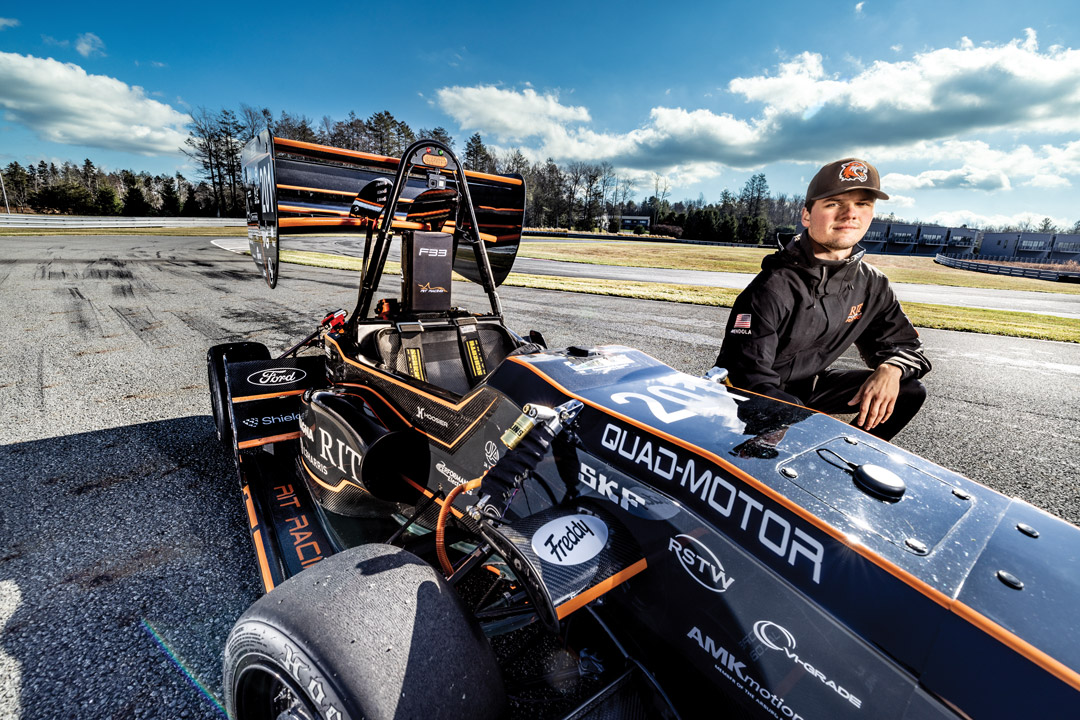
Jason Mendola, a fourth-year electrical engineering student, completed co-ops at MOOG Aircraft Systems and GM Controls.
In 2019, RIT Formula SAE Racing transitioned from building a competitive car with a combustion engine to an all-electric vehicle.
Automotive technology is steadily being driven by electrical systems and adapting was a challenge. But it was one that RIT Racing committed to and found early success with when the team placed first overall at one of the biggest SAE Formula events of the 2024 season.
“A lot of people did not even realize that we had moved to an all-electric vehicle. It was a change in culture for us, and to win at Michigan in 2024 was the biggest accomplishment for so many of us,” said Jason Mendola, a fourth-year electrical engineering student and project manager.
The team also changed how it powered the car, moving from a single inboard motor to in-wheel motors so power was distributed over the vehicle’s four wheels to provide more balance and better control.
In-wheel motors are becoming more popular in e-vehicles being built by car companies today. RIT Racing has consistently pushed its vehicle designs over the years, testing sophisticated systems that often align with auto industry technologies.
As one of the oldest and largest teams, RIT Racing has represented the university on some of the most competitive tracks in the U.S. and internationally.
Each year, more than 80 students in engineering and engineering technology programs, as well as those from business, art and design, and computing, participate on the team.
Alumni can be found on NASCAR teams and in multiple fields beyond automotive industries.
The team will compete June 16-20 at Michigan International Speedway.
Baja SAE Racing
Scott Hamilton/RIT
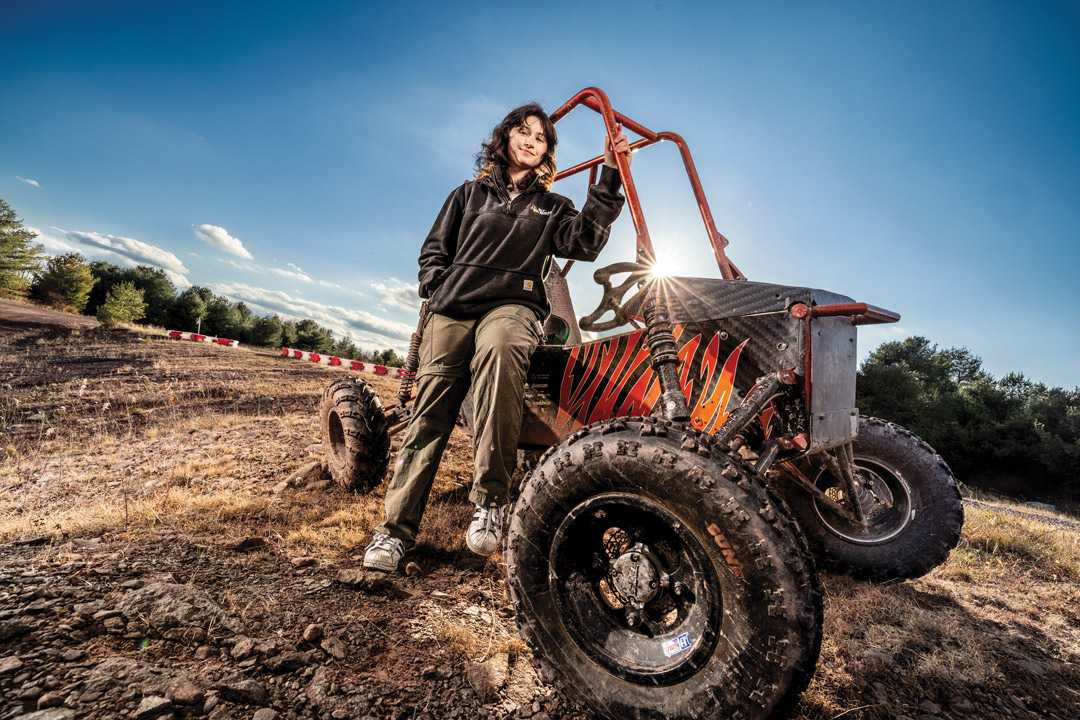
Dom Schmieder, a fourth-year mechanical engineering student, worked on a co-op at GE Vernova Generator Manufacturing.
Baja racing is not for the faint of heart as teams challenge daring rock crawls, sled pulls, hill climbs, maneuvering over rough terrain, and closing competitions with a tough, four-hour endurance race.
RIT’s Baja team has been successful in all those competition races, consistently placing—and winning—in U.S. and international races in its 30-year-plus history.
“This year’s team built another strong car and is coming off a successful spring and summer season with Top-10 placements overall in our three events this year,” said Dominique “Dom” Schmieder, a fourth-year mechanical engineering student and the 2025-2026 team manager.
Schmieder began work on different component sub-teams, getting experience in frame fabrication, drivetrain components, and engine systems.
Each year, team members manufacture precision gears, shocks, and brake systems in-house. All are designed and fabricated on equipment in university labs.
Over time, they earn roles as sub-team leads and later take on overall leadership positions. Team members voted for Schmieder to be team manager, which means coordinating all seasonal events and personnel logistics.
Anthony Guglielmo, a fifth-year mechanical engineering student, is overseeing the technical build process as project manager.
SAE International, the organization sponsoring collegiate Baja competitions, seeks universities to co-host these multiday events.
Every third year since 2004, RIT has welcomed international teams to RIT’s Gordon Field House and Hogback Hill in Palmyra, N.Y. The event will be in Rochester again June 11-14.
Hot Wheelz Solar Racing
Scott Hamilton/RIT
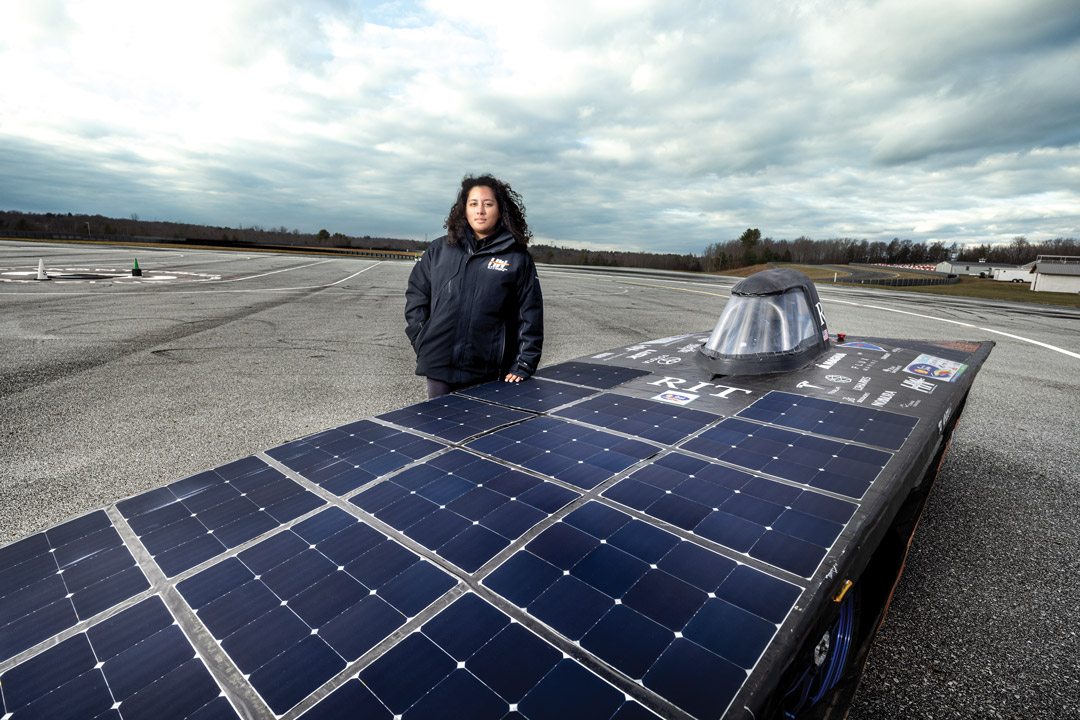
Amarisse Rodriguez, a fifth-year mechanical engineering student, did a co-op at GE Vernova Hitachi Nuclear Energy.
Hot Wheelz is a story of how teams defy the odds.
The team that started as a sporty go-cart winning a campus event in 2012 is now competing among experienced national and international collegiate solar car teams.
The original team members had a lot of interest in building a race car, something they had never done before. After several years and multiple versions of a vehicle, they entered the Formula Hybrid race in New Hampshire in 2016 and placed third. They won the event in 2017.
Four years ago, they shifted gears and set out to build a solar car—relying on their history of building something new.
RIT had a solar car in the 1980s, but the technology has evolved significantly since then. Current team members sought information about solar technologies from experienced faculty members. They attended national solar car races and interacted with collegiate teams to get design tips.
They spent several years building the more than 15-foot chassis covered with solar cells that they race today.
They entered the American Solar Challenge and Formula Sun Grand Prix event in Kentucky for the first time in July 2025.
“This year, our car is going to be even bigger and have new electrical systems,” said Amarisse Rodriguez, a fifth-year mechanical engineering student and the team manager for the 2025-2026 season.
She is leading a team of 50-plus students as they prepare for the 2026 event this summer.
RIT Racing at Monticello Motor Club