3D Printing Metal Implants Drop by Drop
Recent advances in additive manufacturing of biometals—such as iron, magnesium, zinc, and their alloys—have opened new possibilities for patient-specific implants and bone plate systems.
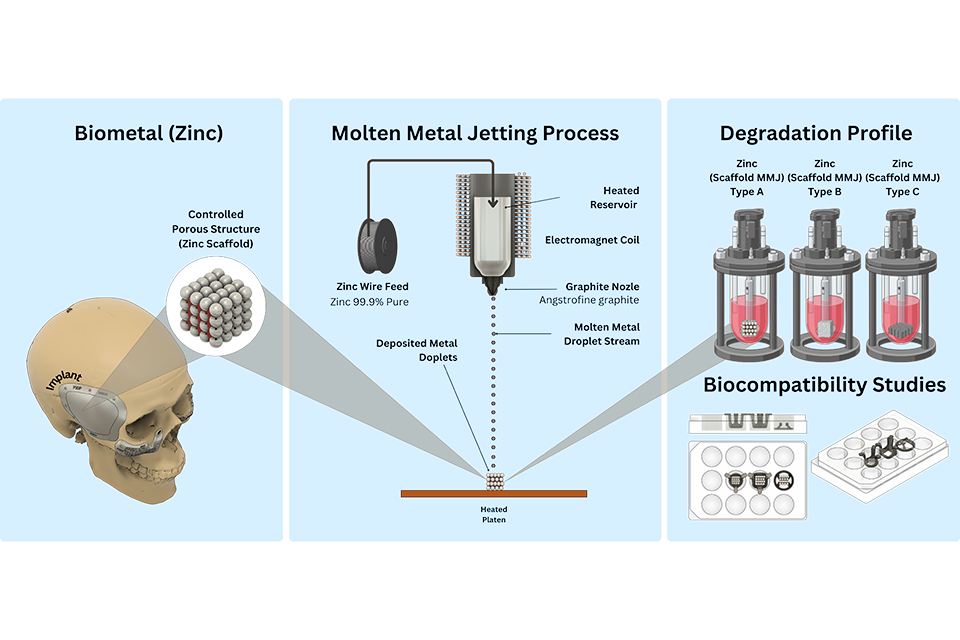
Recent advances in additive manufacturing of biometals—such as iron, magnesium, zinc, and their alloys—have opened new possibilities for patient-specific implants and bone plate systems. These materials offer superior mechanical strength compared to traditional biomaterials. They also provide biocompatibility and a unique ability to degrade over time. This eliminates the need for removal surgeries and makes them ideal for temporary implantable biomedical applications.
Among these biometals, zinc presents distinct advantages due to its intermediate degradation rate. This helps mitigate challenges associated with other degradable metals, such as forming gas pockets that can delay healing and trigger inflammatory responses. Additionally, zinc plays a crucial role in various cellular functions. These include enzymatic activity, gene expression, DNA metabolism, signal transduction, immune response, regulation of cell death, cell differentiation, proliferation, and broader metabolic processes.
Additive manufacturing techniques such as powder bed fusion (PBF) and wire-feed electron beam (EBAM) melting have been used to fabricate patient-specific zinc scaffolds and bone plates. However, most of these studies use computational software to generate pre-designed porous architectures—such as gyroids, diamond structures, and Schwarz-P lattices. They do not explore the unique capability of the additive manufacturing process itself to create intricate porous structures.
Molten Metal Jetting (MMJ) is a highly novel metal additive manufacturing technology that employs a drop-on-demand process to print metal parts. This method utilizes electromagnetic fields to manipulate liquid metals. These fields induce currents that generate Lorentz forces to propel metal droplets and form a consistent jet. Precise control over metal deposition enables the fabrication of complex structures. MMJ is particularly suitable for producing zinc bone scaffolds due to the resulting generated space between drops. By strategically positioning these droplets, MMJ enables the controlled formation of porous structures. These influence zinc structures' degradation rate and surface characteristics, potentially enhancing osseointegration and tissue ingrowth.
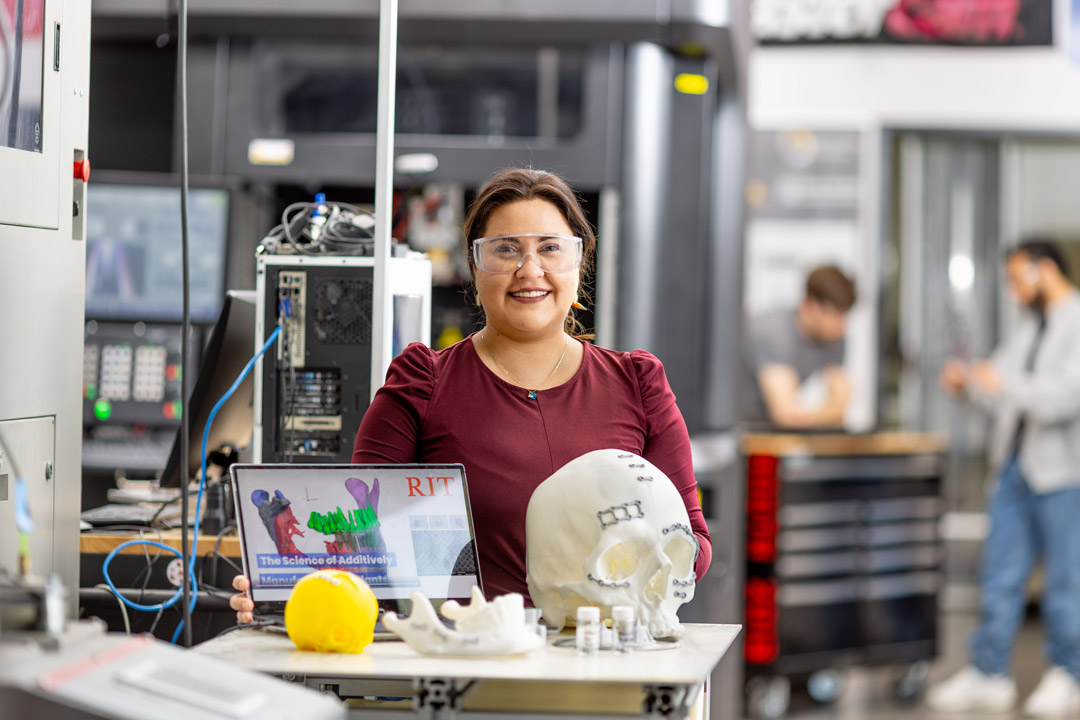
The AMPrint Center is at the forefront of advancing MMJ technology, driving research to refine and elevate its capabilities. This research marks the first exploration of MMJ's potential for biomedical applications. It is being conducted by Valeria Marin-Montealegre, a Ph.D. candidate in Mechanical and Industrial Engineering, under the guidance of Dr. Denis Cormier. The investigation focuses on optimizing MMJ to produce high-quality zinc scaffolds and characterizing their degradation and biocompatibility behavior. Preliminary findings offer insight into the degradation rates of these porous zinc scaffolds. Ongoing studies are examining how porosity patterns affect degradation. This work represents a significant step toward next-generation, patient-specific degradable metal implants using MMJ technology.
More Featured Profiles and Work

Paarth Mehta
Valeria Marin Montealegre
Atik Faisal