The Future of Lightweight Structures: Molten Metal 3D Printing Unlocks New Possibilities for Lattice Design
Lattice structures address a niche in the manufacturing industry due to their lightweight nature, energy absorption capabilities, high strength-to-weight
ratio, and improved thermal management. These advantages make engineered lattice structures ideal for aerospace, automotive, medical, sports, and
architectural applications.

Lattice structures address a niche in the manufacturing industry due to their lightweight nature, energy absorption capabilities, high strength-to-weight
ratio, and improved thermal management. These advantages make engineered lattice structures ideal for aerospace, automotive, medical, sports, and
architectural applications. Simple metal lattice structures can be manufactured using investment casting or sheet metal forming and brazing techniques.
While braiding, weaving, and knitting techniques have been used to produce non-metallic lattices, these techniques are mostly limited to regular shapes
or single-layer sandwiched structures. Complex lattice structures are generally not suitable for fabrication using conventional manufacturing (CM)
techniques.
Modern computer-aided design (CAD) software with generative design and optimization capabilities can model lattice structures with tailored
mechanical, thermal, acoustic, and electrical properties. For example, structures with efficiently graded material distribution and a better stiffness-to-
weight ratio can be produced. These complex geometries can be fabricated via additive manufacturing (AM) technologies such as stereolithography
(SLA), fused deposition modeling (FDM), selective laser sintering/melting (SLS/M), and binder jetting. While these structures have been extensively
studied and characterized, they must adhere to the limitations of AM technologies. These drawbacks result from AM's layer-wise fabrication approach,
which results in weak interlayer bonding. Furthermore, powder and resin-based sintering techniques for manufacturing lattices often have geometrical
variations along the structure's build direction due to poorly sintered powder or uncured resin. This can have a significantly negative impact on the
mechanical response and failure mechanisms. Also, traditional AM technologies struggle to produce lattice structures encased in a solid surface/skin due
to the inability to extract either powder or resin.
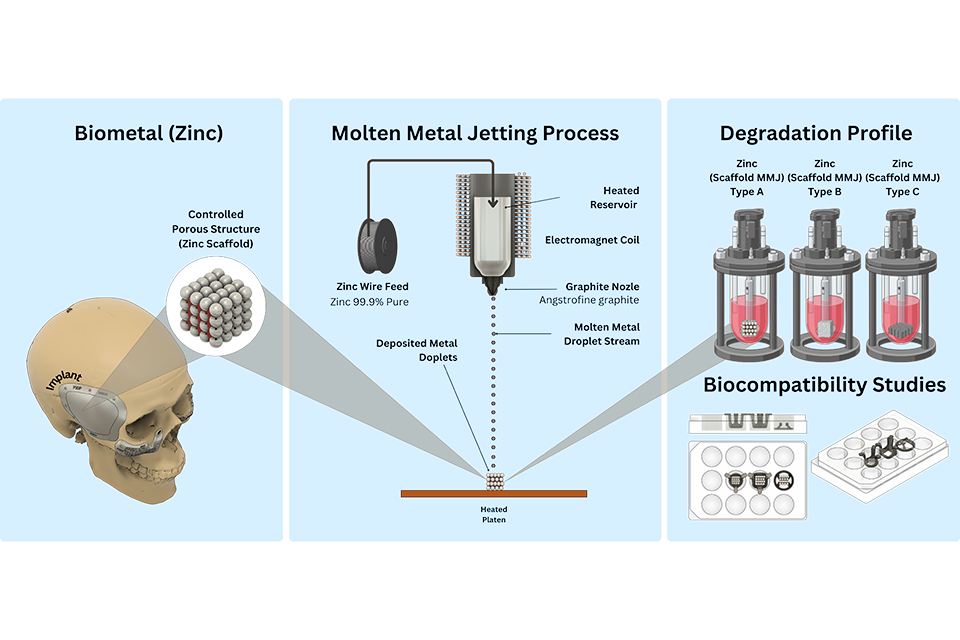
An exciting new technology called drop-on-demand molten metal jetting (MMJ) may finally provide a solution. With MMJ, molten metal droplets are
selectively ejected at ~500 drops/s from a nozzle towards a moving substrate. Each drop lands, cools down, and solidifies into solid metal to form the
desired 3D metal part shape. Since no powders or resins are used, even fully enclosed lattices can be fabricated. By adjusting the droplet size, speed,
location, and layer thickness, near-net shape parts with high resolution and minimal post-processing can be produced.
MIE-PhD candidate Paarth Mehta, his advisor Denis Cormier, and a team of researchers at the Rochester Institute of Technology are at the forefront of
developing MMJ for metallic lattice printing. Using a commercially available ADDiTEC ElemX molten metal jetting printer, droplets are ejected utilizing
the principle of magnetohydrodynamics. Freestanding lattice struts are built up by emitting droplet clusters followed by brief pauses that allow partial
solidification of the jetted droplets. This burst mode approach allows the strut diameter to be varied. It likewise enables the printing of tilted beams at a
desired angle. Encouraging results have already been obtained, including the characterization of strut density, microstructure, and mechanical
properties.
The burst mode MMJ technique paves the way for lightweight lattice designs that were previously unattainable through other metal 3D printing
methods. As the technology progresses, faster printing with a more comprehensive range of alloys will be possible. Molten metal 3D printing is
becoming essential for fabricating high-performance components across major industries. The breakthroughs from this research will help drive the
overall increased adoption of metal additive manufacturing.
More Featured Profiles and Work
Valeria Marin-Montealegre
Valeria Marin Montealegre
Atik Faisal