Biomedical Engineering Master's Capstone: DexFlex
Patient compliance for stroke patients is a concern to health professionals and safety at-home recovery. RIT Master's students addressed the concern via the DexFlex System.
Patient compliance for stroke patients is a concern to health professionals and safety at-home recovery. Healthcare professionals are required to have proof of independence or assistance before patients can be sent home, as they can experience symptoms in post-stroke recovery that affect the use of their hands in everyday tasks, which significantly decreases their quality of life. Exercises and sometimes physical devices are sent home with patients when they are released from the hospital to aid in the recovery process, however, these options are not interactive, which can severely decrease patient compliance.
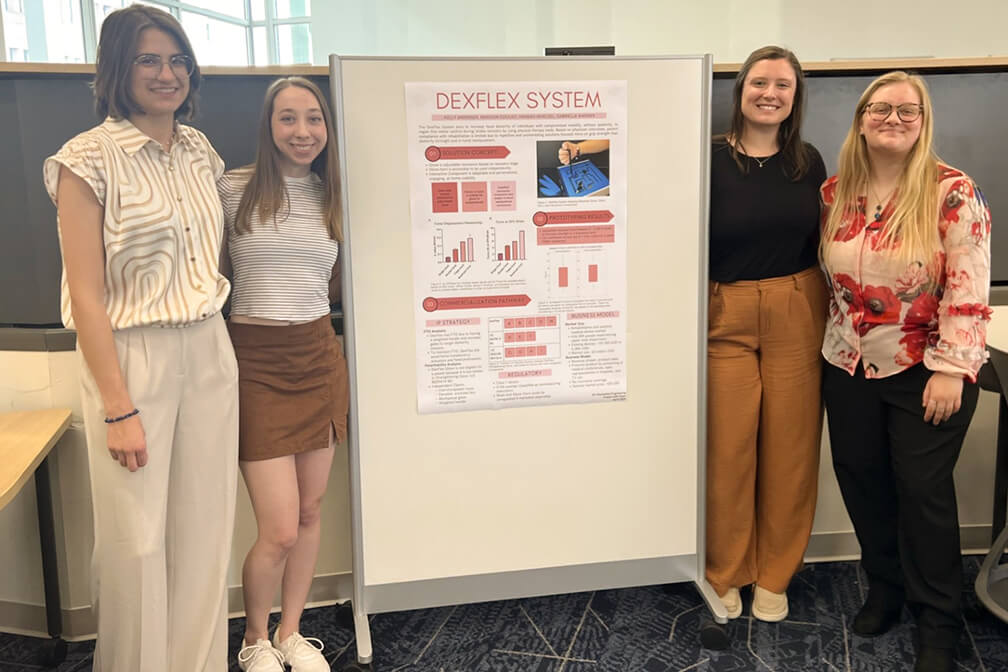
A Biomedical Engineering Master’s Capstone Team, Hannah Henczel, Kelly Andersen, Gabby Wagner, and Madison Dziulko, addressed the need via the DexFlex System. The DexFlex system provides a way to increase hand dexterity of individuals with compromised mobility, without spasticity, to regain fine motor control during stroke recovery by using physical therapy tools. The glove has elastic bands sewn into it and are secured at the wrist via cord locks seated in a 3D-printed wrist component. The cords are adjustable for optimized resistance based off the patient’s needs. To increase compliance, there is an interactive component to be used in conjunction with the glove — an easily customizable maze with obstacles requiring the user to practice every day movements. Rigorous stress and life cycle testing was conducted on the elastic bands, cord locks, and glove to ensure durability. This project saw the DexFlex System through an initial concept to a prototype and included considerations for QMS implementation, market and clinical analysis, intellectual property research, and business model.
More Featured Profiles and Work