Interplay of Interfacial Adhesion and Mechanical Degradation in Anode-free Solid-state Batteries
Batteries play a critical role in powering modern life—from smartphones and laptops to electric vehicles and renewable energy systems. However, traditional lithium-ion batteries are approaching their limits regarding energy storage capacity, safety, and lifespan. To overcome these barriers, researchers are turning their attention to solid-state batteries (SSBs), an innovative technology that replaces conventional liquid electrolytes with solid materials, significantly enhancing safety and energy efficiency.
Batteries play a critical role in powering modern life—from smartphones and laptops to electric vehicles and renewable energy systems. However, traditional lithium-ion batteries are approaching their limits regarding energy storage capacity, safety, and lifespan. To overcome these barriers, researchers are turning their attention to solid-state batteries (SSBs), an innovative technology that replaces conventional liquid electrolytes with solid materials, significantly enhancing safety and energy efficiency.
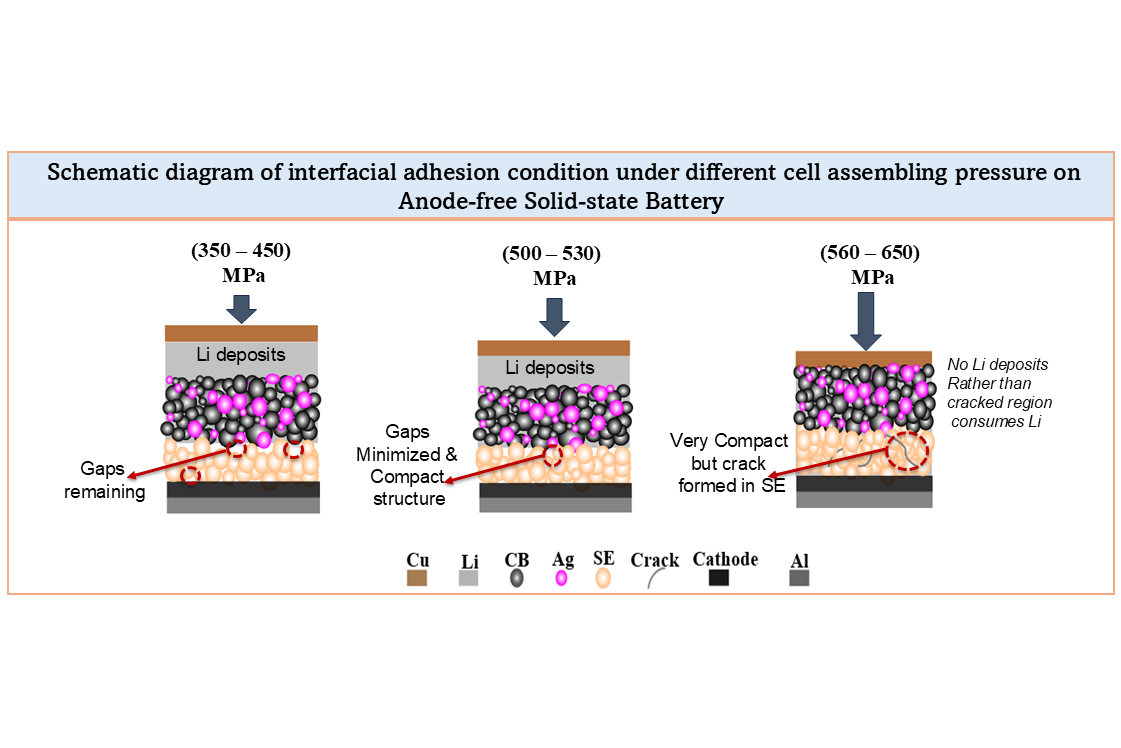
One especially promising type of solid-state battery is the anode-free solid-state battery (AFSSB). AFSSBs stand out due to their higher energy density and lower manufacturing costs compared to conventional lithium-metal-based batteries. However, realizing their full potential requires overcoming several mechanical and electrochemical challenges at the interfaces within the battery. Our research uniquely addresses these interface challenges by investigating how mechanical interactions influence the performance of AFSSBs. Specifically, we focus on the critical interface between a silver-carbon (Ag-C) interlayer and the solid electrolyte separator (SE). This interface greatly influences how effectively the battery can store and deliver energy. By adjusting the assembling pressure—the force used to press battery layers together—we have developed straightforward methods to significantly enhance interfacial adhesion. Our contact angle experiments reveal that increasing the assembling pressure from 350 MPa to 530 MPa notably improves the adhesion energy between the solid electrolyte and lithium metal. Electrochemical tests further demonstrate that this improved adhesion boosts the battery’s initial capacity by over 50%, reaching an impressive energy density of 410 Wh/kg. However, our research also highlights a limitation: applying pressures above 530 MPa risks cracking the solid electrolyte separator, dramatically reducing battery performance. Balancing the assembling pressure is therefore crucial. Overall, our findings confirm that carefully controlling the interfacial adhesion through precise manufacturing techniques is key to preventing performance degradation and unlocking the full potential of next-generation AFSSBs. This research underscores the importance of mechanical interactions at battery interfaces, paving the way for safer, more efficient, and higher-capacity solid-state batteries for future applications.
More Featured Profiles and Work
Valeria Marin-Montealegre
Valeria Marin Montealegre
Atik Faisal