Diagnostic Medical Sonography (Ultrasound) Certificate

Explore OB/GYN, abdominal, and small parts sonography as you deepen your knowledge of ultrasound technology.
Overview for Diagnostic Medical Sonography (Ultrasound) Certificate
The diagnostic medical sonography certificate is an 18-month program that includes a clinical internship. The program–which focuses on various abdominal, gynecological, obstetrical, and small parts examinations including certain vascular studies–has been designed to meet and exceed the objectives of the Joint Review Committee on Education in Diagnostic Medical Sonography of the Commission on Accreditation of Allied Health Education Programs (CAAHEP). It was created to produce competent, compassionate, and responsible ultrasound professionals and leaders. The certificate is available to all registered allied health practitioners as well as to those holding an associate or bachelor’s degree in a relevant discipline. The program includes lectures and course work integrated with a clinical internship. Dependent on a student’s previous degree, certain prerequisite courses may be required prior to enrollment. Required prerequisite courses include one year of anatomy and physiology with laboratories and one year of college or general physics with laboratories.
Graduates earning the certificate will:
- be prepared as competent entry-level general sonographers in the cognitive (knowledge), psychomotor (skills), and affective (behavior) learning domains;
- gain a thorough working knowledge of ultrasound scanning techniques;
- be skilled in the operation of ultrasound instrumentation and laboratory equipment;
- acquire the proper manner in working with patients; and
- under the guidance of faculty and professional staff, be capable of scheduling and performing the daily workload of ultrasound procedures, evaluating new procedures where necessary, and supervising other technical personnel.
Plan of Study
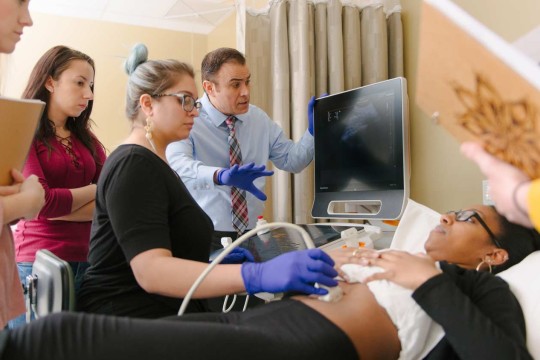
During the first academic year, students complete all the prerequisite courses required to enter the clinical internship phase of the program. Students also apply, polish, and test their clinical skills and techniques in the on-campus ultrasound scanning suite, which is equipped with a variety of ultrasound equipment. Following a required two-week pre-clinical internship orientation session, students begin their training at the first of two assigned clinical training sites.
Careers and Clinical Internships
Clinical Internships
The one-year clinical internship provides hands-on experience at two or more approved medical facilities. After completing the pre-internship course work, all students begin the internship by attending an intensive two-week experience on campus. During this time they enhance and polish the skills they previously learned, prepare to perform complete sonographic examinations as performed in real clinical settings, and advance their knowledge in recognizing anatomy and disease states using a variety of equipment in the Ultrasound Scanning Suite. Students also learn about hospital, departmental, and administrative operations. After completing these requirements, candidates are assigned to a medical training site for their clinical experience. At these facilities, students work side-by-side with sonographers, physicians, and other health care professionals to learn, develop, apply, and sharpen the necessary skills to perform general ultrasound examinations. Students’ clinical progress and performance are closely monitored by the program’s clinical coordinator and program director, who have regular communication and make periodic visits to the clinical internship sites. Additionally, students return to campus each month for three days of lectures, presentations, projects, and testing. Students may complete their clinical internships at any approved regional or national medical ultrasound facility, with approval of the program director.
Featured Work and Profiles
-

Breaking Boundaries: RIT Grad Merges Sonography and PA Studies for Comprehensive Patient Care
Zayneb Ghazle '24 became the first student to graduate with a double major in diagnostic medical sonography (ultrasound) and the physician assistant BS/MS program.
Read More about Breaking Boundaries: RIT Grad Merges Sonography and PA Studies for Comprehensive Patient Care
Curriculum for 2026-2027 for Diagnostic Medical Sonography (Ultrasound) Certificate
Current Students: See Curriculum Requirements
Admissions and Financial Aid
Transfer Admission
Only transfer students are eligible to apply for this certificate program. Applicants must meet the following requirements:
- AS degree in liberal arts (science option), allied health, radiologic technology, or a bachelor's degree from an accredited institution.
- A minimum of college algebra is required.
- Anatomy and physiology I & II are required.
- One semester of physics is required.
Financial Aid and Scholarships
100% of all incoming transfer students receive aid.
RIT’s personalized and comprehensive financial aid program includes scholarships, grants, loans, and campus employment programs. When all these are put to work, your actual cost may be much lower than the published estimated cost of attendance.
Learn more about financial aid and scholarships
Related News
-
November 12, 2024

EchoMentor creates a new wave of sonographers
Hayley Bartkus and Christina Werth created EchoMentor as an educational platform for healthcare professionals working in sonography or ultrasound, a medical imaging method that uses sound waves to peer inside the body.
-
February 14, 2020

Carestream Health donates $1.2 million in ultrasound equipment to RIT
Carestream Health Inc. continues to support the education of sonographers at RIT through a new donation of ultrasound equipment valued at more than $1.2 million. This is the second donation Carestream has made during this academic year to RIT’s diagnostic medical sonography program, with a combined total exceeding $1.4 million.
-
April 28, 2018

RIT grad returns to West Coast for ‘dream job’
Cynthia Walker is on the cusp of a health-care career focusing on the heart. She graduates from RIT on May 11 with a BS from the School of Individualized Study and a certificate in echocardiography, or ultrasound of the heart, from the College of Health Sciences and Technology.
