RIT Fulbright Specialist brings cultural heritage imaging expertise to Indonesia
Tom Rieger, Professor of Practice in the College of Liberal Arts, selected for a Fulbright Specialist Program award
Traci Westcott/RIT
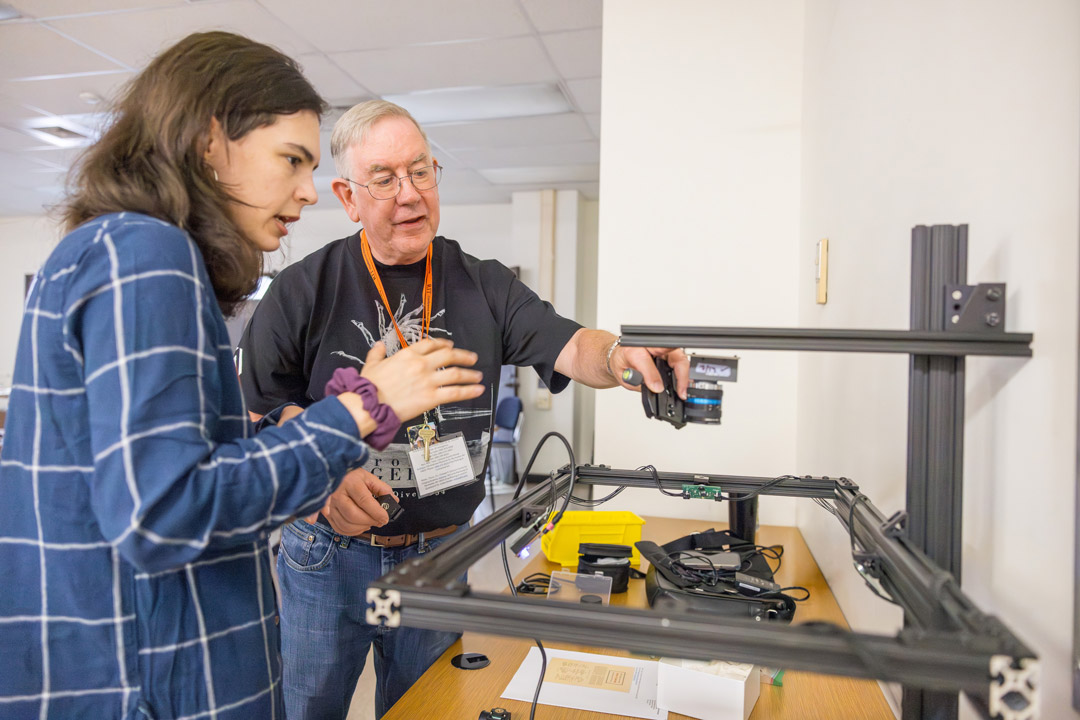
Tom Rieger, right, works with graduate student Lilli Kelley, left, to demonstrate imaging technology developed by the Cultural Heritage Imaging Lab during the MISHA Summer Seminar educational workshop in 2025.
Tom Rieger ’74 (photography) spent his career exploring how imaging and digitization can support cultural heritage preservation. His passion for these efforts coaxed him out of retirement in 2025, when he was named a Professor of Practice for the College of Liberal Arts’ museum studies program.
Now, his passion and expertise are leading him across the globe to Indonesia thanks to a Fulbright Specialist Program award.
From July 12 through Aug. 15, Rieger will travel overseas to the National Library of Indonesia and conduct a variety of educational training activities relating to cultural heritage imaging and preservation. He will also assist staff at the library—including Irhamni Ali, Faisal Huzein, and Khosyi Alfin Maulana—in developing a national-level program for imaging and digitizing at-risk artifacts stewarded by institutions across the country.
“As is the case all around the world, our heritage is disappearing. It’s getting burned up in fires, destroyed in floods, eaten by insects, or, in some cases, it’s been stored in poor environmental conditions and it self-destructs,” said Rieger. “As best we can, we can’t allow that to happen to something like a 500-year-old artifact.”
The Fulbright Specialist Program, part of the larger Fulbright Program, sends American professionals to serve as short-term experts at institutions around the world, where they address critical global issues while building relationships, expertise, and leadership. Recipients are selected based on their academic and professional achievements, demonstrated leadership in their field, and their potential to foster long-term cooperation between institutions in the U.S. and abroad.
Rieger’s efforts in Indonesia will be focused on high-level planning. He will help draft formalized policy framework and workflows to assist the library in determining what they can do to prevent the loss of history, and what can be done to recover what’s already been lost or damaged.
“They really want a facilitator. Someone who’s been there and done that, as far as developing these policies, to guide them through the process,” he said.
Rieger’s expertise aligned with this project seamlessly, as this was precisely the work he completed during his tenure as chief of the Collections Digitization Division at the U.S. Library of Congress.
“I'm trying to blend what they already do into a total process that spans everything from figuring out what the nation has, what condition it’s in, what it needs to survive, and what kinds of preservation and conservation routines can be done for those objects,” said Rieger.
Rieger explained that this collaboration with the National Library of Indonesia won’t be limited to his five-week visit this summer. His work with the library will continue after he’s returned to the U.S., and will be supported, in part, through his affiliation with RIT’s Cultural Heritage Imaging Lab.
Co-directed by Juilee Decker, Roger Easton Jr., and David Messinger, one of the lab’s goals is to empower institutions across the globe with the knowledge and tools to digitize and preserve their collections, as well as recover information from damaged or deteriorated artifacts with the Multispectral Imaging System for Historical Artifacts (MISHA) developed by the lab.
The lab’s mission to democratize access to imaging technology and expertise is what prompted Rieger to abandon his retirement and re-join the workforce.
“We absolutely must pass on the knowledge that we have to the next generation that's coming up behind us if we are to have any hope that our work over the years carries forward,” Rieger said. “You are not a good leader if you can't train the people that come after you to pick up that baton and become the next leader.”
For more information about the award, go to the Fulbright Specialist website. For more information about cultural heritage imaging research at RIT, go to the Cultural Heritage Imaging Lab’s website or RIT’s museum studies program website.

