News
-
November 15, 2019
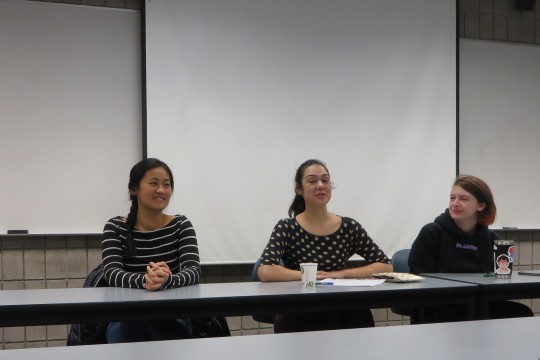
What Students Wish Faculty Knew
A voluntary panel of students facilitated a valuable discussion during the Inclusive Excellence Initiative event, "What Students Wish Faculty Knew."
-
November 14, 2019

Alumni reflect 30 years after Chester F. Carlson Center for Imaging Science opened its doors
The Chester F. Carlson Center for Imaging Science became the only place in the world where students could pursue degrees in the interdisciplinary field of imaging science when it opened its doors in 1989. Thirty years later, alumni returned to campus for a celebration and interactive open house during Brick City Homecoming and Family Weekend.
-
November 8, 2019

New study suggests ‘Pac-Man-like’ mergers could explain massive, spinning black holes
Scientists have reported detecting gravitational waves from 10 black hole mergers to date, but they are still trying to explain the origins of those mergers. The largest merger detected so far seems to have defied previous models because it has a higher spin and mass than the range thought possible. A group of researchers, including RIT Assistant Professor Richard O’Shaughnessy, has created simulations that could explain how the merger happened.
-
November 5, 2019

Watch the planet Mercury pass in front of the sun with the RIT Observatory
The planet Mercury will pass directly across the sun next week for the last time until 2032, and RIT faculty and students will help the community view the rare event. Members of the RIT Observatory will set up telescopes for public use from 7:30 a.m. to 1 p.m. on Monday, Nov. 11, in the Infinity Quad on the RIT campus.
-
November 5, 2019

RIT researchers working to build the basis of life
WROC-TV talks to Moumita Das, associate professor in the School of Physics and Astronomy, about her work with neurons and an NSF-funded project to build synthetic neurons.
-
October 31, 2019

Research at RIT aims to build neurons from scratch
WXXI talks to Moumita Das, associate professor in the School of Physics and Astronomy, about her work with neurons and an NSF-funded project to build synthetic neurons.
-
October 29, 2019

Student to Student: Sustainable polymers
Liam Reilly became motivated to participate in research on sustainable polymers when he learned of the damaging effects of plastic production on our environment. His research is centered on one specific relationship we have with nature, our production and disposal of our most commonly produced material: Plastic.
-
October 28, 2019
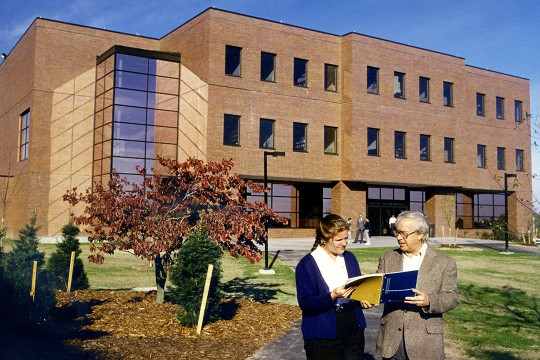
‘Coming of Age’ describes how a signature program shaped RIT’s future
A new book published by RIT Press documents RIT’s trajectory from a teaching institute to a research university with an expanding portfolio of doctoral programs. Coming of Age: The Center for Imaging Science at Rochester Institute of Technology describes the university-wide impact of the center and first Ph.D. program.
-
October 25, 2019

Shedding light on black holes
The Christian Science Monitor talks to Manuela Campanelli, professor and director of the Center for Computational Relativity and Gravitation.
-
October 22, 2019

RIT researchers win first place in international eye-tracking challenge by Facebook Research
The team, led by three Ph.D. students from the Chester F. Carlson Center for Imaging Science, won first place in the OpenEDS Challenge focused on semantic segmentation.
-
October 21, 2019

RIT researcher receives NSF grant to help build a synthetic neuron and neural network
Researchers from RIT and six other universities are teaming up to build synthetic neurons and a programmable network of such neurons in an effort to better understand the rules of life. The project is part of the National Science Foundation’s “Big Ideas” initiative— 10 bold, long-term research and process ideas that identify areas for future investment at the frontiers of science and engineering.
-
October 18, 2019

Detection of the most massive neutron star known
Assistant Professor Michael Lam from RIT and the North American Nanohertz Observatory for Gravitational Waves (NANOGrav) detected the most massive neutron star known after 5-years of observations.