Biology professor named RIT’s first Beckman Young Investigator
The award funds promising young faculty members in chemical and life sciences
Carlos Ortiz/RIT
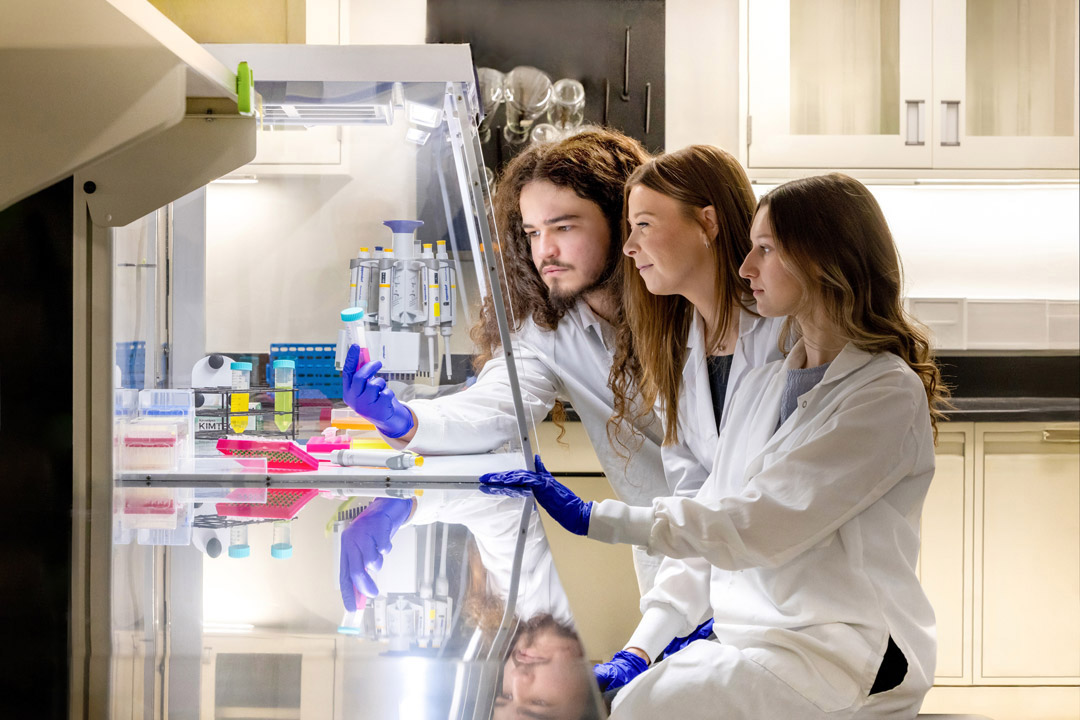
Assistant Professor Elle Barnes, center, works with students William Goyette, left, and Lilly Rennie, right, in the MEGA Lab on RIT’s campus.
RIT Assistant Professor Elle Barnes has been announced as a 2026 Beckman Young Investigator (BYI) Award recipient with funding provided by the Arnold and Mabel Beckman Foundation.
The award provides research support to the most promising young faculty members in the early stages of their academic careers in chemical and life sciences. The funding aims to foster the invention of methods, instruments, and materials that will open up new avenues of research.
Barnes, who is in the Thomas H. Gosnell School of Life Sciences, is the first faculty member at RIT to receive the award and is one of 12 awardees this year out of more than 400 applicants. Fellow 2026 recipients include researchers from Duke University, Yale University, University of Pennsylvania, and Harvard Medical School. The BYI Program began in 1991.
“One of the exciting things for me is to see this type of innovation award go to someone that isn’t working in human medicine,” said Barnes, “but is still innovating and applying molecular and computational tools that would benefit human medicine and life sciences in general.”

Elle Barnes/RIT
This Ambystoma salamander has a genome much larger than a human. RIT Assistant Professor Elle Barnes is researching these amphibians to develop tools to study the large genome problem through a Beckman Young Investigator Award.
Through this funding, Barnes is researching one of the most abundant amphibians in the Great Lakes area, an all-female species of salamander. These salamanders have genomes that are far larger than the human genome, but scientists lack the tools to successfully sequence it rigorously. As Barnes explained, most tools were created under the impetus of the human genome and under human medicine, but she plans to use the salamanders to develop tools to address the large genome problem.
“There are so many innovations that are waiting to happen that exist and are hidden in the genomes of all the other life on Earth,” Barnes said. “There’s a lot of interest in looking at nature’s arsenal and figuring out what exists out there. None of that is possible if we aren’t able to address the large genome problem.”
Barnes’ Microbial Ecology and Genomics in Amphibians (MEGA) Lab applies molecular and computational techniques to answer questions related to the creation and maintenance of biodiversity across time and space. The lab is reliant on a large contingency of student researchers, most of whom are undergraduate students.
“The power of winning this award and being a researcher that’s not at an R1 institution, and what that means for my career and all the students I mentor, is that they can see that you can do great research anywhere,” said Barnes. “You just have to be motivated, and you have to have great ideas.”