Public Speaking and the Public Sphere: Communication in Ancient and Modern Greece
Location: Athens, Greece
Course Discipline:
- Communication
- Philosophy
- History
Credits: 3
Program Type: RIT Faculty-Led
Term(s): Spring/Summer
Language of Instruction: English
Undergraduate
RIT Students Only

Public speaking was once seen as a vital civic duty in Ancient Greece, and today, it remains a powerful skill that reflects critical thinking, leadership, and confidence. In this immersive learning experience, you’ll take a spring 2027 course in Rochester, then travel to Greece in mid-May, where you’ll study communication where it all began, gaining practical tools for today’s world, and growing into a more persuasive, aware, and adaptable speaker.
Highlights
- Explore iconic sites in Greece where ancient orators and philosophers like Aristotle, Plato, and Socrates shaped the foundations of public discourse.
- Refine your public speaking skills, sharpen your critical thinking, and build cross-cultural communication experience — all of which will help you stand out to future employers.
- While in Athens, explore world-famous landmarks, savor authentic Greek cuisine, wander through lively neighborhoods, and immerse yourself in the city's vibrant culture.
- Take a sailing excursion to the nearby Saronic Gulf islands.
- Gain confidence in intercultural settings by interacting with local Greek communities and observing how communication styles shift across cultures.
Course can count towards a communication minor/immersion, as an artistic or social perspective, GE elective, or free elective.
In Ancient Greece, public speaking held great importance and was considered a crucial skill for citizens. The Greeks valued the art of rhetoric and believed that persuasive speaking was essential for effective communication and leadership.
While in Greece, you’ll practice public speaking at historic sites like the Acropolis and Ancient Agora, connect classical techniques to modern platforms like social media and digital marketing, and explore how Greek philosophy still shapes persuasive communication today. All while experiencing the energy of Athens — a vibrant European city rich in history, culture, food, and unforgettable local experiences.
Cultural & experiential learning may include guided visits to:
- The Acropolis and Parthenon
- Ancient Agora of Athens
- Delphi & Temple of Apollo
- Temple of Poseidon at Cape Sounion
- Plato’s Academy & Aristotle’s Lyceum
- National Archaeological Museum
- Temple of Olympian Zeus & Hadrian's Arch
- Lake Vouliagmeni's therapeutic thermal waters
- Sailing excursion to the Saronic Gulf islands
Upcoming Student Info. Meetings
- Tuesday, Oct 13th at 5:00 PM via Zoom: https://rit.zoom.us/j/92839382489
Course Term: Spring course at RIT, travel to Greece in early Summer
Travel Dates: May 11-21, 2027
Credits: 3
Course Details:
- COMM 201: Public Speaking (3 credits)
Students will be enrolled in a spring 2027 course at RIT and travel to Greece in early summer.
No course prerequisites. Program is taught in English.
Open to all undergraduate matriculated RIT students, all majors, all year levels, 2.5 cumulative GPA or above.
Application Deadline: Sunday, October 18th, 2026, 11:59 pm (EST)
Student Experience
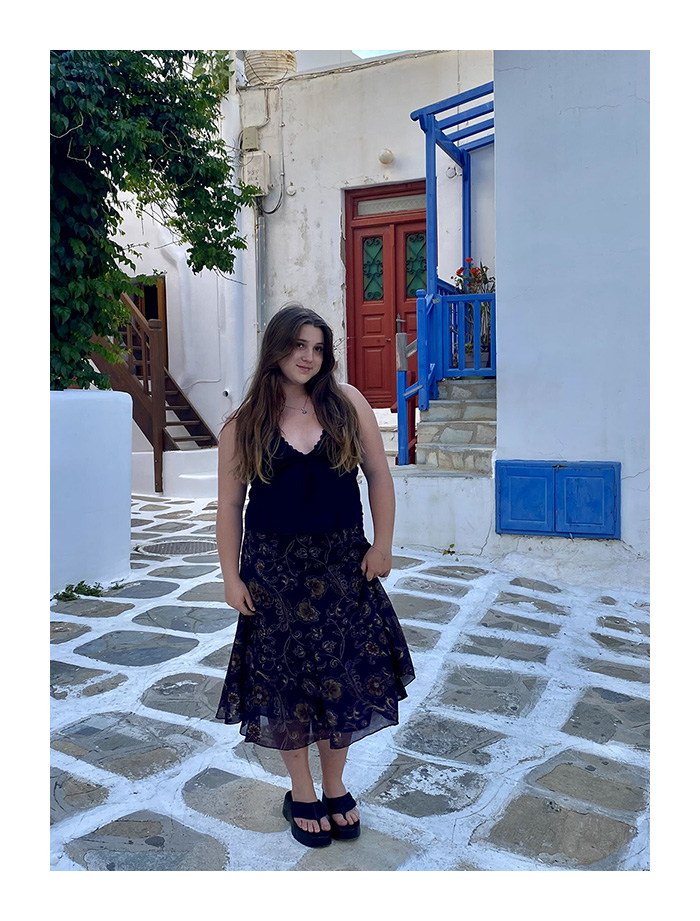 Kate Gibson
2nd year, Museum Studies, College of Liberal Arts
“Traveling the world has always been a goal of mine, and I knew studying abroad in college would be a great way to do it. The Public Speaking in Greece program seemed like the perfect storm: I could fulfill credit requirements while taking a 2-week trip to Greece with my instructors and classmates. The experience opened my eyes to new perspectives and made me seriously consider more opportunities that involved travel. Hearing Greek people talk about their slower-paced culture and emphasis on wellness and happiness made me rethink my priorities and learn to savor my youth. Visiting the Archaeological Museum of Ancient Corinth also solidified my passion for history and assured me that choosing a path in the Humanities was the right thing to do. In short, my study abroad experience made me want study abroad again!”
Program Cost & Financial Aid
Program Cost: Student budget worksheet - Public Speaking Greece 2027 program - outlines all program costs
Financial Aid:
Financial aid may cover some program costs. As you review the budget worksheet, please remember that it does not include your RIT financial aid or scholarships, which may cover some of the program costs. The purpose of the budget worksheet is to show all the costs associated with your study abroad program, which will help your RIT Financial Aid Assistant Director determine how your aid and scholarships may be applied.
To understand how your financial aid and scholarships may apply to your program costs:
- Make an appointment with your financial aid assistant director (call Financial Aid at 585-475-2186) and mention that you are calling for a study abroad appointment
- Upload a copy of your budget worksheet(s) via the Financial Aid upload portal at https://join.rit.edu/register/FA_upload (at least 48 hours prior to your scheduled meeting so they have time to prepare)
- Please rename the file name of your budget worksheet before uploading it to the Financial Aid portal based on the instructions provided in the portal (adding your name and student ID)
To find out the name of your financial aid assistant director for your degree program visit: https://www.rit.edu/admissions/aid/contact#counseling-team
We recommend you meet with Financial Aid before the application deadline so you understand how your aid will apply. The RIT financial aid office is located in Bausch and Lomb Center (Bldg. 77), 2nd floor, 2125.
Scholarships:
-
RIT Education Abroad Travel Grants ($500-$1,000)
All students with pending applications in the RIT Study Abroad Compass for this program will be automatically considered for an RIT Education Abroad Travel Grant. You will be informed of your scholarship status shortly after the application deadline. Scholarships are awarded based on financial need, as determined by financial aid and your FAFSA on file. -
Additional Scholarships
RIT scholarships and national scholarships for study abroad are good options to explore for scholarship funding. Make sure you are checking scholarship eligibility requirements and take note of scholarship deadlines.
To Apply
1) Start an application in the Compass (RIT's study abroad application system)
Once you login to the Compass you will need to complete some profile/registration questions, then use the “Search Programs” tab to search for “Public Speaking Greece” to complete an application.
2) Watch this video, which goes over all important application steps for RIT Faculty-Led Programs
Contact
Elizabeth Reeves O'Connor
Principal Lecturer, School of Communication
College of Liberal Arts
eargpt@rit.edu
Arianna Alsop
Lecturer, School of Communication
College of Liberal Arts
axagpt@rit.edu