Honing résumés and mock interviews pave the way to co-ops
RIT professor and student say practice is key to acing an Online Assessment
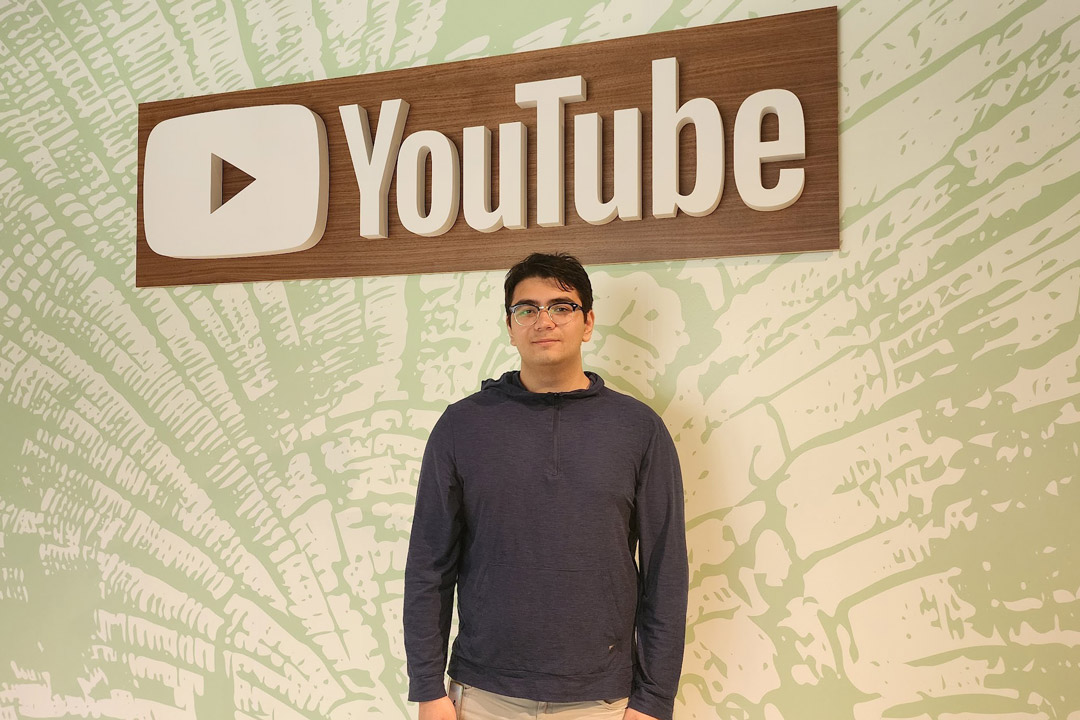
After refining his résumé and doing a mock interview, second-year computer science student Muhammad Rafikov did a software engineering internship at Google in Mountain View, Calif.
Muhammad Rafikov, a second-year computer science student, is heading to the Spring University-Wide Career Fair on the lookout for his second co-op. During this search, he plans to bring along everything he learned from his first internship last summer at Google.
Like many undergraduate RIT students, Rafikov is in a degree program that requires multiple blocks of cooperative education, or co-op. Each paid work experience is related to the student’s field of study and typically lasts one semester.
Ever since he took a high school trip to the New York City Google headquarters, Rafikov has wanted to work at Google. At RIT, he became an event coordinator with the Google Developer Student Club and began honing his résumé.
He applied to Google and was contacted for follow-up interviews, including a technical screening test called an Online Assessment (OA). He remembers spending every minute studying Data Structure and Algorithm (DSA) questions and LeetCode.
“I also reached to one of my software development professors, Robert St Jacques, to do a mock interview—and he was more than happy to help,” said Rafikov, who is from Brooklyn, N.Y. “He said that if I’m stuck on a problem to think of the edge and base cases first—the things that will obviously work and not work—and then do the complicated stuff.”
Visit the Career Fair
RIT’s Spring University-Wide Career Fair is 10 a.m. to 4 p.m., Wednesday, Feb. 25, in the Gordon Field House and Activities Center. Offered every fall and spring, the job fair is open to all RIT students and alumni seeking co-op and full-time opportunities.
St Jacques, principal lecturer of software engineering, worked in industry and as a hiring manager for many years. He said that just like with sports or music, practice is key to programming from scratch.
“Muhammad came to me with topics he thought he was weak in and I posed problems in those areas and gave feedback,” said St Jacques. “It’s important to have a dialogue during an interview—even an OA—and don’t make the interviewer guess what you’re doing or thinking.”
Rafikov added, “If you articulate yourself during the interview—even if you know you’re wrong, maybe you’ll help yourself or they’ll nudge you in the right direction. Interviewers are people too and they want to see you succeed. Say what you are thinking, so they know that you know your stuff.”
Online Assessment tips
Before an Online Assessment, St Jacques recommends that computing students:
- Read the book Cracking the Coding Interview, by Gayle Laakmann McDowell.
- Review mathematical and computer programming problems on ProjectEuler.net.
Rafikov said that whenever his phone rings, he has a habit of declining the call. When Google called three weeks after his interviews, he declined the call and panicked when he couldn’t call them back. Luckily, he answered the phone when Google called him back the next day.
In Mountain View, Calif., Rafikov was an associate software engineering intern with the YouTube TV access team and worked on a new eligibility ID system. During the summer co-op, he enjoyed biking around the Google campus and even got to work one week at the Google offices in New York City.
“Personally, it was one of the most fulfilling periods of my life as I was surrounded with like-minded and brilliant colleagues at the top of their field and given meaningful work that had lasting stakes for the wider team,” said Rafikov. “I also happened to learn a lot from my roommates, who were working for Nvidia.”
Résumé review
Samuel Malachowsky, principal lecturer of software engineering, likes to hold a résumé review session with RIT’s Society of Software Engineers every semester.
“I don’t believe in résumé tips and tricks, but I do like to relate the game theory behind suggestions I give,” said Malachowsky. “For example, when indicating that your résumé should be one page, I typically ask students for good reasons why. Here are three answers I look for.”
- TL;DR — Who wants to read two pages?
- What if the 45-year-old manager, with 25 years of experience themselves, has a one-page résumé and the student hands in a two-page résumé?
- A great one-page résumé demonstrates higher-level soft skills, including prioritization, optimization, and storytelling—rather than tiny fonts and suspicious margins.