New Media Design students present works created through the Honors Program
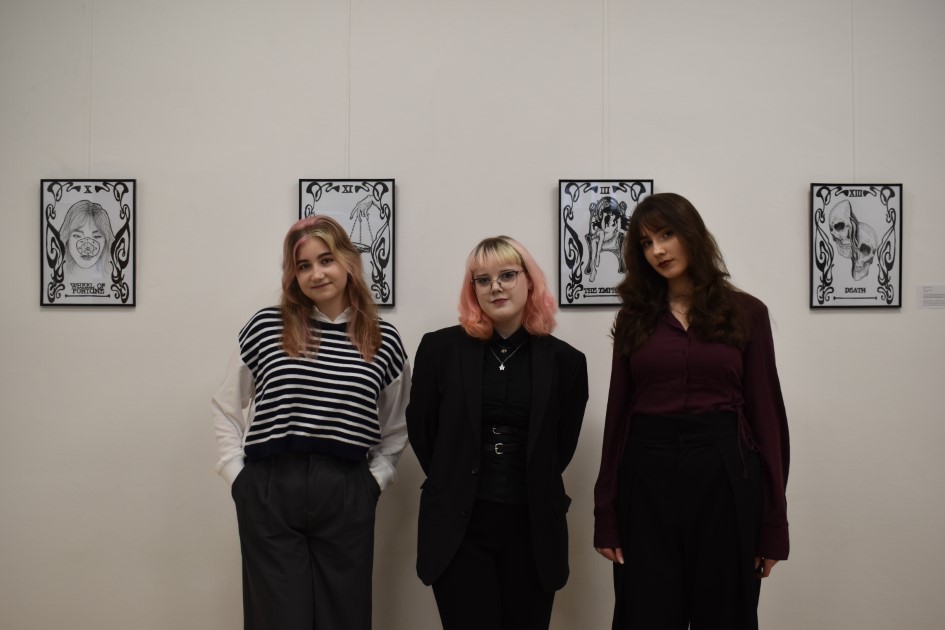
As part of the Honors Program at the Zagreb campus, freshman New Media Design students Paola Ivanic, Robertina Krupa, and Helena Topić presented Respice, Adspice, Prospice, an exhibition exploring identity, emotion, perception, and uncertainty through a variety of artistic media. Developed within the Honors Program for Drawing II under the mentorship of Instructor Stefanie Hudspeth, the exhibition encouraged students to push beyond traditional approaches to drawing and explore more personal, conceptual forms of artistic expression.
Although the program is built around the Drawing II course, students were given the freedom to experiment with sculpture, installation, symbolism, and immersive presentation techniques. “I give them the freedom to think outside the box,” Instructor Hudspeth explained. “Whether it’s using more 3D media such as sculpture and installation or even expanded artistic forms such as video art, I am thrilled to see when a student takes an idea and pushes it more.”
Three different perspectives, one connected exhibition
While each student developed a distinct concept and visual language, their works naturally connected through themes tied to the past, present, and future, reflected in the exhibition’s title Respice, Adspice, Prospice.
For Paola, the focus was on the discomfort of being perceived and observed in public spaces. Through a combination of drawings and installation work, she explored emotions she had previously addressed through art during high school, particularly fear and discomfort. “I wanted to express that uncomfortable feeling of being looked at,” she shared. “I think most people relate to the feeling of being perceived and watched while in public spaces, and that’s what I wanted to convey.” Her work evolved from sketches into a larger installation featuring additional drawings, layered visual elements, and ambient sound. Paola credits the mentorship process for encouraging her to expand the concept further. “Our mentor really helped me continue exploring my topic and encouraged me to do the installation,” she said.
Robertina approached the exhibition through symbolism inspired by tarot cards and the uncertainty of the future. While initially focused on decorative visual elements, her project gradually shifted toward emotional storytelling and meaning. “The project became less about recreating tarot cards and more about using them to explore uncertainty and the unknown future,” she explained. Throughout the process, Robertina especially enjoyed seeing how different artistic styles could still form a cohesive exhibition experience. “Working in this environment was inspiring because we were all constantly giving each other ideas and feedback while developing our projects,” she shared.
For Helena, the exhibition became an exploration of identity and the feeling of constantly adapting to different environments and expectations. Her work focused on the emotional tension between authenticity and change, visualized through imagery of masks, stitching, and fragmented identities. “I used to feel shame for not being authentically myself all the time,” Helena explained. “This is the feeling I wanted to show in my work.” As a freshman student, exhibiting publicly for the first time was both exciting and overwhelming. “I can only describe it as surreal,” she said. “That nervousness slowly turned to joy as the opening night went on.”
A process built on experimentation and dialogue
The exhibition process extended far beyond creating finished artworks. Students spent months researching, sketching, revising ideas, working on presentation details, and collaborating with the gallery space on installation, catalogue production, and artist statements. “There is so much that goes on behind the scenes,” Hudspeth explained. “Research, brainstorming, sketching, and reading are a rinse and repeat process until a solid body of work is formed.” Over time, the mentorship itself evolved into a more collaborative exchange of ideas.
Beyond technical skills, the experience encouraged students to trust their own artistic instincts and develop confidence in their creative voice. Helena reflected that the exhibition helped her appreciate the small details that shape her personal style as an artist, while Paola emphasized the importance of originality and pushing beyond comfort zones. Robertina, meanwhile, discovered an interest in combining symbolism, storytelling, and emotion through visual design.
For Hudspeth, the Honors Program reflects the importance of consistency and curiosity in creative work. “Creative expression is a muscle,” she said. “You make it grow every day through consistency, determination, and most importantly, passion.”