From Neurons to Next Steps: RIT’s First Neuroscience BS Graduates
RIT’s first neuroscience BS graduates reflect on research, mentorship, and what’s next as they pursue careers and graduate study.
Understanding the systems in our brains can help change the world. At RIT, that idea helped shape the undergraduate neuroscience program, co-delivered by the College of Science and the Department of Psychology in the College of Liberal Arts, and led by Dr. Elena Fedorovskaya, program head and research faculty in the College of Science. The RIT neuroscience program provides background knowledge of natural sciences and social sciences and teaches students to apply this foundation in fields such as artificial intelligence, healthcare, and human behavior.
This year marks a milestone for the program with its first graduates: Miranda Garvey, Ella Mahnke, and Katherine Shomper. All three scholars were recognized as Undergraduate Research Awardees for the College of Science this year, highlighting their academic excellence and research work in and out of the classroom. Each graduate shares a few highlights from their experience in the RIT neuroscience program, showcasing the independence, collaboration, and hands-on opportunities students get to lead projects and build skills throughout the program.

“I was able to build a research project from the ground up! I was trained and mentored to formulate a graduate-level research experiment with real participants, something most college undergraduates do not get to do.”
Miranda Garvey describes her experience as extending well beyond coursework. Through the program, she appreciated taking classes from experts in the field and making connections with major institutions outside of RIT that she hopes to work for someday.
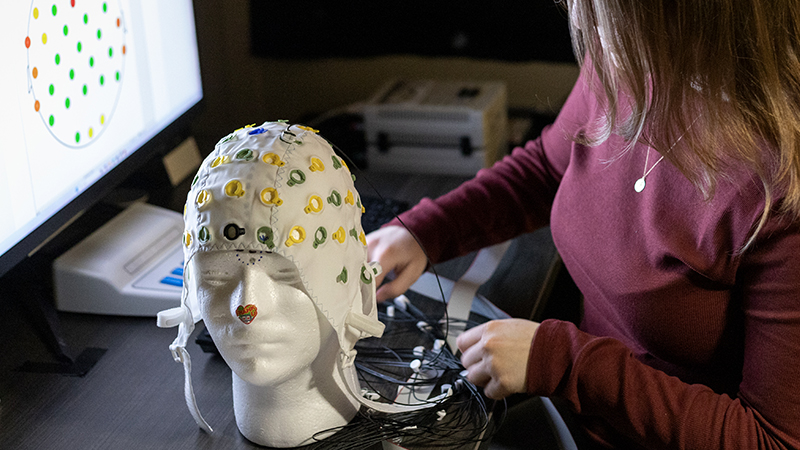
Her biggest highlight was the depth of her research training that prepared her for graduate level work. “I will be leaving RIT with the skills to write grant proposals, submit IRB forms, run EEG experiments on human subjects, analyze brain wave data, and present my findings at national conferences.”
Having direct access to faculty mentors throughout her studies was a key part of the experience. “At RIT, I have been able to learn from individuals who have worked in the field for many years and adjust my practices based on their guidance. Here, I was never just a number. I was someone.”
Miranda is currently applying to full-time research assistant roles in neuroscience labs as she prepares for MD-Ph.D. programs in the coming years. She encourages future students to stay driven and stay curious, and to trust the passion that led them to neuroscience. At RIT, that passion is supported through opportunities to explore, grow, and have fun learning along the way.
“What has really stood out to me during my time in RIT neuroscience was feeling supported while also having a lot of independence. Students don’t just assist on projects, they have the opportunity to take ownership of it.”
For Ella Mahnke, that flexibility shaped her experience. Students can pursue their interests, while building close connections with peers and mentors along the way. Ella also notes the close knit feel of a small program within a larger university as a standout feature of the program.
The highlight of the program for Ella was the level of ownership students have in their work. Neuroscience students are able to take the lead on projects in a way that is not typical at the undergraduate-level, giving them the space to explore different fields and develop their own direction over time.
After graduation, Ella plans to pursue an industry research position before applying to Ph.D. programs. Looking back, her advice is to stay open and trust the process. “I had no clue what my career plans were when I came to RIT and everything fell into place over time. Just have faith in yourself.”
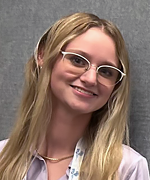
“I enjoyed how passionate everyone I have met is about what they study. It is very inspiring to work alongside people who share the same love as I do for our field.”
Katherine Shomper points to mentorship and collaboration as defining parts of her time in the program. Working with faculty mentor Dr. Rebecca Houston, she developed her research skills, presented at conferences, and was encouraged to try new things outside of her comfort zone. She credits that experience with helping her grow and is proud of what she was able to accomplish during her time at RIT.
She also valued the program’s size and structure, which allowed her to interact with faculty and students across different disciplines. Being surrounded by passionate, driven, and creative peers was encouraging and inspiring, and made a strong impact on her experience.
Katherine plans to spend a gap year working in research focused on mental disorders or psychiatric medication before applying to Ph.D. programs in neuropharmacology or a related field. Her advice to prospective students is to visit campus and attend an open house to get a sense of the community and hear directly from students about their experiences. She also emphasized the importance of speaking up and asking for help when you need it.
More Featured Profiles and Work
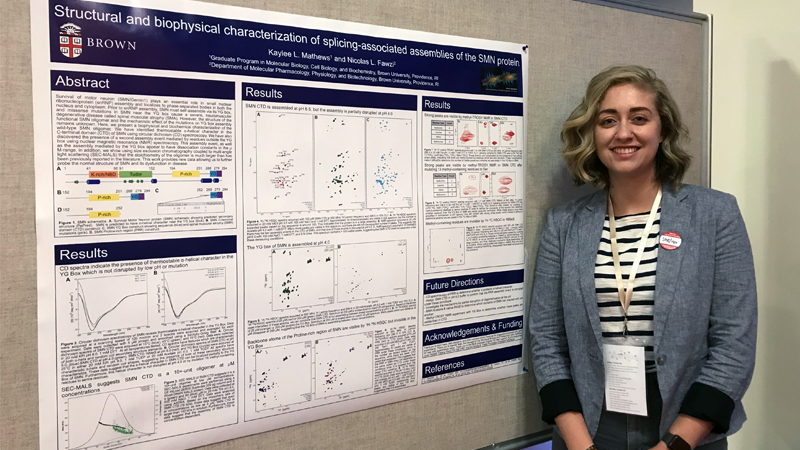
Kaylee Mathews ’16 (science exploration/biochemistry)