How a “Yes, But…” Idea Became a Breakthrough Product Line
A decade-long collaboration with the Center of Excellence in Advanced and Sustainable Manufacturing helped it grow
Mia Mueller
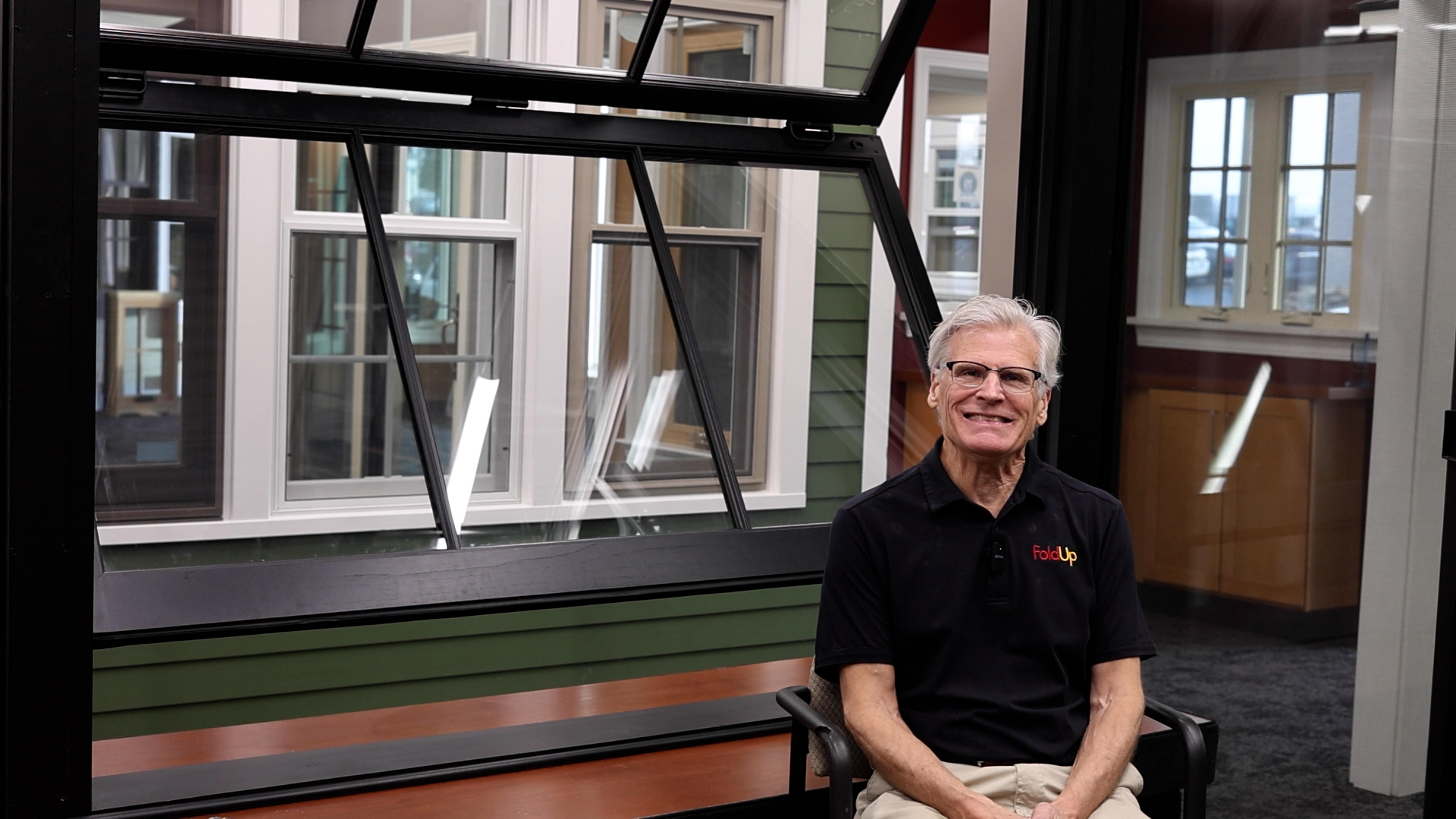
Tim Forster, division director of Luxury Brands at Rochester Colonial, credits RIT engineers with helping to bring the custom design into a successful product line.
WHAT YOU NEED TO KNOW
- Rochester Colonial has worked with RIT on multiple projects in the FoldUp™ window line, from product design and testing to shop floor organization.
- The Center of Excellence in Advanced and Sustainable Manufacturing (COE-ASM) began working with the company in 2014 to create a design configuration tool supporting this line.
- From 2014 onward, the new design, the FoldUp™ window, took off, gaining a larger customer base and later winning an architectural design award.
- From 2014-2024, as Rochester Colonial expanded the FoldUp™ line, the manufacturer worked continuously with COE-ASM to update and add capability to the design tool.
- As Rochester Colonial added capabilities such as new sizes, shapes, and materials, the employees collaborated with COE-ASM engineers to improve the product and evaluate the structural robustness of the design.
- In 2022, COE-ASM engineers analyzed shop-floor operations and then provided recommendations to improve raw material storage and streamline shop-floor processes and inventories.
- At each stage, RIT engineers added value by working closely with Rochester Colonial and anticipating their organizational and technical needs.
- COE-ASM engineers provided the expertise and testing capabilities as well as the responsiveness and open-minded feedback that Rochester Colonial needed while their product line grew.
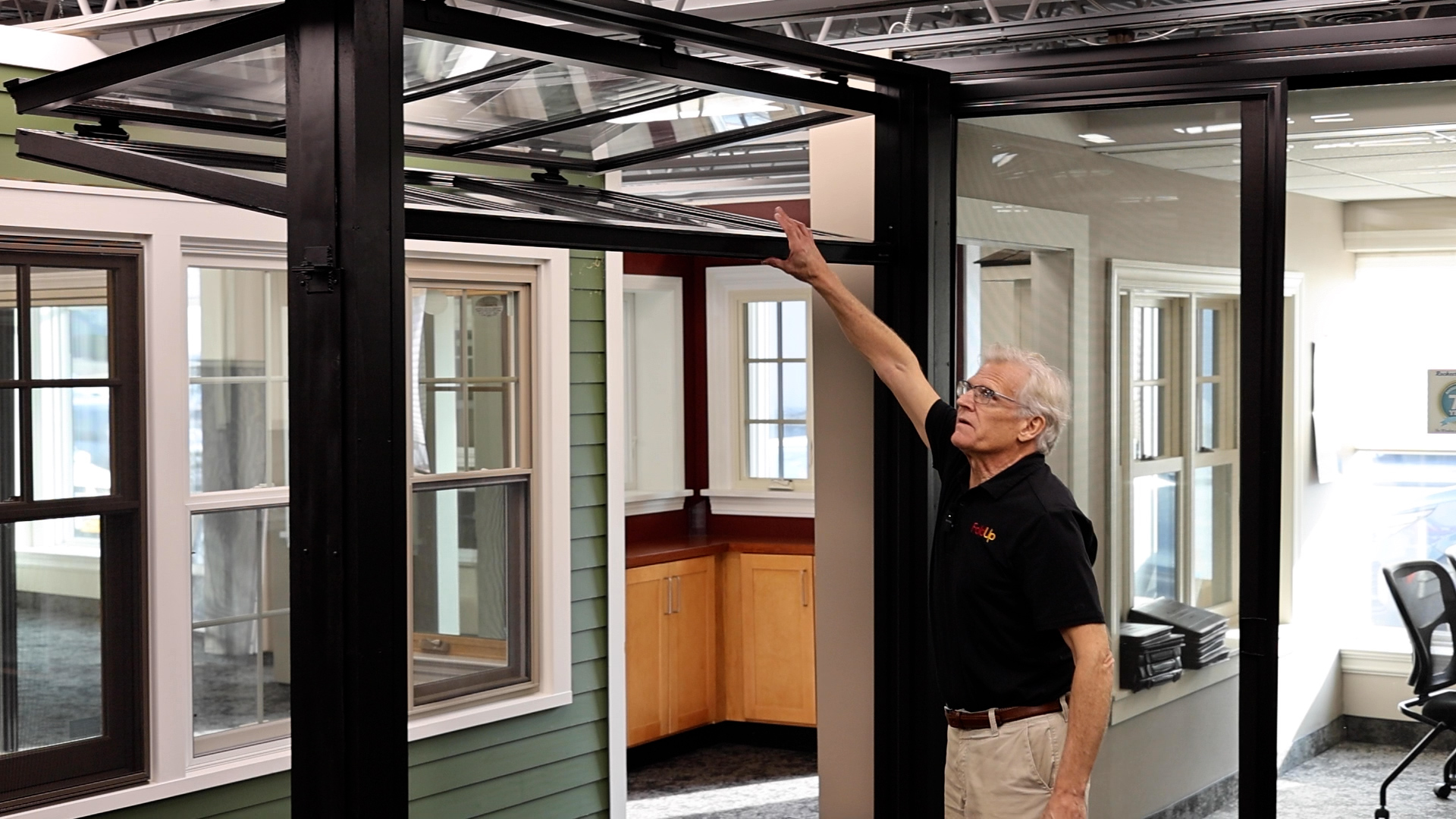
A window nearly the size of a wall glides up with ease and folds outward, accordion-style, opening a space large enough to walk through. We could be looking out on a swimming pool or the dining patio of a historic inn, but instead, we are on the humming shop floor of Rochester Colonial in Rochester, NY. Tim Forster, division director of Luxury Brands, is demonstrating a FoldUp™ 5000 series, seven feet wide and eight feet tall, and about two hundred pounds of glass and wood slide silently up or down with a light push of his hands. “There is virtually no friction, but you can stop it and it will stay at any point,” Forster tells us, adding,“Without RIT, we wouldn’t have been able to develop this.”
Over the course of a decade, a multifaceted collaboration between RIT and a hometown company nationally famous for its custom-window craftsmanship helped launch and expand the FoldUp™ line of windows. By continuously tailoring a technical design tool for a new product line, this partnership has paid dividends in long-term trust.
Paving the Way
Founded in 1947, Rochester Colonial had evolved over the decades from making storm windows, then aluminum windows and doors, to vinyl and wood windows.
This huge luxury window before us in the showroom was a product of what Forster calls the company’s unofficial motto: “Yes, but...” Famous for their custom and historical replica windows and doors, the company excels in special projects of high complexity or intricacy, and then often must modify structural and material requests as needed in order to make sound artisanal products.
A Winning Design Opportunity
The company was thriving, crafting luxury and architectural doors and windows. In 2012, a call came in from an architect working on a landmark historic building, the Sherwood Inn in Skaneateles, NY, “who asked us whether we could make a double-hung window that wouldn't open traditionally [one pane slides up in front of the other], but rather that would open in by folding up and down, to which we told him, ‘Yes, but...’, and we ended up working together with them on the project,” Forster says. Rochester Colonial made a custom set of oversized windows with a special spring and pulley apparatus, upgrading the inn’s signature enclosed porch dining room overlooking the lake. The window design enables maximum air flow and opens the indoors to the outdoors while retaining a screen and facilitating ease of cleaning.
Word soon got out about the historically accurate, highly functional new folding windows at the Sherwood Inn. “Within a very short period of time, we realized that we had something that people wanted,” says Forster. But a bigger decision was on the horizon. “We had to make a decision at that point, as a company that makes one-off custom items,” he explains. “To make a product the same way over and over again in a durable and repeatable fashion, we needed somebody who could help us understand how to do this right every time.” Building on a prior successful collaboration, they called RIT once more.
The Design Tool that Launched a Product Line
Michael Thurston, director of RIT’s Center of Excellence in Advanced and Sustainable Manufacturing (COE-ASM), and Allen Luccitti, senior engineer, took on the project in 2014. Luccitti put the problem into simple terms: Rochester Colonial “wanted to know what potential issues they could have if this became a commercial product offering, particularly what could fail, what could break, and what the user experience was going to be.” The COE-ASM team was perfectly positioned to answer these questions.
First, Thurston took the general requirements from Rochester Colonial and used engineering principles to model the mechanics and design how the tool would work. Then Luccitti, an RIT mechanical engineering graduate with industry experience in automotive parts and optics manufacturing, took on the project as a “puzzle, breaking it down and focusing on the individual pieces.” From an engineering and physics standpoint, Luccitti says, the team set out “to model the window and identify key points where the forces would be applied on the moving components and what the restrictions and limitations would be so that we could mitigate potential failures.”
Unlike most common operable windows in double-hung or casement styles, where forces on the sashes remain constant through their entire range of motion, the forces on FoldUp™ sashes continually change throughout every degree of operation. Taking into account these changing forces, the COE-ASM team studied the company’s Computer-Aided Design (CAD) drawings and all of their fabrication requirements and proposed a mathematical tool: a calculator based on geometry, physical forces, and material properties. They measured sash sizes and weights—along with applied force and friction and angles—to guide production. “The product has to be precise to move this smoothly; there can be no deviation,” said Forster. The guide helped Rochester Colonial launch the FoldUp™ as a line and sell distinctive windows at quantity.
The manufacturer began to develop new products in several sizes, which had different construction requirements because of a significant difference in weight. A second project in 2016 analyzed the system and components and updated the tool to accommodate design features. COE-ASM measured the window’s forces at every point of movement as well as the properties of all the materials. For example, an early model used a set of pins traveling along a plastic (high-density polyethylene) coupling that would sometimes break. COE-ASM identified geometry and material changes that solved this challenge. By testing components and materials in RIT labs and taking measurements on-site at Rochester Colonial, COE-ASM gathered definitive data and created a 2D kinematic modeling software application. Now known as the FoldUp™ Window Design Analysis Tool, it enables Rochester Colonial engineers and designers to rapidly assess and optimize window design options.
As part of the ongoing collaboration, another benefit emerged. The RIT team identified inefficiencies in inventory processes for raw materials and shop-floor material flows. A 2022 project investigated the manufacturing process in detail and provided recommendations to improve inventory management and shop-floor process layout. Implementation by Rochester Colonial employees yielded more efficient processes with greater production throughput.
As the tool helped to launch a robust business, it was a collaborative effort through and through. Rochester Colonial’s “Yes, but . . . ” customer interactions generated more questions, and the design tool often had the answers. When it didn’t, the COE-ASM team worked out solutions and upgraded the capability of the tool.
The back-and-forth relationship ultimately led to product improvements, preparation for successful testing and certification by a third party, and a design tool that enabled Rochester Colonial to deliver like-custom products with high quality on an efficient production schedule. The tool’s precision helps to save materials such as fine woods like mahogany, eastern white pine, and white oak used to make sashes. Most importantly for the manufacturer, Forster says, “we can say with confidence when plugging all the information into the model, ‘yes, we can’ or ‘no, we can’t’” to the customers and find alternatives for them. “And that information is invaluable. Saves us just tons of time and gives us peace of mind.”
Growing Panes
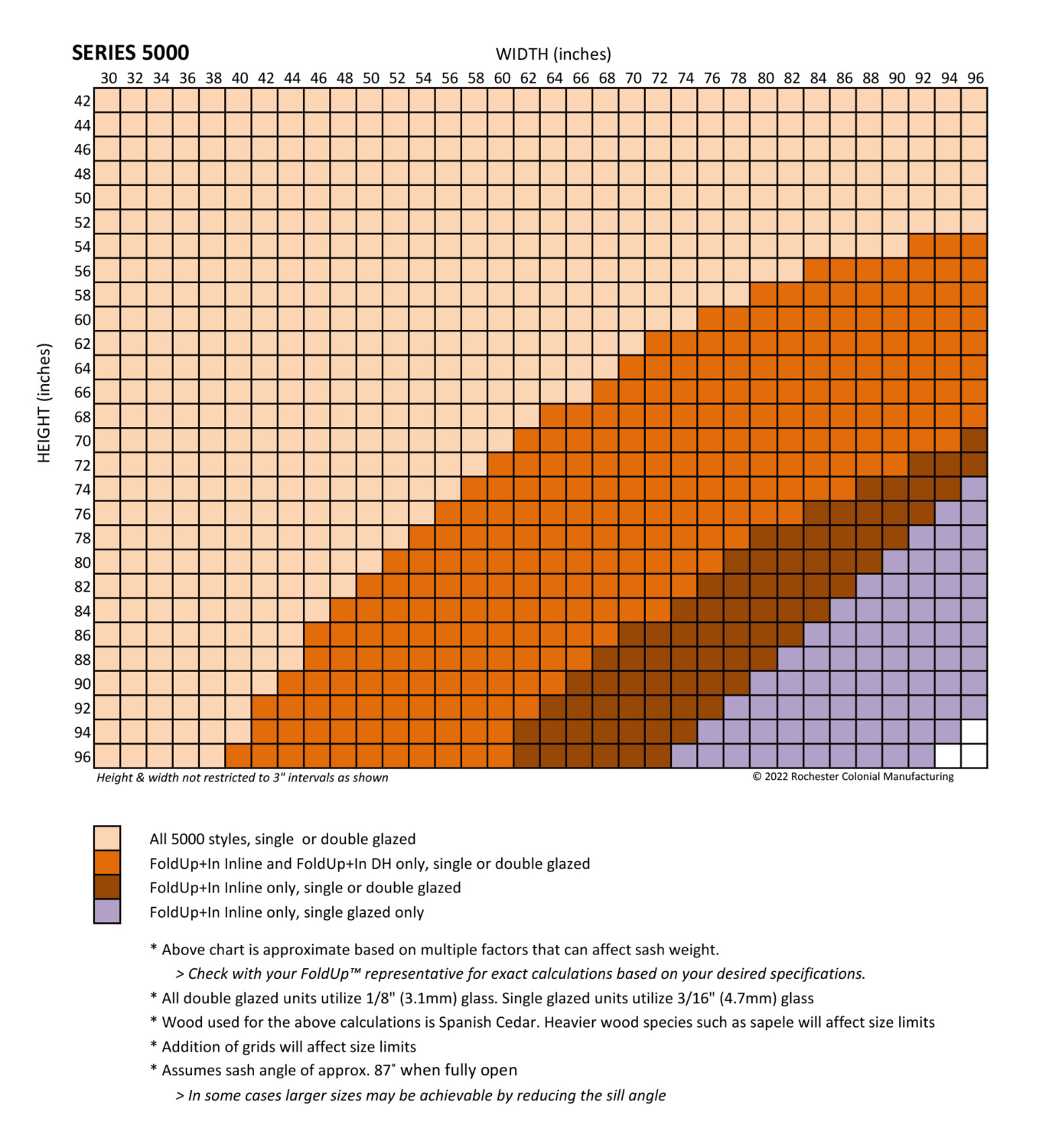
The FoldUp™ line took off, with orders coming in from across the US for residential and commercial use. It was added to Rochester Colonial’s Heartwood Fine Windows and Doors architectural collection and won the Architizer A+ Awards in the Building Products/Window category. The design tool was indispensable in expanding the FoldUp™ line, enabling it to grow into several series. From the original 3000 series, the double-hung design that folds up and inward, it expanded to the larger 4000 and top-of-line 5000 series. These windows are available as in-line designs, in which the top and bottom panes align in the same plane, and have added options to fold either up and inward or outward. Back in the shop, Tim Forster is gently lifting a massive eight- by seven-foot window up its smooth track, marveling, “This is several hundred pounds!” In designing the FoldUp™ line, it was equally important to the company to combine ease of use with materials that continually improved in heat and light ratings and soundproofing.
As the market grew and new requirements came in, the larger sizes required different materials and components, presenting a new challenge. Forster explains, “as we've gotten larger, things have gotten a little trickier. And in 2024, we actually had Allen come back and work on updating the model. Our design had evolved in several different directions.” In particular, the larger windows requested by customers would require heavier-duty designs and materials that were not included in the design tool.
Allen Luccitti and his team got right to work. In this eight-month collaboration, the COE-ASM team measured the weights of individual sash components at various stages of assembly and the new sash geometries. They directly implemented the new design features driven by Rochester Colonial customer requirements into the design tool.
The two-part collaboration over the course of a decade enabled the product line to expand and meet customer demand. Rochester Colonial’s bottom line saw “an initial increase in sales of 469% over a 4-year time period,” according to Forster. The tool is so valuable, it’s used by every salesperson in meetings with customers. It has allowed improving and upgrading the design and diversifying products they offer customers, like the 3-wide architectural rhythm popular in aging New England homes offered in a look-alike single FoldUp™ unit.
The long-term collaboration has been mutually beneficial, allowing COE-ASM to broaden its expertise into the details of low-volume manufacturing of wooden window products. “Even after a project is completed, Tim will reach out to let us know about interesting jobs the tool aided them in completing or seeking advice on how to approach new window design configurations,” Luccitti says. And Forster emphasizes the ease of ongoing work with the RIT team: “The partnership with RIT has been unbelievably good. If we have a question or a small wrinkle, we can call and Allen is on it. They provide ongoing technical support. It’s unheard of, frankly.”
Partners in Pride
Trust is crucial to businesses and equally important in the long-term partnership between Rochester Colonial and RIT. “For me personally, I take pride in knowing the work we did with the design tool has enabled Rochester Colonial to expand their business and confidently build windows that meet their high quality and performance requirements. I think this shows in our continued relationship over the years and multiple projects, and the confidence they have in COE-ASM,” says Luccitti. For Forster, “the biggest benefit of working with COE-ASM has been the ability to feel that we’re putting together a product that’s safe and repeatable. They’ve just made it easy. If we have a question, we don’t have to go through a lot of rigmarole to get Allen on the phone.”
Today, FoldUp™ windows have been installed in 47 states, including Hawai’i. The company’s unofficial motto, “Yes, but . . . ” started a decades-long partnership with COE-ASM that has yielded a flexible, updatable design tool custom-fitted to the manufacturer of architectural windows. Along the way, the partnership yielded additional value from COE-ASM, including several rounds of product design improvement, assistance in preparing new models for certification, and improvement of manufacturing process efficiency. Businesses evolve, and RIT’s COE-ASM team met the company where and when it needed expert help. According to center director Michael Thurston, “we love working with forward-thinking companies like Rochester Colonial that are innovating and asking hard questions, and we’re very proud of the part that we have been able to play in their continued success.”
Learn more about the COE-ASM partnership with Rochester Colonial.
© 2026 Rochester Institute of Technology
This work was conducted by the Rochester Institute of Technology using funding provided by Empire State Development through NYSTAR to its Center of Excellence in Advanced and Sustainable Manufacturing (COE-ASM), as well as funds from Empire State Development as a New York State High Technology Matching Grant (HTMG). Any opinions, findings, conclusions, or recommendations expressed herein are those of the author(s) and are the responsibility of Rochester Institute of Technology. They do not necessarily represent the official views of New York State, Empire State Development, NYSTAR, or any federal agency.

