Opening of new Research Building will position RIT at the ‘forefront of discovery’
Nineteen state-of-the-art labs will advance research in cognitive science, artificial intelligence, advanced manufacturing, and more
Traci Westcott/RIT
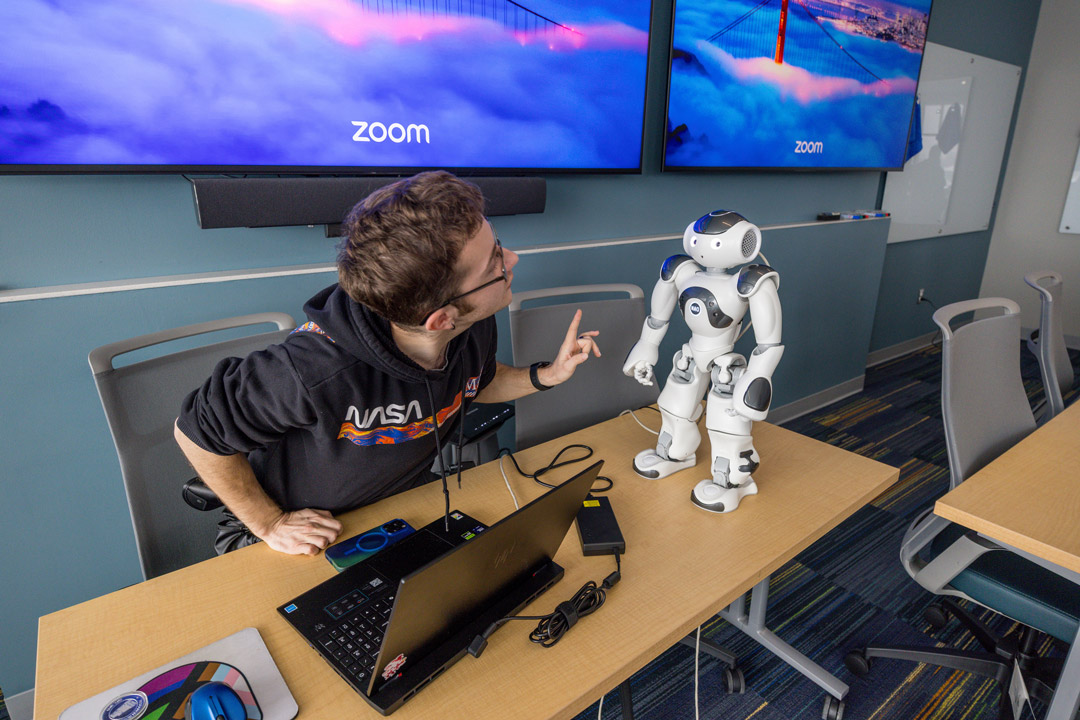
Victor Lockwood, an artificial intelligence master’s degree student, demonstrates the face-tracking capabilities of a robot during the RIT Research Building grand opening on Dec. 2.
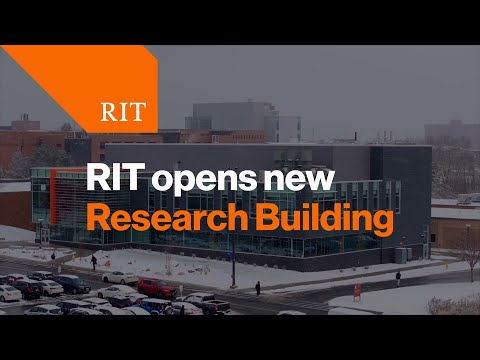
RIT’s new Research Building officially opened its doors Dec. 2, and inside, faculty and students are gearing up to usher in a new era of discovery on campus.
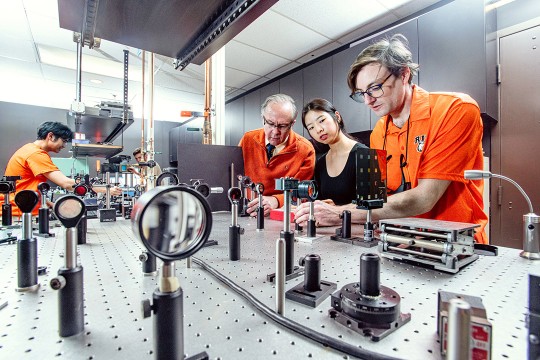
In one state-of-the-art lab, NTID Professor Matt Dye, director of RIT’s cognitive science Ph.D. program, and a multidisciplinary team of cognitive scientists will examine the human brain and how it allows people to learn, reason, speak multiple languages, and recall moments from decades past—capabilities far beyond what even the most powerful AI systems can achieve.
Traci Westcott/RIT
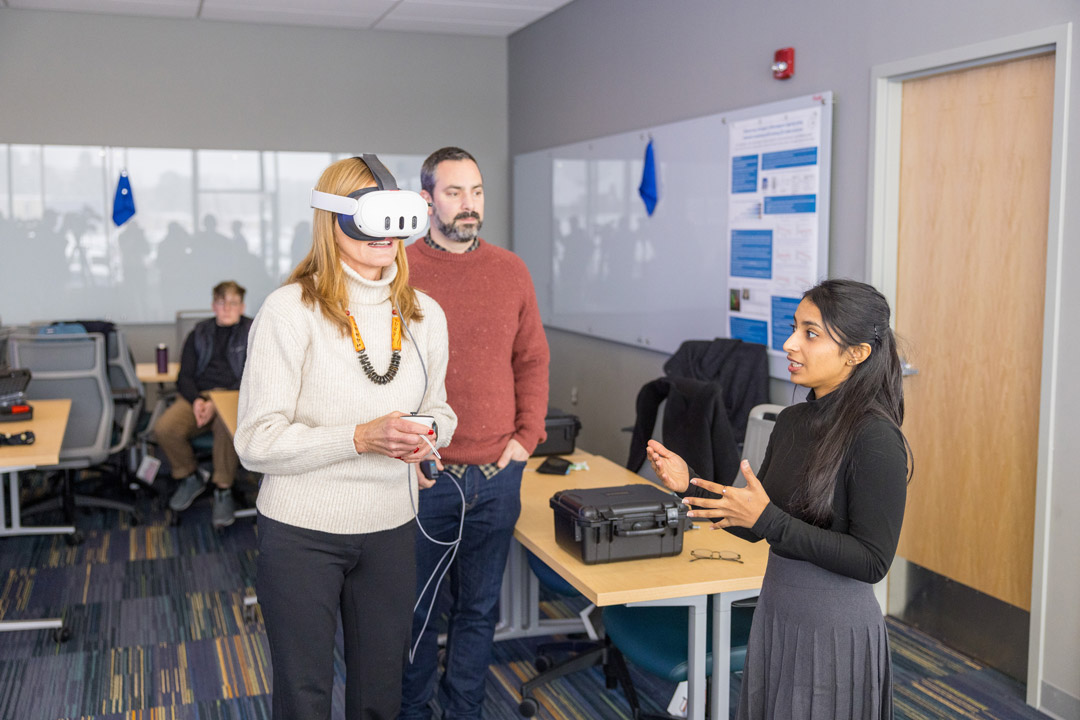
Imaging science Ph.D. student Triya Belani, right, is dedicating her research to exploring stereo vision, the human brain’s ability to perceive depth and the third dimension by merging two slightly different images from each eye. “What I love about RIT is the spirit of collaboration and the unique opportunity to do interdisciplinary research,” she said.
The cognitive science lab is one of 19 in the 39,000-square-foot building that will be filled with the tools—and a collection of researchers and scientists from across the university—to enhance RIT’s position as a leading research university.
“This building reflects RIT’s commitment to giving our faculty, staff, and students what they need to push boundaries, pursue bold ideas, and make an impact in the world,” said RIT President Bill Sanders. “In many ways, the RIT Research Building represents the next step in our journey, from a university known for innovation in teaching and technology, to one equally recognized for research that changes lives and moves the world forward.”
According to RIT Vice President for Research Ryne Raffaelle, research awards as well as national funding sources for economic development have increased to record levels at the university, prompting the need for more research laboratory space on campus. With the renovation of Brown Hall, freed-up spaces as a result of the SHED, and the construction of the new Research Building, 55 new labs and nearly 60,000 square feet of additional research space were created in just three years.
The labs in the new building are reconfigurable, designed to accommodate a wide spectrum of research, including in the areas of high-speed computing, artificial intelligence, wet chemistry, cognitive science, advanced manufacturing, neuroscience, and more. The spaces will also support new programs and enable the strategic recruitment of faculty researchers across disciplines.
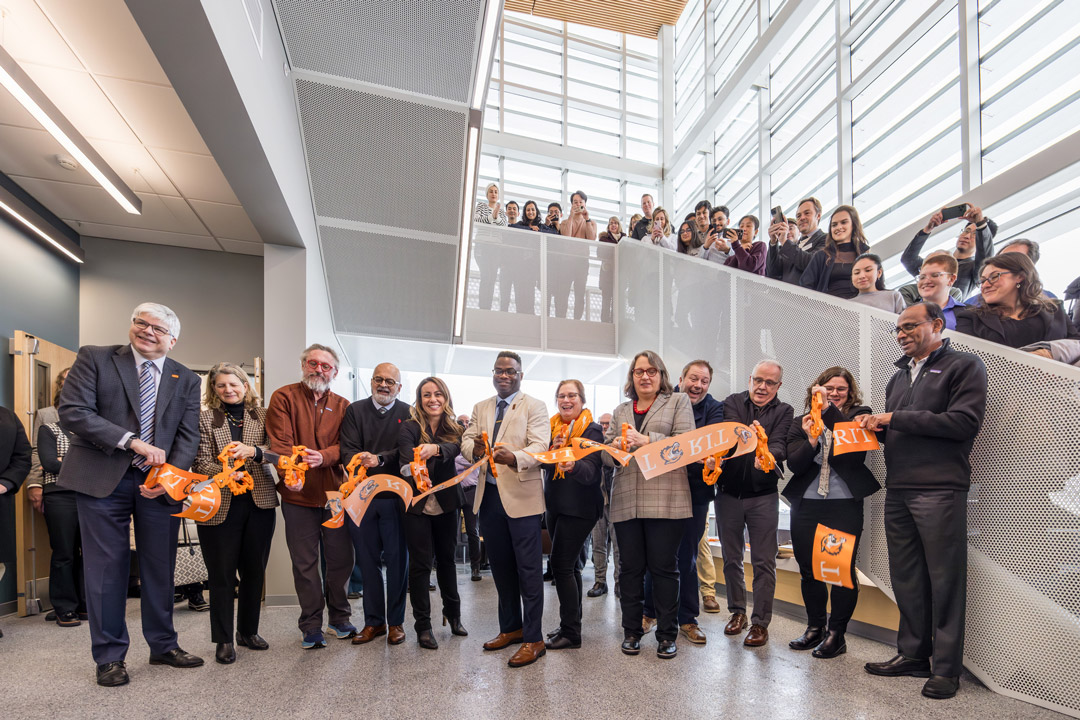
Traci Westcott/RIT
RIT’s new research building officially opened Dec. 2. Celebrating the opening, from left to right, are RIT President Bill Sanders; Jacqueline Mozrall, dean of Saunders College of Business; James Hall, dean of School of Individualized Study; Neeraj Buch, dean of Undergraduate Studies and associate provost for Student Success; Kelly Martin, dean of College of Liberal Arts, Andre Hudson, dean of College of Science; Diane Slusarski, dean of RIT Graduate School; Doreen Edwards, dean of Kate Gleason College of Engineering; Matt Huenerfauth, dean of Golisano College of Computing and Information Sciences; Gary Behm, interim dean of NTID; Caroline Solomon, president of NTID; and Prabu David, provost and senior vice president for Academic Affairs.
The cognitive science lab, directed by Dye, will be outfitted with an electroencephalogram to measure brain activity, eye tracking technology to reveal how people think and reason using vision, and augmented reality and virtual reality devices. He is looking forward to using the lab to create an environment that is diverse, welcoming, accessible, and a place where students can bring their questions, find answers, and thrive.
“The creation of these labs on the RIT campus allows us to train deaf and hard-of-hearing students in cutting-edge research facilities within a fully accessible environment. That’s something no other university in the world can match,” said Dye.
Upstairs from Dye, Steven Weinstein, the Harvey J. Palmer Professor in Chemical Engineering, will be working with his research team to revolutionize the design, creation, and testing of two-dimensional polymers with molecular structures that enable incredible stiffness and strength, low density, and a network of nanometer-scale pores that make them ideal for battery applications and filtration. These unique material characteristics will enable transformative changes to industries including environmental, energy, chemical, pharmaceutical, and structural engineering.
Weinstein’s lab will house a state-of-the-art machine to continuously create long and wide sheets of 2D-polymer films under controlled environmental conditions. The machine is scalable to larger and faster industrial machines, so the lab will allow companies to develop and prototype a wide range of 2D- polymer materials suitable for manufacturing. An adjoining wet lab will allow for novel materials to be formulated, created, and studied on the benchtop prior to implementation on the adjacent machine.
“To my knowledge, RIT is the only place in the world with the expertise, equipment, and facilities to enable industry partners to translate novel benchtop 2D-polymer films to commercially viable scales,” said Weinstein. “Our space in the Research Building will showcase RIT’s expertise and background in this new and emerging field.”
Raffaelle said the building solidifies RIT’s commitment to innovation, collaboration, and the pursuit of knowledge.
“It reflects the vision and hard work of many and embodies our shared belief that research and discovery are central to our mission as a university,” he said. “May this building stand as a beacon of innovation, collaboration, and excellence for years to come.”
Opening of new Research Building