University launches multidisciplinary training program to strengthen the U.S. semiconductor workforce
NSF-funded training program equips graduate students with broader experiences in semiconductor technologies
Scott Hamilton RIT/Photography
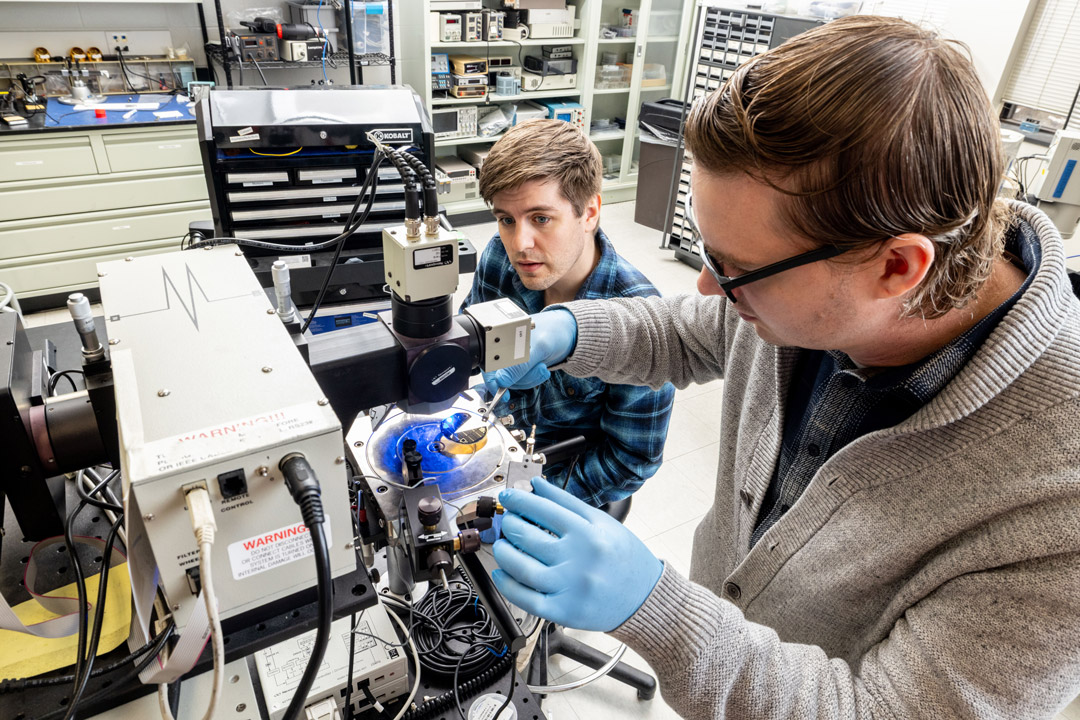
Microsystems engineering doctoral students, Jacob Boisvere (foreground) and Elijah Sacchitella (back) work in the NanoPower Research Lab testing photovoltaic cells. They are part of the first cohort of students in the new NSF-funded CMOS+X traineeship.
Graduate students like Elijah Sacchitella recognize the need to supercharge their doctoral training to get an edge on the competition in the semiconductor field.
To meet this need, RIT launched CMOS+X, a National Science Foundation Research Traineeship (NRT) program that prepares future STEM leaders like Sacchitella to pursue their specialized research and to supplement it with professional skills training—interdisciplinary collaboration, scientific writing, strategic communication, and project management skills—areas not often included in traditional doctoral programs.
Sacchitella, a microsystems engineering doctoral student, is in the first cohort of RIT’s Convergent Graduate Program in CMOS+X Semiconductor Technologies (CMOS+X). Program flexibility allows trainees to perform interdisciplinary research in semiconductor material innovations; micro- and nanoelectronics; optoelectronics and photonics; and integrated circuits, systems and packaging.
The goal is to give students broader experiences in semiconductor technologies at the same time they are focusing on their central research.
“We wanted CMOS+X to be something that is different from a traditional Ph. D. program in that we are embedding more interdisciplinary aspects into it and providing more professional training activities,” said Jing Zhang, principal investigator and director of the program.
One of the NSF’s most competitive initiatives, NRT programs prepare students in areas of national importance, align with workforce needs to fill a domestic workforce shortage, and encourage contemporary research. CMOS+X complements RIT’s established engineering and science doctoral and master’s degrees.
Currently, there are seven funded doctoral students in the new cohort. Joined by a dozen graduate students from RIT’s science and engineering colleges, all participants can access multidisciplinary research and training coursework, tour RIT labs and centers where semiconductor chips are produced, and they are provided funding support for travel to professional conferences. They meet regularly to discuss new journal papers about cutting-edge research topics, and attend seminars to learn more about strategic communications skills, project management, and other professional skills.
These professional offerings are reasons Sacchitella became part of the NRT program. He researches III-V material growth and device design, specifically for space-based photovoltaics. Some of the more detailed work is in substrate reuse to lower terrestrial photovoltaic cost, using nano structures—quantum wells—to enhance performance in space. Another area is on devices that convert lasers into electrical power.
“This program can help build a lot of the soft skills that may not be thought about when you are in the trenches of scientific research,” said Sacchitella.
Professor Seth Hubbard, his adviser and co-director of RIT’s CMOS+X NRT program agreed. “With typical Ph.D. research, you are into one topic with a set project and you pretty much work on that throughout your program. We try to offer these benefits and an educational climate where we are graduating Ph.D.’s with direct knowledge across all aspects of microelectronics materials and devices.”
In microelectronic engineering, CMOS is the common term for complementary metal-oxide semiconductors and refers to the technology needed to create high performance electronic circuits. As one of the specialty areas at RIT, it is integral to the chip development academic curriculum at RIT and within industry manufacturing processes.
With a huge demand from industry as the U.S. seeks to reshore semiconductor manufacturing capabilities, companies such as Intel and Micron are building huge-scale manufacturing and research facilities across the country.
“All semiconductor manufacturing plants need millions for the workforce to support operations, expertise from all levels—from technicians and engineers to scientists—to make it happen,” said Zhang, associate professor in RIT’s Kate Gleason College of Engineering. “Where are those people coming from? Our CMOS+X program is timely and very needed to support those fast-expanding semiconductor industries.”