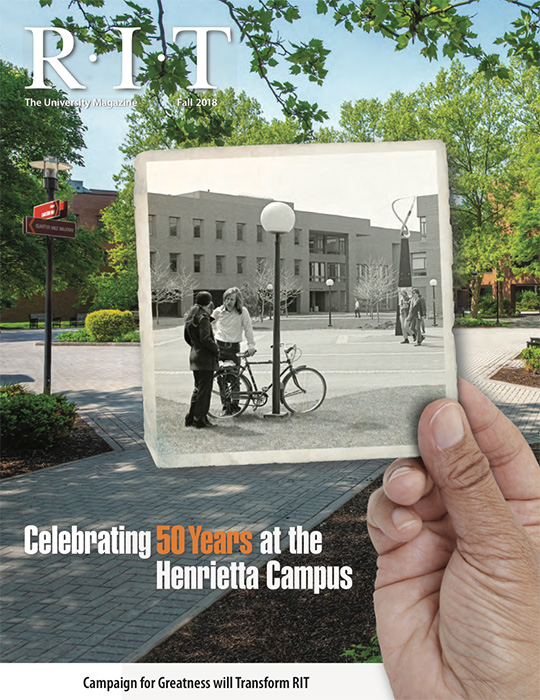
A campus
on the move
A tour of campus quickly
reveals that RIT is a thriving, dynamic, diverse, burgeoning community.
New buildings. Construction. Busy classrooms and labs. Clusters
of students working hard or perhaps working a little recreation
into their crammed lives.
 |
Kate
Gleason College of Engineering
Early rendering of proposed wrap-around addition. |
RIT enrollment reached
15,312 for the current academic year, up 25 percent since fall
of 1994. Full-time undergraduate and graduate enrollment reached
an all-time high with 12,110 in fall 2002, with the quality of
students rising at the same time. This year average SAT scores
for incoming students hit 1210.
At the same time, the
university is becoming more diverse. The total number of African
American, Hispanic American and Native American students is about
1,131, up 33 percent since 1994.
Of total freshman this
year, 50 percent were from out of New York state, 4.5 percent
were from other countries, and 10 percent were African American,
Hispanic or Native American.
There continues
to be a growing demand for what RIT offers, says James G.
Miller, vice president, enrollment management and career services.
Responding to the ever-changing needs of the technological workplace,
RIT continues to add new programs that, in turn, attract more
students. RITs breadth of programs is very attractive
to many college-bound students, notes Miller.
 |
College
of Applied Science and Technology
Illustration of a proposed facility to house engineering technology
programs. |
Growth has certain
advantages, but providing for more students also poses challenges.
The RIT administration and board of trustees have given the subject
a great deal of study and determined an optimal size of 17,000
students. Enrollment growth will be controlled so that the
enrollment level will be achieved by 2009-2010, with most of it
occurring by 2005-2006, says President Albert Simone.
Achieving an optimal,
pre-determined enrollment allows for greatest efficiency in managing
resources, says Miller. It allows us to be proactive rather
than reactive. You can do a lot more with a deliberate, planned
growth strategy.
Academically, growth
means more options for students, says Provost Stanley McKenzie.
A greater variety of programs is possible, and particular classes
can be offered more frequently. The faculty becomes larger, meaning
that there can be more diversity in terms of expertise.
As we grow, we
become better known, and we attract more students and better
students, notes McKenzie. On the down side, you have
to make sure the human resources are in line. Were working
very hard to be proactive.
 |
College
of Business
A new wing added to the Lowenthal Building would
accommodate executive education programs. |
RIT also works hard
to provide the facilities needed for students and for a growing
effort in applied research. In the past five years, several major
buildings have opened, including a new wing for the Gosnell Building
housing the College of Science, a complete renovation and expansion
of the Gleason Building housing the Kate Gleason College of Engineering,
the Laboratory for Applied Computing and the new building for
the B. Thomas Golisano College of Computing and Information Sciences.
The university plans to construct facilities for the new Center
for Biotechnology Education and Training (part of the College
of Science), engineering technology (College of Applied Science
and Technology), executive education (College of Business), film
and animation (College of Imaging Arts and Sciences) and other
programs.
The needs are not solely
driven by expanding enrollment. As a technical university, labs,
equipment and related academic facilities need to be continually
upgraded even if there is no growth, notes Miller.
RIT is a little unusual
from other universities in that most of the buildings date to
a single year, 1968, when the current campus opened. The infrastructure
has reached the age where many components heating, roofs,
and plumbing, for example are at the end of their life
cycle.
As we do needed
renovation, were building in a new standard of quality,
says James Watters, vice president, finance and administration.
One of the most significant
projects already completed was a five-year, $65 million renovation
of residence halls.
 |
School
for American Crafts
The School for American Crafts needs enhanced workspace for
glass, metal and ceramics programs. |
RIT also constructed
six handsome fraternity and sorority houses and completed the
University Commons apartment complex, adding important options
for on-campus housing. All residences and academic buildings have
been wired for Internet access.
As we continue
to grow we need to pay close attention to housing and the need
for more social gathering locations, says Student Government
President Erick Littleford, a fourth-year public policy major.
The new field house (now under construction) will allow
our clubs and organizations to sponsor larger events for the campus
population. This facility plus smaller study and social
lounges that have been and will be created in academic buildings
can truly aid in the continual building of community among
the students as the numbers increase.
Over the past decade,
notes Watters, RIT has evolved from an institute primarily serving
local and regional students to a major university with a growing
national and international reputation.
If were
going to be competitive at that level, Watters says, the
needs are far beyond what they once were. Our mission is to ensure
that the physical aspects of our campus are up to the quality
of our academic programs.