RIT
history:
Times to remember
RIT’s first 175 years are filled with
milestones. Here are some of the highlights, as well as a few
key events in world history.
 |
1885
Carved in stone
The capstone is from the Eastman Annex, one of the earliest
buildings of Mechanics Institute. |
1829 Col. Nathaniel Rochester and other Rochester community leaders
found the Rochester Athenaeum “for the purpose of cultivating
and promoting literature, science and the arts.” The Athenaeum
becomes a popular center for lectures and debates.
1844 Samuel
Morse sends a “telegraph” message a
distance of some 40 miles. The telegraph and Morse Code are the
world’s first long distance, instant communication system.
1847 The Athenaeum merges with the Mechanics Literary Association,
founded in 1836, to form the Rochester Athenaeum and Mechanics
Association. The libraries of the two groups boast a collection
of 7,000-8,000 volumes on a variety of subjects. Speakers include
Charles Dickens, Ralph Waldo Emerson, Oliver Wendell Holmes,
and Frederick Douglass.
 |
| The “MI” insignia also appeared on athletic
letters. |
1861 – 1865 The Civil War is fought.
1876 Alexander Graham Bell demonstrates the telephone.
1877 Thomas Edison makes the first audio recording.
1881 George Eastman founds the Eastman Dry Plate Co., later
to become Eastman Kodak Co.
1885 Mechanics Institute is founded. Ezra Andrews, Henry Lomb,
Max Lowenthal, William Peck, Frank Ritter and other businessmen
and citizens start the school to provide technical training for
workers. Lomb, first president of the board of trustees, guides
the direction of the institute until his death in 1908.
1891 Rochester Athenaeum and Mechanics Institute merge, combining
cultural education and practical technical training. Enrollment
reaches 1,000 students.
 |
1891
Getting together
The Rochester Athenaeum and Mechanics Institute merged in
1891, combining cultural activities and technical training. |
1894 Manual Training Building, later known as Eastman Annex,
is the first building erected by the institute. The building
contains machine shops, classrooms and a lecture hall.
1895 Guglielmo Marconi succeeds in transmitting a wireless signal
a distance of about 1.2 miles.
1903 Enrollment reaches 3,000. The school divides into five
departments:
Industrial arts – Eugene Colby, superintendent
Mechanic arts and sciences (language, mathematics, science) – Roland
Woodward, superintendent
Manual training – Board members James E. Gleason, Frank
A. Brownell and Henry Lomb supervise
Domestic science and art – Mary Bliss, superintendent
Department of fine arts – directed by Bevier Memorial Committee
made up of Adelbert Cronise, Dr. E.V. Stoddard, Harold C. Kimball,
Lewis P. Ross, Charles H. Wiltsie
Orville and Wilbur Wright successfully
test the world’s first airplane.
1905 Henry Ford founds the Ford Motor Co.
 |
1910
Leading man
The institute’s first president, Carleton B. Gibson,
served for six years. |
1909 First student publication, The
Institute Breeze, is published,
featuring a cover design and drawings by students in the fine
arts department.
1910 The first president, Carleton B. Gibson, is appointed.
He will serve until 1916.
1912 A cooperative education program is launched by President
Gibson, giving students practical experience before they graduate.
Students work in stores, factories, restaurants and hospital
kitchens.
An alumni association forms.
Publication of Ramikin, the student
yearbook, begins.
1914 War breaks out in Europe. World War I continues to 1918.
1916 James F. Barker is appointed president. He serves until
1919.
 |
1912
Student views
The institute’s early yearbook was called “RAMIKIN,” combining
the initials of Rochester Athenaeum and Mechanics Institute. |
1919 Royal B. Farnum becomes president. He serves until 1921.
1922 John A. Randall becomes president. He serves until 1936.
1923 A four-year cooperative retail distribution program begins.
1928 Canadian physician Alexander Fleming discovers that penicillium
mold destroys colonies of bacteria, providing the basis for the
development of antibiotic medicines.
1930 The department of photography is founded.
1936 Wrestling coach and professor Mark Ellingson becomes president.
He will serve until 1969.
1937 Chester
F. Carlson invents an electrostatic copying process that
he names “Xerography.”
Empire State School of Printing, the forerunner of RIT’s
School of Print Media, is acquired through the efforts of newspaper
publisher Frank Gannett.
 |
1930
In focus
The first class in photography was taught in 1903, and the
photography department was founded in 1930. These are the
first graduates. |
1939 – 1945 World War II is fought.
1940 Classes are offered all day and all night to train thousands
for jobs in the defense industry. Enrollment totals 4,565.
1942 The institute’s evening school opens to women to
assist in war effort. A counseling center opens to provide personal
and career counseling to students.
1944 The institute adopts the name Rochester Institute of Technology.
Congress
enacts the G.I. Bill of Rights (Servicemen’s Readjustment
Act), providing education benefits to veterans.
1947 Scientists at Bell Labs invent the transistor.
 |
1942
War years
Although the institute was co-ed from its earliest years,
World War II brought more women to campus. |
1950 With the establishment of the Graphic Arts Research Center,
RIT becomes a hub of research on all aspects of the graphic arts.
The
School for American Craftsmen, which was founded by Mrs. Vanderbilt
Webb, moves to RIT.
Student enrollment is 4,376. RIT becomes
the first technical school in New York state to offer an associate’s
degree in applied science.
1952 RIT acquires the McKechnie-Lunger School of Commerce in
Rochester, which later becomes the College of Business.
1955 The first bachelor of science degrees are awarded.
1957 The Soviet Union launches Sputnik I, marking the dawn of
the space age and the start of the space race between the U.S.
and the U.S.S.R.
 |
1950
The art of crafts
The institute’s long tradition of art and craft instruction
is boosted when the School for American Craftsmen moves to
RIT. |
1958 The first microchip is produced.
1960 RIT awards its first master’s degrees (all fine arts
degrees).
Student enrollment reaches 8,546.
1961 The board of trustees makes the decision to move from downtown
Rochester. Land south of the city in the Town of Henrietta is
purchased and construction begins in 1964.
1963 The College of Science is established. An award for excellence
in teaching is established. In 1974 the name is changed to the
Eisenhart Awards for Outstanding Teaching.
1963 President John F. Kennedy is assassinated.
 |
1966
The deaf are heard
With its selection as the site for the National Technical
Institute for the Deaf, RIT becomes a leading center for
education of the deaf and hard-of-hearing.
|
1964 U.S. military involvement in Vietnam escalates after Congress
passes the Gulf of Tonkin Resolution. More than 50,000 Americans
and millions of Vietnamese are killed in the conflict before
the U.S. withdrawal in 1973.
1966 RIT is chosen as the home for the new National Technical
Institute for the Deaf.
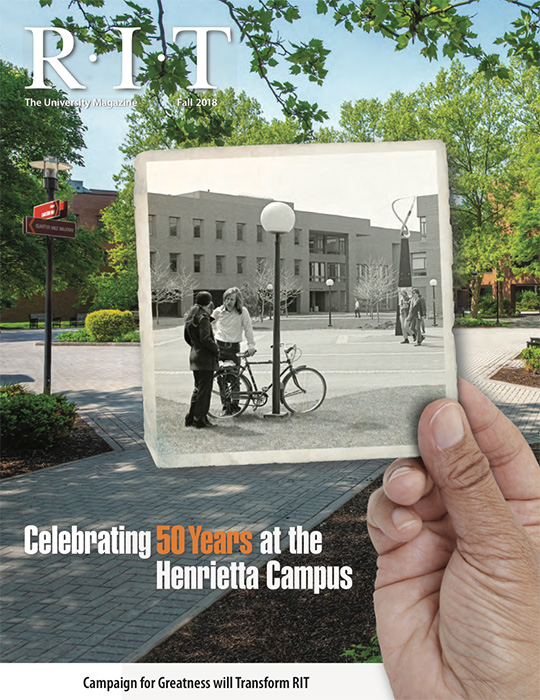
1968 RIT moves to its new campus, and dedication ceremonies
take place in October during homecoming weekend.
The first freshman class enters NTID.
 |
1968
Welcome to Brick City
RIT moves from downtown Rochester to a new campus south of
the city limits. |
1968 Civil rights movement leader Martin Luther King Jr. is
assassinated.
1969 Paul Miller is appointed President. He serves until 1979.
1969 U.S. astronauts land on the moon.
1970 Enrollment reaches 10,941.
1972 The criminal justice program is announced. The School of
Computer Science and Technology is founded.
1973 Motorola produces the first cellular telephone.
 |
1970
Room to grow
Enrollment reaches 10,941 at RIT. |
1979 M. Richard Rose becomes president. He serves until 1992.
RIT continues to expand with many new degree programs.
1981 IBM,
following the lead of many smaller innovators including Apple,
introduces the company’s first “personal computer.”
1982 RIT installs a campus-wide computer network with 300 “intelligent” terminals.
RIT launches the nation’s first undergraduate program in
microelectronic engineering.
 |
1983
Tigers roar
Hockey team members return to campus with their NCAA Division
II championship trophy. |
1983 The RIT men’s hockey team wins the NCAA Division
II championship, the institute’s first NCAA championship
in any sport.
1985 The first “Puttin’ on
the RITz” dinner
takes place. The event, sponsored by the Department of Hospitality
and Service Management, becomes an annual tradition.
1986 The Center for Microelectronic and Computer Engineering
is dedicated. The facility will be a center for undergraduate
education and research in the design and fabrication of integrated
circuits.
1987 The RIT Athenaeum opens to provide educational and enrichment
programs for people over 50.
1988 RIT launches the nation’s first Ph.D. program in
imaging science. This is also RIT’s first doctoral degree
program.
 |
1985
Full plate
The first “Puttin’ on the RITz” dinner,
sponsored by the Department of Hospitality and Service Management,
was a huge success. |
1989 The International Center of Hearing and Speech Research
opens. The center conducts research on the prevention, early
detection, diagnosis, and treatment of people with hearing loss.
The Chester F. Carlson Center for Imaging Science is
dedicated.
The telecommunications engineering technology program
begins. It is the first such bachelor of science program
in the United States.
1990 Enrollment is 13,195.
NASA and the European Space Agency
launch the Hubble Telescope.
Software engineer Tim Berners-Lee
and CERN, the European Organization for Nuclear Research, implement
a hypertext system for accessing information online. Originally
developed for use by physicists, HTML leads to the birth in
1991 of the World Wide Web.
 |
1998
First lady
RIT’s College of Engineering takes the name of Rochester
native Kate Gleason, a pioneer in many fields. |
1991 RIT offers full degree programs online for the first time.
The
Commission on Cultural Diversity, later to become the Commission
for Promoting Pluralism, is established. The goals include
articulating an institutional commitment to a pluralistic
campus environment and promoting diversity as an institutional
value.
1992 RIT’s eighth president, Albert Simone, is appointed.
RIT launches the nation’s first B.S. program in information
technology.
1996 RIT offers the nation’s first undergraduate program
in software engineering.
A Scottish scientist clones a sheep,
Dolly.
 |
1999
Cover girl
Automotive industry exec Nancy McKee Fein ’76 (applied
mathematics) is featured in the first issue of The University
Magazine. |
1997 The Center for Integrated Manufacturing Studies opens with
a mission to increase the competitiveness of manufacturers through
technology solutions and training.
RIT opens the American College
of Management and Technology in Dubrovnik, Republic of Croatia.
1998 RIT’s College of Engineering is named for Kate Gleason.
The dedication of the Center for Excellence in Mathematics,
Science and Technology takes place.
First Brick City Festival
is held.
1999 The first issue of The
University Magazine is published.
2001 The B. Thomas Golisano College of Computing and Information
Sciences is created. It is home for programs in computer science,
information technology, and software engineering.
The Joseph F.
and Helen C. Dyer Arts Center opens. The gallery will host rotating
exhibits as well as NTID’s permanent
collection of works by deaf, hard-of-hearing, and hearing artists.
 |
2000s
Still growing strong
RIT ushers in a new century with new buildings, renovations
and extensive campus improvements. |
The IT Collaboratory, a state-funded project with University
of Buffalo and Alfred University, is formed. The center for
research in microsystems and photonics will focus on applications
in high bandwidth communications and integrated remote sensing
systems.
RIT introduces B.S. and M.S. programs in bioinformatics
that merge biotechnology and information technology.
The North
Star Center for Academic Success and Cultural Affairs opens.
The center serves as a source of guidance for the recruitment,
retention and graduation of African American, Latino and Native
American students.
A Ph.D. program in microsystems engineering,
the first in the U.S., is launched by the Kate Gleason College
of Engineering.
 |
2001
Now there are eight
A $14 million donation from a Rochester businessman and Board
of Trustees member makes possible the creation of the B.
Thomas Golisano College of Computing and Information Sciences. |
2001 On Sept. 11, the U.S. suffers a terrorist attack that destroys
the World Trade Center and damages the Pentagon. More than 3,000
are killed and the nation mounts an assault on terrorist organizations.
2003 A master’s degree program in telecommunication engineering
technology is added to RIT’s offerings of more than 340
academic programs.
ESPN Sports Zone, the first on a college campus,
opens.
Printing industry giant Heidelberg Bruckmaschinen AG installs
its most advanced commercial web press, the “Sunday 2000,” on
campus in the new Heidelberg Web Press Laboratory.
The Sentinel,
a 70-foot, 110-ton steel sculpture by Albert Paley, is dedicated.
It is the most prominent of numerous campus enhancement projects
spanning several years.
 |
2004
The future is here
RIT’s 15,000-plus students are enrolled in more than
340 career-focused programs. |
An intense international research effort
known as the Human Genome Project leads to the complete genetic
mapping of human beings.
2004 As RIT begins its 175th anniversary celebration, more than
15,000 students are enrolled in some 340 graduate and undergraduate
degree programs in the university’s eight colleges.