Philosophy Bachelor of Science Degree

Overview for Philosophy BS
Why Pursue a Bachelor of Science in Philosophy at RIT?
Dynamic Curriculum: Provides a thorough grounding in core areas of philosophy (history of philosophy, ethics, and logical argumentation) and a four-course specialization within philosophy.
Seven Dynamic Specializations: Philosophy of mind and cognitive science, social and political philosophy, applied ethics, philosophy of social sciences and political philosophy, philosophy of art and aesthetics, history of philosophy, and philosophy and law.
Opportunity for Combined Accelerated Bachelor's/Master's Degree: Earn a BS in philosophy and MS in sustainable systems in as little as five years of study.
Teaching Partnership Program Available: 4+1 or 3+2 programs enable you to earn your bachelor’s degree at RIT and a master’s degree in education at one of our partner universities.
What is the Study of Philosophy?
Most of the skills required for student and career success—how to learn, how to apply that learning in professional and personal environments, and how to communicate that knowledge—are central to philosophy. Philosophy will teach you to evaluate complex problems, identify and examine underlying principles, investigate issues from diverse perspectives, and communicate clearly in both written and oral forms.
RIT’s Degree in Philosophy
RIT’s bachelor in philosophy provides a thorough grounding in core areas of philosophy, such as the history of philosophy, ethics, and logical argumentation, as well as a core competence in another discipline, encouraging you to creatively pursue cross-disciplinary studies.
This philosophy degree provides a thorough grounding in core areas of philosophy (history of philosophy, ethics, and logical argumentation), as well as a four-course specialization within philosophy. You may also combine philosophy with a core competence (or even a double major) in another discipline to creatively pursue cross-disciplinary studies. The major concludes with an optional senior thesis.
With RIT's bachelor of science in philosophy, you will develop skills through a core of philosophy courses that cover the history of philosophy, ethics, and logical argumentation. You will choose a specialization and take four courses dedicated to that topic.
Complete a professional core of courses designed to provide foundational knowledge in a professional/technical discipline outside of philosophy, which complements your studies. A Seminar in Philosophy (PHIL-416) examines a selected area or topic in philosophy at an advanced undergraduate level. The optional Senior Thesis in Philosophy (PHIL-595) provides an opportunity to integrate philosophy with various fields of application. Philosophy electives, general electives, and liberal arts courses complete the curriculum.
Bachelor's of Philosophy Specializations
Philosophy of mind and cognitive science: Examine the philosophical issues involved in studying intelligence, cognition, identity, consciousness, rationality, creativity, and emotion, especially as such concepts and categories are invoked by computer and cognitive scientists, and as they are applied in relation to natural and artificial systems.
Philosophy of science and technology: Examine the concepts, methodologies, and philosophical implications of science and technology, and explore the underlying theories, practices, and consequences of science and technology and their role in shaping societies and their values.
Applied ethics: Examine the ethical underpinnings of different professions as well as the ethical presuppositions and implications of technology, engineering, science, management, and other disciplines. Attention is also given to ethics education within the professions and the role professional ethicists can play in different professional and organizational settings.
Social and political philosophy: Examine philosophical issues arising from social and political life as well as the disciplines that study them.
Philosophy of art and aesthetics: Examine how different philosophical frameworks conceive of the various arts and crafts and the forms of creative experience and production with which they are engaged; explore the relationship between aesthetic perception and other forms of experience and judgment, between art and society, between art and ethics, and between art and technology.
History of philosophy: Explores the development and connection of philosophical ideas, concepts, and movements throughout time through an in-depth analysis of significant transformative moments and figures and examines how philosophical positions result from an ongoing conversation with previous thinkers.
Philosophy and law: Prepares for law school and other advanced studies by focusing on the skills and topics important to the study of the law. The courses provide an examination of the theoretical and ethical foundations of the law and an understanding of the logical and epistemological skills helpful in evaluating and constructing legal arguments. In addition, a grounding in these topics and skills is valuable in a range of professions outside the legal field.
Advising
You will be assigned a faculty advisor who assists in planning course schedules, professional/technical core requirements, and a philosophy specialization area. For more information, please refer to the college's academic advising page.
RIT’s Pre-Law Program
Law schools welcome applications from students majoring in a wide range of academic programs. RIT’s pre-law program will help you navigate the admission process for law school, explore a range of legal careers, and guide you through course selection to ensure you build the skills and competencies required of competitive law school applicants. The program is open to students in all majors who are interested in pursuing a career in law.
Furthering Your Career in Philosophy
Today’s careers require advanced degrees grounded in real-world experience. RIT’s Combined Accelerated Bachelor’s/Master’s Degrees enable you to earn both a bachelor’s and a master’s degree in as little as five years of study, all while gaining the valuable hands-on experience that comes from co-ops, internships, research, study abroad, and more.
- Philosophy BS/Sustainable Systems MS: In this accelerated dual-degree program, a foundation in philosophy teaches you how to evaluate complex problems, identify and examine underlying principles, examine ethical implications, and consider diverse perspectives with a truly open mind, while a focus on sustainable systems creates a framework for applying sustainability science principles to address the world’s most challenging issues—pollution, food scarcity, public health crises, and more.
- +1 MBA: Students who enroll in a qualifying undergraduate degree have the opportunity to add an MBA to their bachelor’s degree after their first year of study, depending on their program. Learn how the +1 MBA can accelerate your learning and position you for success.
3+3 Accelerated BS/JD Programs
RIT has partnered with Syracuse University’s College of Law and University at Buffalo School of Law to offer accelerated 3+3 BS/JD options for highly capable students. These programs provide a fast track to law school where you can earn a bachelor’s degree at RIT and a Juris Doctorate degree at Syracuse University or University at Buffalo in six years. Interested students may apply to the option directly, with successful applicants offered admission to RIT and conditional acceptance into either Syracuse University’s College of Law or University at Buffalo School of Law.
RIT’s philosophy degree is one of the approved majors for the 3+3 option.
Learn more about Accelerated Law 3+3 Programs.
RIT’s Teaching Partnership Programs
Whether your goal is to go into early childhood or elementary education, become a secondary education teacher with a content area specialty at the middle or high school level, or work in the higher education or counseling fields, RIT’s partnership programs with local universities provide a guided pathway to a career in teaching.
These 4+1 or 3+2 programs enable you to earn your bachelor’s degree at RIT and a master’s degree in education at one of our partner universities. As you progress, you’ll benefit from focused academic advising, career exploration opportunities, and resources for research, learning, and skill development.
RIT’s philosophy degree is eligible for RIT’s Teaching Partnership Program.
Learn more about RIT’s Teaching Partnership Programs.
Careers and Experiential Learning
Typical Job Titles
| Business Ethics Consultant | Lawyer | Teacher |
| Policy Analyst | Paralegal | Instructional Designer |
| Bioethicist | Data Analytics | Editor |
| Journalist | Non-profit Program Director | Business Consultant |
Industries
Cooperative Education and Internships
What’s different about an RIT education? It’s the career experience you gain by completing cooperative education and internships with top companies in every single industry. You’ll earn more than a degree. You’ll gain real-world career experience that sets you apart. It’s exposure–early and often–to a variety of professional work environments, career paths, and industries.
Co-ops and internships take your knowledge and turn it into know-how. A liberal arts co-op provides hands-on experience that enables you to apply your knowledge in professional settings while you make valuable connections between course work and real-world applications.
Cooperative education is strongly encouraged for philosophy majors.
Featured Work and Profiles
-

From spintronics to philosophy of punishment, Jack Cawthon followed his curiosity at RIT
Read More about From spintronics to philosophy of punishment, Jack Cawthon followed his curiosity at RIT -

Storytelling, Archives, and Finding a Voice: Elle-Anna Parrotta Reflects on her Journey
Deciding on one narrow pathway, one discipline, one dimension of yourself to focus on while you’re in college is unrealistic and, frankly, no fun. For Elle-Anna Parrotta, having the freedom and the...
Read More about Storytelling, Archives, and Finding a Voice: Elle-Anna Parrotta Reflects on her Journey -

Meet Afnaan Qureshi, May 2025 Philosophy and Political Science Grad
He had always been an inquisitive and driven person, but at RIT, Afnaan Qureshi discovered that the study of philosophy ignited a special fascination and fueled his thinking in ways other disciplines...
Read More about Meet Afnaan Qureshi, May 2025 Philosophy and Political Science Grad -

Philosophy Grad Makes Positive Impact with a Career in Teaching
“No matter what subject you teach, you are helping the future of our entire nation. The nation may rest in the hands of the future generations, but those future generations are resting on our...
Read More about Philosophy Grad Makes Positive Impact with a Career in Teaching -

Shaping the Future of AI Through Ethical Inquiry and Policy
Evan Selinger Professor Evan Selinger of RIT leads critical discussions on the ethical implications of artificial intelligence, advocating for responsible development and regulation to address potential harms while...
Read More about Shaping the Future of AI Through Ethical Inquiry and Policy -

Exploring Idealism in Modern Philosophy with a New Fellowship
Katie Terezakis Professor Katie Terezakis of RIT's Philosophy Department receives the prestigious John William Miller Fellowship, allowing her to focus on completing her book that explores the relevance of Idealism...
Read More about Exploring Idealism in Modern Philosophy with a New Fellowship
Curriculum for 2026-2027 for Philosophy BS
Current Students: See Curriculum Requirements
Admissions and Financial Aid
First-Year Admission
First-year applicants are expected to demonstrate a strong academic background that includes:
- 4 years of English with a strong performance is expected.
- 3 years of social studies and/or history with a strong performance is expected.
- 3 years of math is required and must include algebra, geometry, and algebra 2/trigonometry.
- 2-3 years of science.
Transfer Admission
Transfer applicants should meet these minimum degree-specific requirements:
- A minimum of college algebra is required.
Financial Aid and Scholarships
100% of all incoming first-year and transfer students receive aid.
RIT’s personalized and comprehensive financial aid program includes scholarships, grants, loans, and campus employment programs. When all these are put to work, your actual cost may be much lower than the published estimated cost of attendance.
Learn more about financial aid and scholarships


Related News
-
March 20, 2026
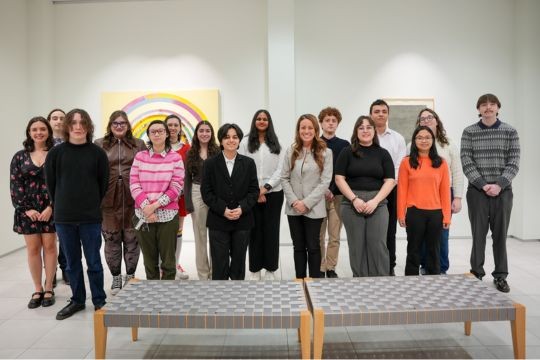
Students Honored for Writing Excellence
Eighteen students from across campus were honored this year by the Rochester Institute of Technology College of Liberal Arts 46th annual Student Writing Awards presentation on March 20, 2026.
-
September 9, 2025

Winter, Spring, and Summer 2026 RIT Faculty-Led Study Abroad Programs
If you’re considering studying abroad, but aren’t quite sure how it will fit into your schedule, a Faculty-Led Study Abroad Program may be the perfect option. RIT’s College of Liberal Arts faculty are leading a fascinating range of courses during spring and summer 2026.
-
September 4, 2025

Supporting Your New College Student
Thankfully, it's not quite as dramatic as the first day of preschool, but sending your child off to college does take a special kind of fortitude. One RIT family shares a candid glimpse of their journey plus advice to make yours easier.
