Supporting Your New College Student
3 Top Tips from a Family That’s Been There

Marc Grillo
"Even though we were nervous, we were excited about the opportunities that RIT had to offer him," recalled Afnaan's mother, Laura Qureshi. “But I would say: trust in your student and trust in RIT because they provide safe space. They provide the resources, and it's a small enough campus where everyone really does know each other.”
According to the National Student Clearinghouse Research Center, 2,484,000 first-year undergraduate students enrolled at colleges and universities in the U.S. last year, bringing the total number of U.S. undergraduate students to nearly 16 million.
It’s said that there is comfort in numbers, yet somehow knowing that millions of students have launched before yours, doesn’t make much of a difference to most parents on dorm move-in day.
Will they find friends? Will they struggle to keep up with the rigors of college academics? Can they really do their own laundry now? Did we buy the right size bedsheets? What if their roommate is not a good match?
The worries are real. But, so is the joy.
Four years ago, as they dropped their son Afnaan off to begin at RIT, the Qureshi family from Boston, Mass., found themselves navigating a new milestone—wanting to be present and positive, while not letting the long list of new college parent worries eclipse the joy of the moment. Last spring, just weeks before his graduation from the RIT College of Liberal Arts, they shared honest perspectives and actionable advice that can help any parent of a new college student set themselves up for a journey of mutual learning, growth, and support.
“We had to have a lot of faith because he's so far away,” recalled Afnaan’s mother, Laura Qureshi. “Even though we were nervous, we were excited about the opportunities that RIT had to offer him. The feel of the campus when we toured, being able to see all that it had to offer, and seeing that Afnaan felt really at home here was really important for us.”
Allowing themselves to trust the environment and trust in Afnaan was one of their first hurdles. Coming from a tight knit, familiar community to a totally new environment and community took some time to get used to for both Afnaan and his parents.
“When I first went to college, it was exciting to think I would figure everything out on my own,” said Afnaan. “I spent my first two weeks going back and forth between class and my dorm room, hardly interacting with anyone. It was miserable, but very soon Dr. Benso, who taught my Ancient Philosophy course, shared the importance of engaging with peers, keeping the door open, and fostering communication. The idea that I could learn from everyone sparked my desire to get involved in my community. The first student group I joined was Engineering House; I showed up and used their workshop to repair one of my bicycles.”
New Parent Tip # 1: Encourage Making Connections with Their New Community.
It’s not quite as dramatic as a first day of preschool, with sobbing toddlers reaching desperately for departing parents while patient, experienced teachers encourage teary-eyed parents to stay strong and walk on, but it's kind of the same idea.
College students who feel connected to campus do better academically, are more likely to persist and graduate, report less anxiety and mental health concerns, and overall feel more positive about themselves and their ability to succeed in college and beyond. The sooner a new student begins making connections, the better.
“He grew up in a small town. Everyone knows everyone. And so when it came to RIT, I think the hardest part for us was to trust the new environment,” shared Laura. “But I would say: trust in your student and trust in RIT because they provide safe space. They provide the resources, and it's a small enough campus where everyone really does know each other.”
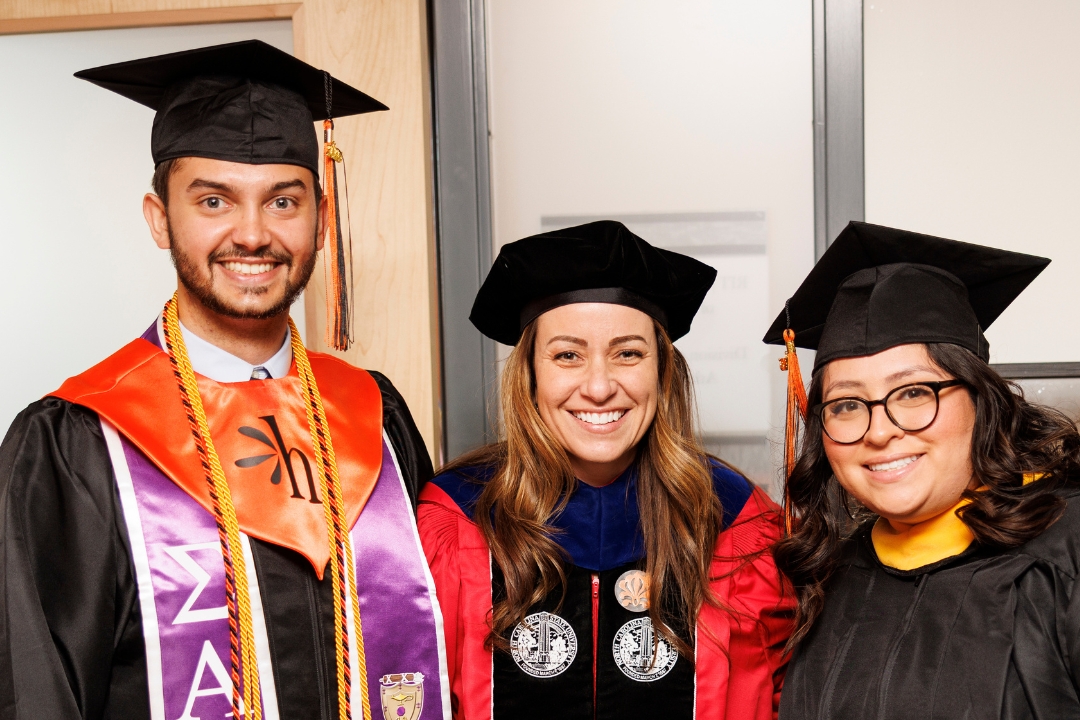
Pictured from left to right, Afnaan, Dean Kelly Norris Martin, and Graduate Commencement Delegate Venita Monet D'Angelo. Photo by Marc Grillo.
New Parent Tip #2: Carve Out Intentional Family Time and Set Shared Expectations for Checking in.
Although she can laugh about it now, Laura remembers a time during Afnaan’s first semester when she hadn’t heard from him for a while and began to worry. “He didn't return my calls or texts, and it was at midnight, and I said to my husband, ‘Honey, I'm going to have to drive there because I just don't know where he is’,” she said.
“But, first I called campus safety. They went to his dorm and knocked on his door. They actually had me on the phone, and they said ‘Okay, we see your son. He's in the room. He's safe.’ And, then they said, ‘Son, call your mom,’ so he called me.” Afnaan recalled he had been singularly focused on preparing for his first set of midterm exams and, without a check-in phone call scheduled, was immersed in his studies.
For many new college students, first-year is the first time they’ve been out on their own for an extended period. It’s natural to expect that you’re going to wonder about their whereabouts and safety, and not knowing can be a cause for worry. Conversely, a feeling of homesickness is common for first-year students, and regular check ins and news from home can be a source of comfort.
It’s also natural—and, in fact, very good—for your new student to become so immersed in coursework and college life that they forget to check in. Save yourself the stress of the unknown by talking directly and openly with your student about when and how you’ll all check in with each other from afar. Establish a new routine that everyone can count on.
Visits to campus for traditions like Brick City Homecoming and Family Weekend in the fall or the ImagineRIT Creativity and Innovation Festival during the spring can be great opportunities to spend time with your student and see first-hand how their first year of college is shaping up. The Qureshi family took advantage of their visits to RIT to also explore the Rochester region and meet some of Afnaan’s professors.
“I would have loved to have had a chance to know more of the philosophy teachers or the department even better. We’re coming from a medical engineering background,” Laura explained. Afnaan’s father Abrar Qureshi is a medical doctor, and she, an accomplished entrepreneur who has launched two businesses, holds degrees in psychology and philosophy. Together they’ve raised a family of five children.
New Parent Tip #3: Your Child’s Time in College May be a Windy Path of Discovery. “Success” is an Individually Defined Construct.
“I am not the same person that entered as a first year, academically, socially, and in many other ways. One of the most important ways that I have changed has been seizing the opportunity in the moment,” said Afnaan, who graduated in May 2025 with a double major in philosophy and political science. Those opportunities can unfold in unexpected ways. For him, the experience of reading an essay by Seneca on the shortness of life during a Classical Constitutionalism course ignited a fresh commitment.
“Every day presents an opportunity to push the needle of progress forward, so I would schedule just one more meeting or one more hour of studying, ensuring that I wouldn't look back the next day with regret. I have stopped procrastinating as much, and I am shying away from complacency. This approach has helped me in my relationships by prioritizing communication over the need to simply be right or get my point across. Life is short, and who we spend it with is an important choice. It truly is difficult not to waste time, but it is the most important distinction we can make with the only resource that can never be made back,” he explained.
During his time at RIT, he also engaged in community service and volunteer work, continuing a tradition already well established in his family. From a medical mission in Turkey following an earthquake in 2023 to establishing an olive oil production company that employs women and practices sustainable agriculture, the Qureshi family has a long history of humanitarian work.
“When applying for college, my high school advised me not to include community service because it was not as ‘useful’ as my STEM extracurricular activities,” said Afnaan. “But, through my fraternity, the honors program, and internships, I felt encouraged by my environment at RIT to get involved in the community. It's contagious!”

Photo by Marc Grillo.
Having completed the honors program, delivered the undergraduate address at his commencement ceremony, and earned his undergraduate degree in May 2025, Afnaan went on to Washington, D.C., where he has enrolled in a graduate program. He’s set his sights on a master’s degree in public administration and a dream job of becoming a Supreme Court Justice.
“College is what you make of it, and RIT takes that further by encouraging you to make it happen,” he offers in explanation for his motivation to continue reaching for higher goals.
For parents, there’s a special satisfaction and sense of hope in watching that progress. “When we're given an opportunity, we just have to make the most of it. I think for Afnaan, that mindset has set him up for his experience at RIT. Also, Afnaan’s experience has had an effect on my husband and I as we think about the ways to prepare our children for the world so, as parents, we feel like we're giving them the best support systems,” said Laura.