Comics scholar wins Eisenhart Award for Outstanding Teaching
Scott Hamilton/RIT
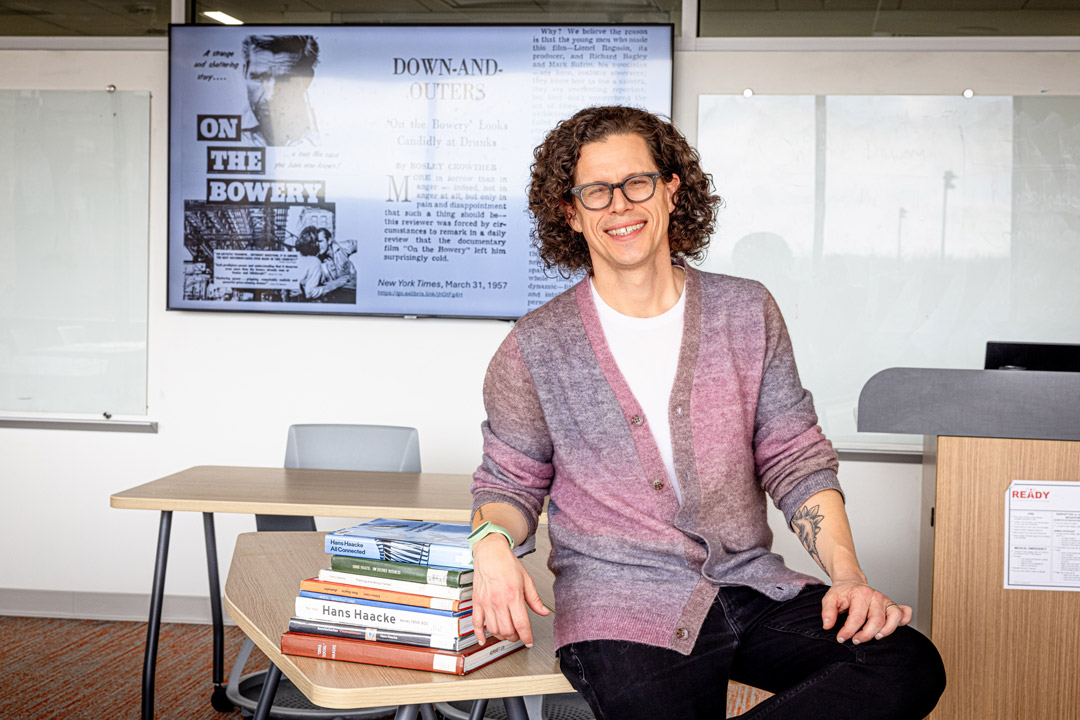
Eisenhart Award-winning professor Daniel Worden teaches popular classes in Art Comics and Documentary Aesthetics.
Winning an Eisenhart Award for Outstanding Teaching took Daniel Worden by surprise.
Although he knew of his nomination, Worden doubted that he would win with only 10 years at RIT and for teaching general education classes not tied to a degree program, he explained.
Read More
Teaching and scholarship awards recognize top educators, students.
Neither reason mattered. Worden’s ability to connect with students and make his material relevant shines a light on the professor of art, who teaches comics art and documentary media in the College of Art and Design.
“We always talk about the materials that were being used, about the technology that artists used to make things,” Worden said. “I increasingly now let my students make art for their assignments and their projects, too.”
In his Art Comics class, Worden makes connections to abstract painting, sculpture, avant-garde theater and experimental film. Comics studies allow him to include traditional arts forms in the discussion.
“You would be hard pressed 10 years ago to find many colleges teaching something like comics next to abstract painting,” Worden said. “Today, it’s more common, and I think it helps students to understand both.”
Worden teaches and writes about American art, comics, print, and visual cultures. He earned his Ph.D. in English in 2006 from Brandeis University. His work has helped establish comics studies as an academic discipline. He is also the Cary Fellow in Comics Studies at RIT’s Cary Graphic Arts Collection.
Coming from the humanities, Worden was trained to think and write as an art or literary critic. Early on at RIT, he tinkered with tradition. His art students needed to do more than interpret a comic or documentary film; they needed to internalize and create something to show their understanding.
“I view my role now to encourage the students to think critically and to analyze art, but it matters a lot less to me what shape or what form that analysis takes.”
He asks students to synthesize and express their understanding through art.
“It’s more complicated and it took me awhile to figure out all the steps that are necessary to get a student to that point,” Worden said. “It’s something I've intentionally put into every class session. I try to have those kinds of tangible applied assignments in each class.”
Worden knows his audience. Adapting to his students’ needs also has taught him more about the language of art than he understood from teaching in a more traditional humanities environment.
He modified his approach to reach his RIT students long before the current trend found in humanities departments across the nation. Now, his colleagues in humanities Ph.D. programs at research one universities are changing how they teach to engage students.
“They call it ‘critical making’ in the humanities classroom,” Worden said. “I just call it ‘teaching’ here because to me it’s the most effective way.”

