RIT startup program teaches founders to listen
Students at the Bernard Kozel StartUp Program spent their summer listening more than talking to perfect their businesses
Traci Westcott/RIT
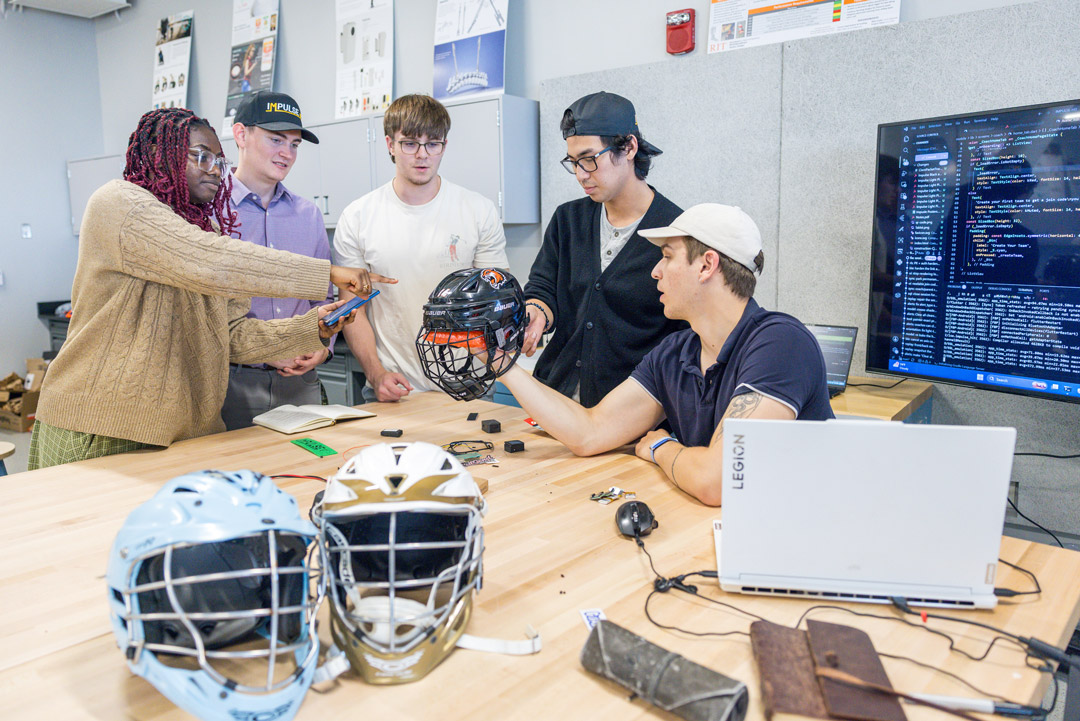
Impulse team members, from left, Vivienne N. Quarshie, Nick Velasquez, Dylan Gallo, Eric Choi, and Luca Chiossone test their wearable head-impact sensor in the Student Hall for Exploration and Development (SHED). The Bernard Kozel StartUp Program @ Saunders gives students an environment to improve as entrepreneurs.
Aspiring entrepreneurs at Rochester Institute for Technology (RIT) spent their summer interviewing coaches, athletic trainers, and sports parents, to perfect their product: a wearable head-impact sensor for athletes.
Yet in most of those interviews, the students never brought the product up. It was an intentional move to understand the problems surrounding tracking head impacts, rather than pitch a solution.
That discipline is at the core of the Bernard Kozel StartUp Program @ Saunders. Before students build their budding businesses, they’re expected to interrogate the problem it solves through a required process called customer discovery.
“Every viable business starts with relentless customer discovery,” said program director Anthony Testa. “If you don't fully understand the problem, you cannot build the solution.”
Traci Westcott/RIT
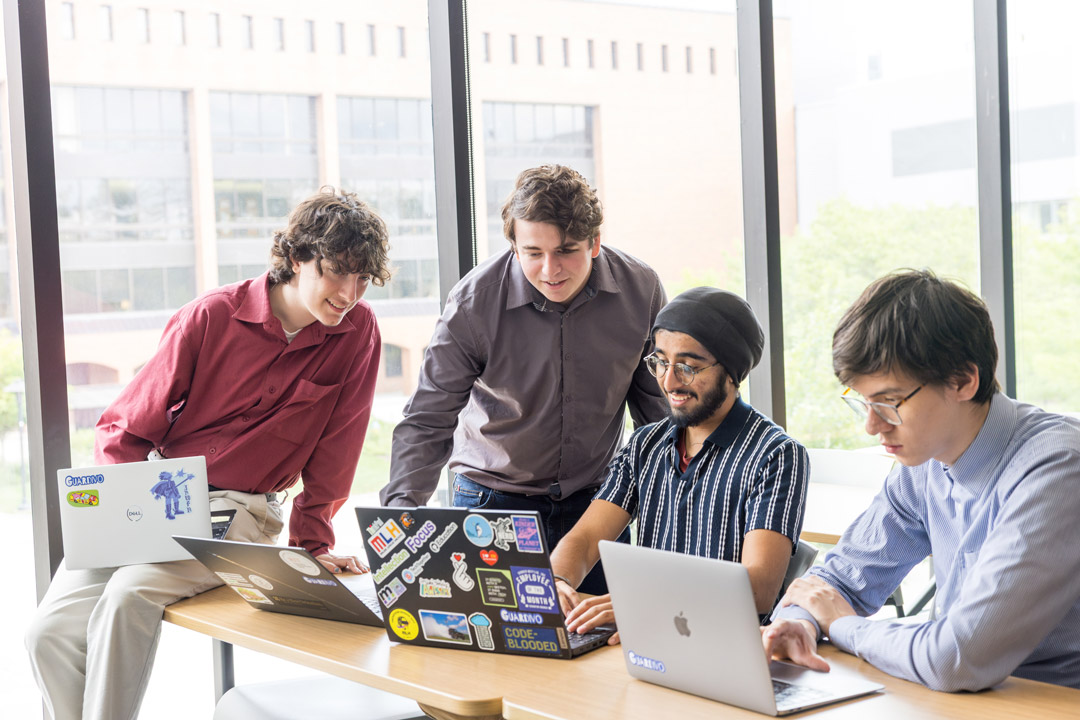
Guardivo team members, from left, Dan Weil, Colin Rills, Ekam Ghai, and Austin Schmidt work on their platform, which helps artists protect their work from online theft. Hundreds of customer conversations pushed the team to redesign their product into a more streamlined, filterable dashboard.
Now in its 24th cohort, the program is a 12-week immersive summer experience open to students from across the university and run through Saunders College of Business. Teams work on their ventures full time with support from an honorarium, meet twice weekly for coaching sessions and guest speakers, and cap the summer with a demo presentation in the Student Hall for Exploration and Development (SHED).
Listening instead of pitching worked out for the Impulse team—consisting of founder Luca Chiossone ’26 (mechanical engineering, individualized program); Eric Choi ’26 (computer science); fifth-year co-op student Dillon Gallo (finance); and fourth-year students Nick Velasquez (individualized program) and Vivienne Quarshie (management information systems). The device—which is smaller than an AirPods case—mounts to any helmet, tracks impacts in real time, and can alert coaches and athletic trainers on the sideline when a hit crosses a risk threshold.
“When you’re working on something cool and technical, of course you want to talk about it,” said Chiossone. “But learning to just listen is something I take away a lot from this experience.”
“We’ve done a few mini-pivots and really refined our scope,” added Gallo. “We’re wasting less time because of how much they made us prioritize interviews.”
Another company in this cohort is Guardivo, a team consisting of third-year computer science students Ekam Ghai and Colin Rills; Dan Weil, a fourth year human-centered computing student; and Austin Schmidt, a 2026 graduate with a degree in global business management. They are building a platform that helps artists protect their work online. The platform scans the web for stolen or copied artwork and lets users send takedown notices with a single click.
Traci Westcott/RIT
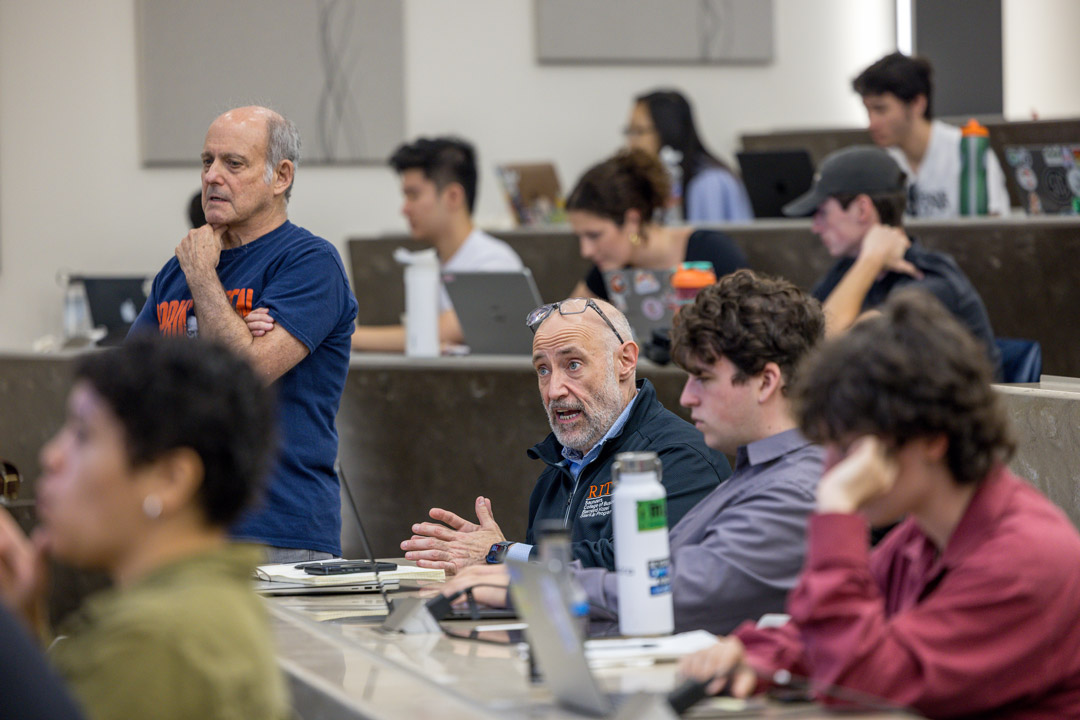
Program director Anthony Testa, center, helps student founders perfect their business pitches during a Bernard Kozel StartUp Program @ Saunders session. Testa encourages teams to prioritize talking to potential customers while building a business.
Feedback from hundreds of conversations pushed the team to redesign an overwhelming wall of search results into a filterable dashboard, so a working artist can differentiate between a harmless fan repost and a company selling bootleg merchandise.
“Instead of throwing every piece of information at someone, they’re able to filter it—we implemented that pretty quickly once we heard it,” Rills said. “We were like, obviously that makes sense. We just didn’t think of it beforehand.”
“Sometimes asking ‘why’ 15 different times sounds annoying,” added Ghai. “But in reality, that’s where you get the majority of answers you never realized.”
The habit of asking questions doesn’t stop with customers. Between sessions in Saunders’ Gueldenpfennig Auditorium, teams critique each other’s pitches and pass along interview contacts that may fit another venture better than their own. RIT alumni and graduates from previous Kozel cohorts impart their wisdom and experience to the young founders.
“We’re not out for only ourselves,” said Choi. “We see the potential and the growth of the other companies as well, and that inspires all of us to keep giving feedback to each other.”
The Kozel program is one stop in a campus-wide entrepreneurial pipeline. Guardivo formed in the Traver Creative Technologist Founders Program at RIT’s MAGIC Spell Studios before joining the summer cohort, while Impulse, founded as a capstone project, will continue with funding through the Gap Year Fellowship. Students can continue building at other campus resources, including the Albert J. Simone Center for Innovation and Entrepreneurship, which provides coaching and programming to grow an idea into a business. Early to mid-seed stage startups can also grow their businesses at the university’s Venture Creations incubator.
Applications for the 25th cohort in the summer of 2027 are open on a rolling basis. Interested student teams are encouraged to apply early and reach out for guidance.

