Research Insights: MDscan will see you now
Introducing an AI tool that screens for mental disorders
Although mental disorders affect nearly one billion people worldwide, an astonishing 94% of those conditions go undiagnosed and untreated because of a shortage of trained clinicians. Now, researchers are turning to Artificial Intelligence as a means of addressing this scarcity using AI screening.
Ali Tosyali, assistant professor in the department of MIS, marketing, and analytics, describes one such method in a co-authored article, “Explainable Artificial Intelligence for mental disorder screening: A computational design science approach,” published in the Journal of Management Information Systems.
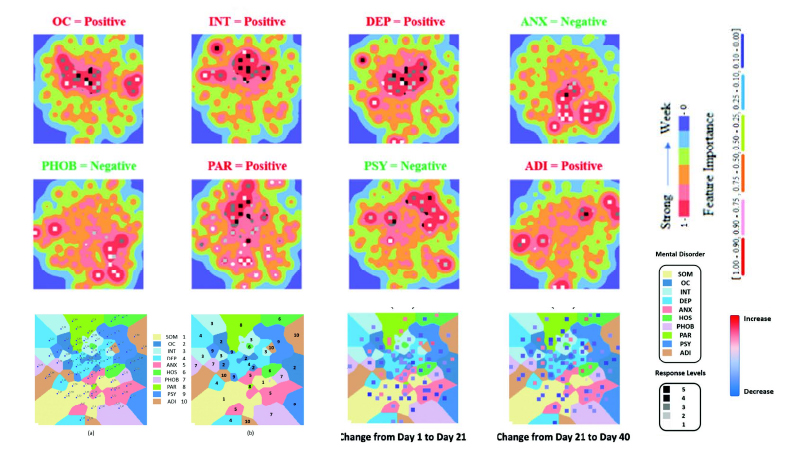
Tosyali and his collaborators introduce mental disorder scan (MDscan), a novel artifact for screening ten mental disorders. MDscan uses data from the standardized Symptom Checklist-90-Revised (SCL-90-R) mental disorder screening instrument, an explainable artificial intelligence approach, and their own ShapRadiation algorithm. The final artifact is a full-color visual image—similar to a radiological image—of ten mental disorders, overlaid with the grayscale representation of each SCL-90-R item to indicate the severity of each symptom and disorder for each patient. These images allow experts to screen multiple concurrent disorders quickly and accurately.
The researchers evaluated MDscan using pre-labeled mental disorder patient data sourced from a Turkish mental health clinic. They trained three mental health experts to read and interpret the resulting MDscan images and then asked them to interpret those images and classify them for mental disorders. The result was a high level of prediction accuracy by MDscan. Moreover, MDscan provides clear explanations of each diagnosis so that clinicians can judge whether to trust its predictions. The success of this application shows promise for the use of AI in many clinical settings.
View paper in the Journal of Management Information Systems (2024), Explainable Artificial Intelligence for mental disorder screening: A computational design science approach.
View all Saunders Research Insights on our website.

More Featured Profiles and Work

Amelia Sykes, co-op
Tharunika Ashok Kumar, co-op
Vaishnave (Vaish) Muthukumaresan, co-op, MIS '26, MS BAAI

Karl English, co-op