Department of History

Overview
The Department of History offers minors and immersions that promote broad perspectives on human experiences, teach critical appraisal of primary and secondary sources, develop communication and writing skills, and enable you to make comparisons and draw contrasts across global historical perspectives—all skills that are essential in a wide variety of professions, including business, education, journalism, law, politics, and public service. We are a tight-knit department with faculty who have a wide variety of professional and scholarly interests, from the history of gender to the history of computing, from the history of Asia to the history of the United States, from the history of imperialism to the history of baseball.
10
Faculty in the department
68
History courses offered
9
Geographical and historical areas of study
Latest News
-
August 14, 2026

Dual-degree RIT student finds his niche internship with the Smithsonian
Nathaniel Bartsch, a dual-degree student studying history and film production, uses interdisciplinary expertise in history and film to get his an internship at the Smithsonian Center for Folklife and Cultural Heritage.
-
June 26, 2026

RIT historians elevate local LGBTQ+ history in a new exhibit
Using never-before-shared archival documents, photographs, videos, and oral history interviews, the exhibition at George Eastman Museum explores how Kodak's Lambda members changed corporate culture and benefit policies to be more inclusive.
-
June 4, 2026
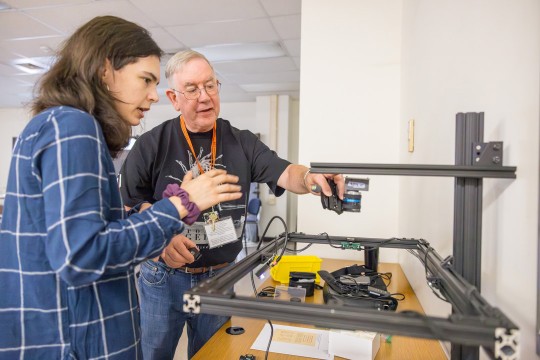
RIT Fulbright Specialist brings cultural heritage imaging expertise to Indonesia
Passion and expertise are leading Tom Rieger, Professor of Practice in the College of Liberal Arts, across the globe to Indonesia thanks to a Fulbright Specialist Program award.
Featured Work and Profiles
-

From Small-Town Archives to Collection Manager: Lizzy Carr's Museum Studies Path
A childhood love of history led Lizzy Carr '22 to museums, archives and a career shaped by curiosity, critical thinking and hands-on experience.
Read More about From Small-Town Archives to Collection Manager: Lizzy Carr's Museum Studies Path -

When You Know, You Know: Why Elly Medcalf Only Had Eyes for RIT
Elyana "Elly" Medcalf had no shortage of options for where to go to college, but once she discovered its interdisciplinary Humanities, Computing, and Design BS program, she only had eyes for RIT.
Read More about When You Know, You Know: Why Elly Medcalf Only Had Eyes for RIT -

A History Major plus 3+3 Law Program Provided a Foundation and a Fast Track for a Career as a Disability Rights Lawyer
Julia Resciniti knew she wanted to go to RIT and the National Technical Institute for the Deaf (NTID) since she was in sixth grade. Now, after fast-tracking her undergraduate education, she is...
Read More about A History Major plus 3+3 Law Program Provided a Foundation and a Fast Track for a Career as a Disability Rights Lawyer -
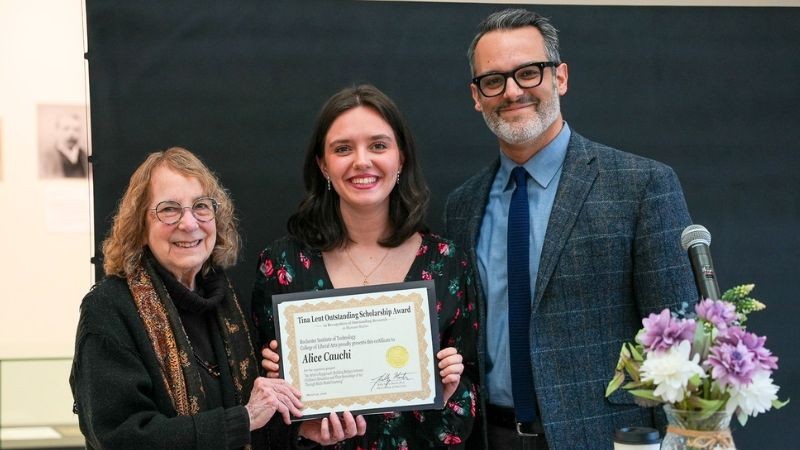
From Code to Curating: How Alice Found Her Voice and Her Future
As a first-generation American and college student, Alice Cauchi arrived at RIT with a "one-track mind" focused solely on grades and independence. However, the unique intersection of her double major...
Read More about From Code to Curating: How Alice Found Her Voice and Her Future -

Co-op & Internship Spotlight: History Major's Internship Built Skills, Solidified Career Path
A summer internship at a museum let Nathaniel Bartsch apply tech, project management, and digital skills and focused his future career goals.
Read More about Co-op & Internship Spotlight: History Major's Internship Built Skills, Solidified Career Path -

2025 Grad Found a Home in History
Chase Foresti began at RIT enrolled in a different major, but soon into his time here he found a home in history. Now, as he prepares for graduation day, he reflects on his journey that led to on-the...
Read More about 2025 Grad Found a Home in History