Museum Studies Bachelor of Science Degree
Learn how to curate and interpret collections for museums, archives, galleries, libraries, and public institutions.
100%
of grads are either employed, in grad school, or pursuing volunteer/service work.
1st
and only BS in Museum Studies in the U.S.
29K+
Internship hours completed by Museum Studies students at cultural heritage sites such as museums, archives, or libraries.
Overview for Museum Studies BS
Why Pursue a Museum Studies Degree at RIT?
World-class Resources: RIT Collections on campus include RIT Archives, The Cary Graphic Arts Collection, The Dyer Art Center at NTID, and The Vignelli Center for Design Studies.
Hands-On Experience: Gain real-world career experience in museums, archives, libraries, or special collections through a required internship experience.
Develop Expertise in Digital Tools and Applications: Differentiate yourself from museum studies majors at other universities with a comprehensive knowledge of digital tools and a robust project-based portfolio.
Top Employers: Recent graduates are employed by Genesee Country Village & Museum; The Strong, National Museum of Play; Buffalo AKG Art Museum; Smithsonian Institution; National Geographic; the National Archives; and a number of academic museums, art galleries, libraries, and archives.
3+3 Law Program: Accelerated 3+3 BS/JD programs with Syracuse University College of Law and University at Buffalo School of Law.
Teaching Partnership Program Available: 4+1 or 3+2 programs enable you to earn your bachelor’s degree at RIT and a master’s degree in education at one of our partner universities.
What is Museum Studies?
Museums, archives, libraries, and other cultural institutions seek emerging professionals who can help develop and implement strategies to digitize, exhibit, manage, curate, and interpret their artistic, cultural, historical, and scientific collections and make them available to the public in interactive and engaging ways. Museum studies provide a thorough grounding in the history, theory, and practice of institutional collecting, exhibition development and design, multi-platform technologies, collection management, fundraising, and grant writing. You’ll be prepared to help institutions share their collections, engage with their communities, and enhance, assess, and improve the visitor experience.
RIT’s Degree in Museum Studies
At RIT, museum studies is an interdisciplinary, technology-infused major that prepares you for careers in museums, archives, libraries, galleries, historical societies, and other cultural organizations.
Three principles guide our program and your academic experience:
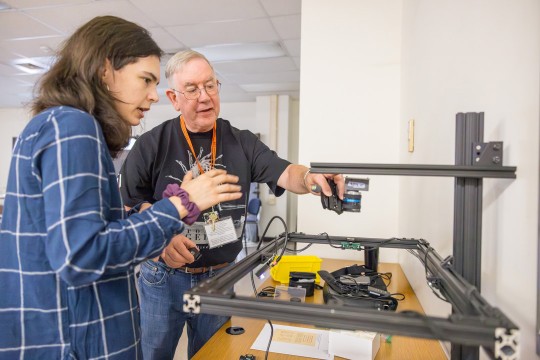
- Tech-infused and collections-based curriculum, projects, and initiatives, making use of RIT’s resources from across campus, including the new makerspace in the SHED
- Collaboration across campus and in the community to highlight the interdisciplinary nature of museum work
- Equity-focused work that can take many forms, including foregrounding under-studied narratives from Rochester’s history and democratizing access to technology.
RIT’s Museum Studies Courses
The museum studies major at RIT includes a set of introductory core courses to familiarize you with the history, theory, and practice of institutional collecting. These courses are bolstered by classes in exhibition development, education and interpretation, and multi-platform interpretation and design. To broaden and deepen your knowledge, you will choose from a selection of electives that cover a range of topics and areas of studies that can speak to your interests and passions.
You will also complete at least one co-op or internship experience in a cultural institution or similar entity.
Overall, the museum studies curriculum is anchored around museum studies courses that reflect current opinions about necessary skill sets, competencies, and subject areas identified by the American Alliance of Museums (AAM), International Council of Museums (ICOM), and the National Council on Public History (NCPH). You will also acquire skills of critical reflection, sound argumentation, and presentation of information to public audiences in a variety of formats.
Collections, Exhibit Spaces, and Labs
RIT has long been a hub of creativity. See and experience it for yourself, tap into generations of inspiration, and use it as a springboard for your own.
RIT Collections:
- RIT Archives collects and makes accessible physical and digital materials relating to the rich history of RIT, Deaf culture and history, artwork by RIT alumni, faculty, and students, and other special collections.
- The Cary Graphic Arts Collection is one of the world’s premier libraries on graphic communication history and practices, holding 45,000+ volumes and more than 130 archival collections.
- The Dyer Art Center at NTID houses several state-of-the-art galleries that showcase artworks created by current students, alumni, and artists who are nationally and internationally renowned. All of these artists are deaf, hard of hearing, and/or allies of the Deaf community.
- The Vignelli Center for Design Studies is a hub of research, education, and creative inspiration that houses more than 750,000 artifacts across all fields of design.
Exhibit Spaces:
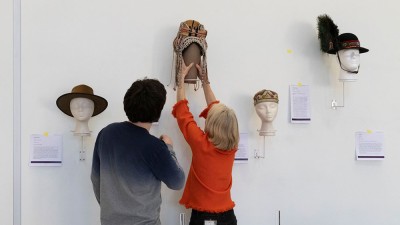
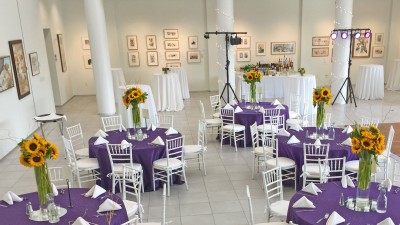
Student-led and faculty-led displays and exhibitions at RIT’s exhibit spaces are the result of collaboration with professionals and artists locally, regionally, and worldwide — exposing you to the latest techniques and trend makers in the industry:
- University Gallery, in Booth Hall
- Wehrheim Gallery in the SHED
Other Stats
- +11% employment growth predicted by the U.S. Department of Labor Statistics.
- $800K grant-sponsored research funds secured by museum studies program in the last five years.
- $1.3M gift that supports RIT-museum partnership with the Genesee Country Village & Museum.
Jobs in Museums Studies
A career in museums, archives, libraries, other cultural institutions, or cognate fields awaits you! The good news is that the occupational outlook for archives and museums is very good, with a 12% growth predicted in the next decade, and the outlook for libraries is good, with a 6% growth for library media specialists predicted by the Bureau of Labor Statistics in the next decade.
Upon graduation, you will be prepared for a variety of positions in museums, historical sites, historical societies, libraries, archives, and corporations or other organizations with cultural repositories that develop and implement strategies to digitize, exhibit, manage, curate, and interpret their artistic, cultural, historical, and scientific collections, and to make them available to the public in interactive and engaging ways.
You may also wish to further your education in graduate programs in library and information science, archival studies, informatics, or a number of disciplines including art history and related humanities fields, business, color science, imaging science, and other disciplines that can build upon the firm foundation of liberal arts and tech-infused courses and projects that are cornerstones of the museum studies degree program.
Furthering Your Career in Museum Studies
Combined Accelerated Bachelor's/Master's Degrees: Today’s careers require advanced degrees grounded in real-world experience. RIT’s Combined Accelerated Bachelor’s/Master’s Degrees enable you to earn both a bachelor’s and a master’s degree in as little as five years of study, all while gaining the valuable hands-on experience that comes from co-ops, internships, research, study abroad, and more.
- +1 MBA: Students who enroll in a qualifying undergraduate degree have the opportunity to add an MBA to their bachelor’s degree after their first year of study, depending on their program. Learn how the +1 MBA can accelerate your learning and position you for success.
3+3 Accelerated BS/JD Programs
RIT has partnered with Syracuse University’s College of Law and University at Buffalo School of Law to offer accelerated 3+3 BS/JD options for highly capable students. These programs provide a fast track to law school where you can earn a bachelor’s degree at RIT and a Juris Doctorate degree at Syracuse University or University at Buffalo in six years. Interested students may apply to the option directly, with successful applicants offered admission to RIT and conditional acceptance into either Syracuse University’s College of Law or University at Buffalo School of Law.
RIT’s museum studies degree is one of the approved majors for the 3+3 option.
Learn more about Accelerated Law 3+3 Programs.
RIT’s Teaching Partnership Programs
Whether your goal is to go into early childhood or elementary education, become a secondary education teacher with a content area specialty at the middle or high school level, or work in the higher education or counseling fields, RIT’s partnership programs with local universities provide a guided pathway to a career in teaching.
These 4+1 or 3+2 programs enable you to earn your bachelor’s degree at RIT and a master’s degree in education at one of our partner universities. As you progress, you’ll benefit from focused academic advising, career exploration opportunities, and resources for research, learning, and skill development.
RIT’s museum studies degree is eligible for RIT’s Teaching Partnership Program.
Learn more about RIT’s Teaching Partnership Programs.
Careers and Cooperative Education
Typical Job Titles
| Assistant Curator | Collections Associate | Cultural Heritage Imaging Specialist |
| Digitization Specialist | Exhibit Project Manager | Film Archivisit |
| Museum Manager | Archivist |
Industries
Cooperative Education
What’s different about an RIT education? It’s the career experience you gain by completing cooperative education and internships with top companies in every single industry. You’ll earn more than a degree. You’ll gain real-world career experience that sets you apart. It’s exposure–early and often–to a variety of professional work environments, career paths, and industries.
Co-ops and internships take your knowledge and turn it into know-how. A liberal arts co-op provides hands-on experience that enables you to apply your knowledge in professional settings while you make valuable connections between course work and real-world applications.
Students in museum studies are required to complete one co-op or internship experience in a cultural institution. Co-ops are usually a summer or semester in duration. Internships may be full- or part-time and are often completed during the semester. They vary in duration depending on the organization. Co-ops and internships may be completed locally, nationally, or internationally.
Students have recently been placed as interns locally, nationally, and internationally.
Recent local placements include: Genesee Country Village & Museum; George Eastman Museum; Memorial Art Gallery; Strong, National Museum of Play; Out Alliance; India Community Center; and the Rochester Public Library. Beyond Rochester, students have served as interns at the Penn Museum; Baseball Hall of Fame; Smithsonian Institution; National Park Service; and National Geographic.
Featured Work and Profiles
-

From Small-Town Archives to Collection Manager: Lizzy Carr's Museum Studies Path
A childhood love of history led Lizzy Carr '19 to museums, archives and a career shaped by curiosity, critical thinking and hands-on experience.
Read More about From Small-Town Archives to Collection Manager: Lizzy Carr's Museum Studies Path -
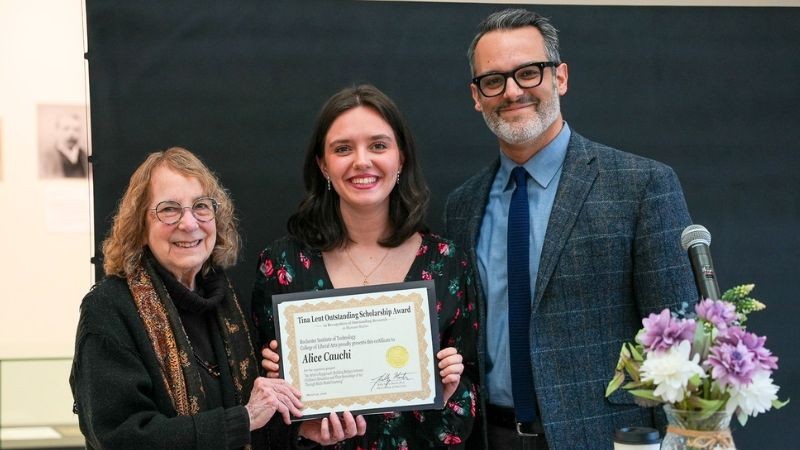
From Code to Curating: How Alice Found Her Voice and Her Future
As a first-generation American and college student, Alice Cauchi arrived at RIT with a "one-track mind" focused solely on grades and independence. However, the unique intersection of her double major...
Read More about From Code to Curating: How Alice Found Her Voice and Her Future -

Historians Put Today’s AI to Work to Better Understand the Past
From medical devices to economic forecasting tools to writing and editing assistants and more, artificial intelligence is playing a role in nearly every industry and activity of contemporary life, but...
Read More about Historians Put Today’s AI to Work to Better Understand the Past -

Graduate Exploring New Frontiers in Museum Studies Through Fulbright Award
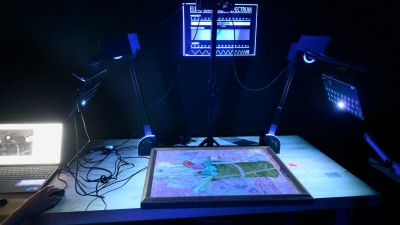
Izzy Moyer Museum studies graduate Izzy Moyer returns to Croatia as a Fulbright awardee, leveraging her expertise with RIT's Multispectral Imaging System to support The State Archives and inspire future museum...
Read More about Graduate Exploring New Frontiers in Museum Studies Through Fulbright Award -

Internship Provides First-Hand Experience in Imaging Science for Museums
RIT museum studies students, including Izzy Moyer and Kyra Schultz, have developed the low-cost Multispectral Imaging System for Historical Artifacts (MISHA), which enables the recovery of hidden...
Read More about Internship Provides First-Hand Experience in Imaging Science for Museums -

Lecturer Empowers Voices of the Past in a Traveling Exhibition
Samaya Nasr RIT lecturer Samaya Nasr plays a pivotal role in an award-winning exhibition that highlights the often-overlooked narratives of diverse communities in the American West.
Read More about Lecturer Empowers Voices of the Past in a Traveling Exhibition
Curriculum for 2026-2027 for Museum Studies BS
Current Students: See Curriculum Requirements
Admissions and Financial Aid
First-Year Admission
First-year applicants are expected to demonstrate a strong academic background that includes:
- 4 years of English with a strong performance is expected.
- 3 years of social studies and/or history with a strong performance is expected.
- 3 years of math is required and must include algebra, geometry, and algebra 2/trigonometry.
- 2-3 years of science.
Transfer Admission
Transfer applicants should meet these minimum degree-specific requirements:
- A minimum of college algebra is required.
Financial Aid and Scholarships
100% of all incoming first-year and transfer students receive aid.
RIT’s personalized and comprehensive financial aid program includes scholarships, grants, loans, and campus employment programs. When all these are put to work, your actual cost may be much lower than the published estimated cost of attendance.
Learn more about financial aid and scholarships

Related News
-
October 16, 2026
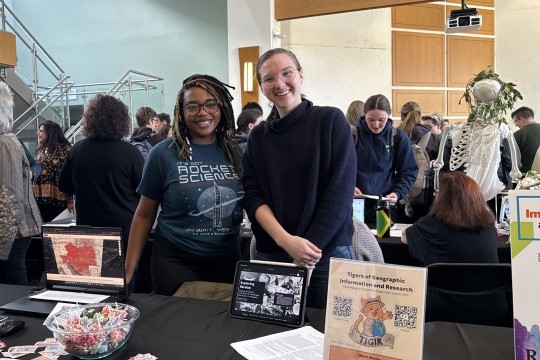
RIT club connects students with growing geospatial field
Tigers of Geographic Information and Research is more than a geography club, although its members do love maps. Geographic information systems technology is used to analyze and visualize location-based data, with applications varying from urban planning and environmental management to crime analysis.
-
June 4, 2026
RIT Fulbright Specialist brings cultural heritage imaging expertise to Indonesia
Passion and expertise are leading Tom Rieger, Professor of Practice in the College of Liberal Arts, across the globe to Indonesia thanks to a Fulbright Specialist Program award.
-
May 29, 2026

Research, art history, and imaging science came together at RIT this week
The Cultural Heritage Imaging Lab — a joint effort between the Chester F. Carlson Center for Imaging Science in the College of Science and Museum Studies in the College of Liberal Arts — hosted a team of researchers from the National Gallery of Art for work connected to The CIIIPRESES Project.
