Diagnostic Medical Sonography (Ultrasound) Bachelor of Science Degree

In RIT’s diagnostic medical sonography degree you’ll use learn to use ultrasound to diagnose, evaluate, and treat a range of medical diseases and conditions.
Overview for Diagnostic Medical Sonography (Ultrasound) BS
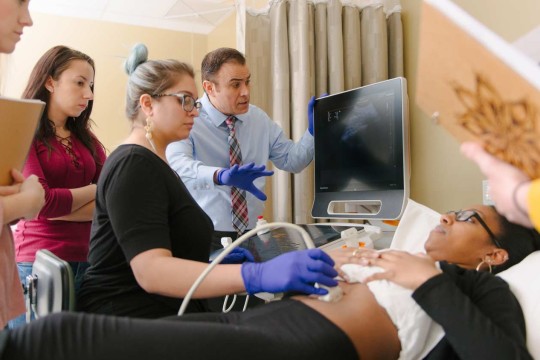
A rigorous, hands-on approach, coupled with a strong emphasis on experiential clinical learning–in both our state-of-the-art Ultrasound Scanning Suite and at our affiliated hospitals and clinics–provides you with a remarkable educational advantage.
Our forward-thinking curriculum integrates technology and health care to prepare graduates for immense career opportunities where you can manage and lead in environments where technology and medicine converge.
Engaging, passionate faculty are national leaders in ultrasound education and are fully committed to helping you develop into an exceptional sonographer and leader.
An exceptional option for pre-med and graduate programs in health care professions. With the addition of a few extra courses, the program’s curriculum covers the required course work that positions you as a strong candidate for medical, dental, or other graduate programs in the medical or health sciences.
Imagine the possibilities that can result from attending a nationally-ranked ultrasound program that houses a modern, state-of-the-art scanning suite where classes are taught by outstanding faculty who are leaders in their field. The outcome is a first-rate educational experience, complete with one year of on-site clinical training, that sets you a path for success in a dynamic health care field.
What is Diagnostic Medical Sonography?
Diagnostic medical sonography, also referred to as ultrasound, has revolutionized the field of medicine. It offers a unique opportunity in the diagnosis, evaluation, and treatment of medical diseases and conditions without the use of surgery, injection of dyes, or radiation. Diagnostic medical sonography is a noninvasive, nontoxic diagnostic medical imaging tool in which high-frequency sound waves are used to produce images of the human body. Ultrasound is readily used to image the heart, blood flow, and abdominal organs as well as the developing fetus and male/female reproductive organs. But ultrasound has found itself to be a critical health care tool beyond radiology, OB/GYN, vascular, and cardiology. It is now used in areas such as emergency medicine, orthopedics, sports medicine, ophthalmology, rheumatology, pain medicine, intensive care, and more. The profession has grown rapidly in the last 20 years and careers in diagnostic medical sonography are expected to continue to grow over the next several decades. Evaluation of the job market, advancements in medical technology, and a survey of current employers all indicate a strong demand for well-trained sonographers.
How to Become a Diagnostic Medical Sonographer
Our diagnostic medical sonography degree is a four-year program that includes a one year clinical internship. RIT is one of very few colleges with ultrasound programs in the U.S. that lead to a bachelor of science in diagnostic medical sonography.
RIT’s ultrasound program provides comprehensive sonography education. The program begins with a solid foundation in biology, human anatomy and physiology, and human cross-sectional anatomy. Sonography courses include extensive didactic lectures with full immersion ultrasound scanning in our state-of-the-art Ultrasound Scanning Suite, where students have hands-on instruction in sonography instrumentation and sonographic scanning skills and techniques for vascular evaluation, obstetrics, gynecology, and abdominal and small parts sonography. These courses occur before a one-year clinical internship, where students work in a range of health care settings (hospitals, outpatient centers, physician offices, etc.) where they complete their sonography education with mentors, physicians, and other medical professionals. Courses in patient care and the liberal arts round out your studies. In addition to the development of scanning and diagnostic abilities that focus on relevancy to clinical practice, the program also emphasizes skills in administration, leadership, and research. You will be prepared for careers in diagnostic medical sonography and related medical fields, as well as for medical school and graduate programs in the health sciences. This is a program that provides a high-quality, comprehensive diagnostic medical sonography education. You will graduate well-prepared, well-trained, and sought-after in the workplace.
Apply Your Knowledge
With a rigorous hands-on approach, coupled with an emphasis placed on experiential learning, you will gain a wealth of experience applying what you’ve learned in classroom lectures and lab experiences to a variety of real-life situations. A dedicated faculty is both engaged and passionate about your education and is fully committed to the development of exceptional sonographers and leaders.
Graduates are prepared to pursue a variety of careers in diagnostic medical sonography, nationally and internationally, in medical, industrial, and educational settings. Graduates can be found in a wide range of supervisory and administrative positions in hospitals, clinics, private physicians’ offices, teaching, research, sales, and industry. Graduates also can work as freelance sonographers or for mobile services.
Medical Community Support
Our diagnostic medical sonography degree benefits from a comprehensive, supportive medical community comprised of highly-trained radiologists, physicians, sonologists, sonographers, and echocardiographers that guide, educate, and train our students. Many of these professionals are involved in teaching our students both on-campus and at off-campus clinical sites. Our partner clinical sites also employ many of our graduates. Through these interactions, you are exposed to generous and dedicated health care professionals who will enhance your education through professional development, increase your awareness of community needs, and share a sense of cooperative spirit in which medicine is practiced. In addition, many of our clinical instructors, echocardiographers, and sonographers are alumni of our program and are familiar with the standards, expectations, and rigor of the ultrasound program. Learn more about the program's affiliated faculty.
Ultrasound Program Effectiveness Data
Review the Program Outcomes Data.
Additional Sonography Education Opportunities
In addition to the bachelor of science in diagnostic medical sonography, RIT also offers two diagnostic medical sonography certificate programs: a certificate in diagnostic medical sonography and a certificate in echocardiography (cardiac ultrasound). Both of these options are not only designed to meet the growing needs of the national and international medical communities but also the needs of individuals who:
- Hold a degree in the life sciences and other closely related degrees who are interested in that may be approved by the program director. Additional pre-requisite course work may be required for any type and level of degree.
- Have a current, active license or registry in an area of medical or allied health sciences, some examples of medical or allied health sciences areas include respiratory therapy, nuclear medicine, physical therapy, radiography (x-rays), nursing, and more. Any of the more than 200 medical or allied health sciences fields also will be considered.
Sonography as a Pre-Med Option
Being accepted into a medical graduate program requires certain qualifications, including completing prerequisite courses, a strong academic record, acquiring pertinent experiences in the field, and developing key intrapersonal and interpersonal qualities. The Pre-Health Professions Program works with all students on an individual basis to help them become competitive candidates for admission to graduate programs in the medical and health professions.
The diagnostic medical sonography degree has assisted students in entering the worlds of medicine and dentistry. With the addition of a few courses, and without extending your time at RIT, the ultrasound program can prepare you for medical, dental, or other graduate school programs in the medical or health sciences. Graduates of the ultrasound program have gone on to become physicians, dentists, chiropractors, and more. Learn more about how a diagnostic medical sonography degree can be used as a pre-med option.
Sonography Education Resources
Program Policy and Procedures Handbook/Technical Standards
Please refer to these two documents for more information:
Prospective students are invited to view the diagnostic medical sonography program brochure.
Combined Accelerated Bachelor's/Master's Degrees
Today’s careers require advanced degrees grounded in real-world experience. RIT’s Combined Accelerated Bachelor’s/Master’s Degrees enable you to earn both a bachelor’s and a master’s degree in as little as five years of study, all while gaining the valuable hands-on experience that comes from co-ops, internships, research, study abroad, and more.
+1 MBA: Students who enroll in a qualifying undergraduate degree have the opportunity to add an MBA to their bachelor’s degree after their first year of study, depending on their program. Learn how the +1 MBA can accelerate your learning and position you for success.
-

Apply for Fall 2027
Early Decision I and Early Action deadlines are November 1.
-
Meet Us on Campus
Learn about academics, co-op and internships, financial aid, and more at one of our on-campus open houses.
October 12 | October 24 | November 14
Careers and Clinical Internships
Typical Job Titles
| Diagnostic Medical Sonographer | Ultrasound Technologist | Registered Diagnostic Medical Sonographer |
| Sonographer |
Graduates work primarily in the Health Care industry.
Clinical Internships
The one-year clinical internship provides hands-on experience at two or more approved medical facilities. After completing the pre-internship course work, all students begin the internship by attending an intensive two-week experience on campus. During this time they enhance and polish the skills they previously learned, prepare to perform complete sonographic examinations as performed in real clinical settings, and advance their knowledge in recognizing anatomy and disease states using a variety of equipment in the Ultrasound Scanning Suite. Students also learn about hospital, departmental, and administrative operations. After completing these requirements, candidates are assigned to a medical training site for their clinical experience. At these facilities, students work side-by-side with sonographers, physicians, and other health care professionals to learn, develop, apply, and sharpen the necessary skills to perform general ultrasound examinations. Students’ clinical progress and performance are closely monitored by the program’s clinical coordinator and program director, who have regular communication and make periodic visits to the clinical internship sites. Additionally, students return to campus each month for three days of lectures, presentations, projects, and testing. Students may complete their clinical internships at any approved regional or national medical ultrasound facility, with approval of the program director.
Featured Work and Profiles
-

Alumnae Launch Echomentor, An Educational Platform for Sonographers
Echomentor is an online platform for continuing education, mentorship, professional development, and more.
Read More about Alumnae Launch Echomentor, An Educational Platform for Sonographers -

Tiger Testing Team Offers Health Science Majors Unmatched Clinical Experience
More than 25% of the nearly 90 students that make up the Tiger Testing Team are majors in the College of Health Sciences and Technology. To help keep campus safe, the team conducted thousands of COVID...
Read More about Tiger Testing Team Offers Health Science Majors Unmatched Clinical Experience -

Alumna Pairs Ultrasound with Entrepreneurship to Launch Mobile Ultrasound Business
Hey, Baby! Mobile 4D Ultrasound is Jenny Kron's mobile ultrasound business. Kron provides elective ultrasounds in the comfort of people’s homes with a portable ultrasound machine.
Read More about Alumna Pairs Ultrasound with Entrepreneurship to Launch Mobile Ultrasound Business -

Diagnostic Medical Sonography Students Poised to Graduate
Trisha Taft and Juliana Bermudez Trisha Taft and Juliana Bermudez, Class of 2023
Read More about Diagnostic Medical Sonography Students Poised to Graduate
Curriculum for 2026-2027 for Diagnostic Medical Sonography (Ultrasound) BS
Current Students: See Curriculum Requirements
Admissions and Financial Aid
First-Year Admission
First-year applicants are expected to demonstrate a strong academic background that includes:
- 4 years of English
- 3 years of social studies and/or history
- 3 years of math is required and must include algebra, geometry, and algebra 2/trigonometry. Pre-calculus is preferred.
- 2-3 years of science. Biology is required. Chemistry and physics are preferred.
Transfer Admission
Transfer applicants should meet these minimum degree-specific requirements:
- A minimum of college algebra is required. Pre-calculus or calculus is preferred.
- Biology is required. Chemistry and physics are preferred.
Financial Aid and Scholarships
100% of all incoming first-year and transfer students receive aid.
RIT’s personalized and comprehensive financial aid program includes scholarships, grants, loans, and campus employment programs. When all these are put to work, your actual cost may be much lower than the published estimated cost of attendance.
Learn more about financial aid and scholarships


Related News
-
January 8, 2025

Alliance addresses health needs
The alliance aims to enhance programming in the university’s College of Health Sciences and Technology and prepare healthcare professionals to enter the workforce.
-
November 12, 2024

EchoMentor creates a new wave of sonographers
Hayley Bartkus and Christina Werth created EchoMentor as an educational platform for healthcare professionals working in sonography or ultrasound, a medical imaging method that uses sound waves to peer inside the body.
-
May 3, 2024

Two graduates bring new meaning to legacy family
Two RIT students graduating next week continue their family legacies while pioneering unique paths in their fields.
