New Global Futures Interdisciplinary Degree Equips Grads with Toolbox for Lifelong Success
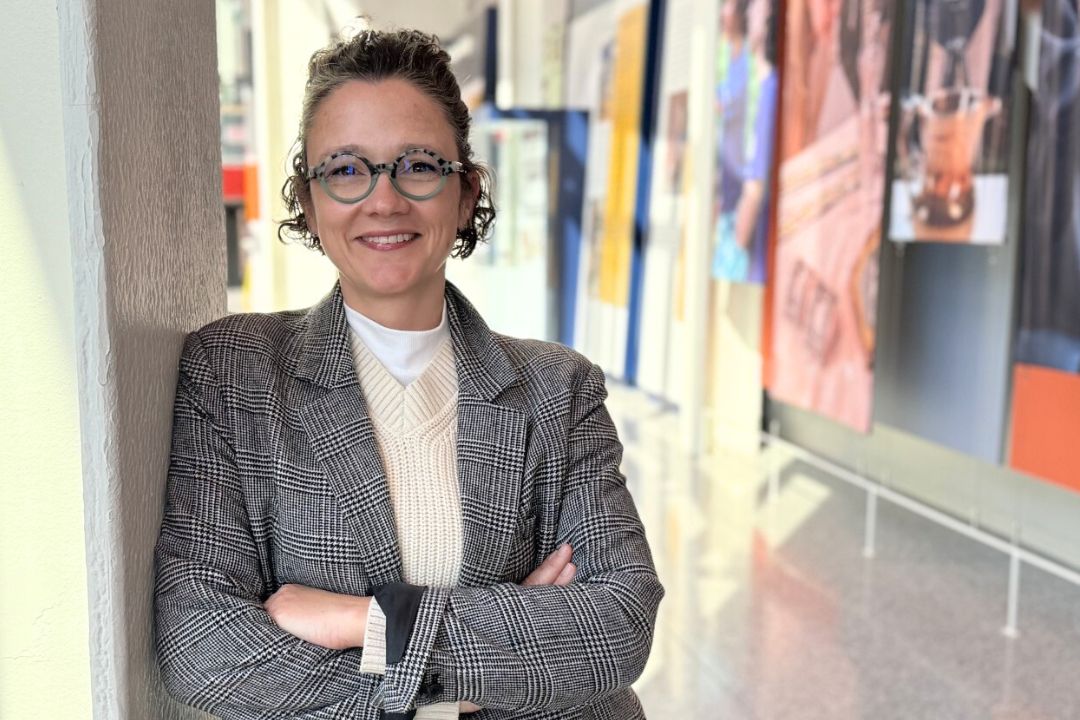
Strategic foresight training is the focus of the new Global Futures BS program. Program Director Jessica Hardin describes outcomes as “a toolbox” of adaptable, durable skills valuable for nearly every industry sector and organizational type, from healthcare, business, and manufacturing to government, policy making, and peacekeeping. Design thinking, economic literacy, trend analysis, global business, and cross-cultural collaboration are just a few examples of the skills students will hone.
Flash forward fifty years and what will it take for an organization to be successful? How will rapid advancements in technology and AI change our business operations, trade, global economies, health care, education, and nearly every facet of human life? In 2050 or 2075, what will our workforce, our communities, or our societies need to thrive?
While none of us has a magic crystal ball, a new undergraduate degree program developed by the RIT College of Liberal Arts aims to equip grads with the mindset, tools, and skills to anticipate and envision a pathway for future flourishing. Global Futures BS, the latest addition to the college’s list of innovative interdisciplinary programs, is now accepting applications for its first cohort that will start fall 2026.
“Global Futures BS capitalizes on RIT's strengths and liberal arts strengths,” explains Associate Professor and Program Director Jessica Hardin. “It's an amazing fusion of strategic thinking, humane thinking, and tech thinking all at once, which, really, is hard to find anywhere else other than RIT.”
The program’s curriculum draws from a multidisciplinary mix of areas—public policy, economics, science and technology studies, anthropology and sociology, history, political science and more—to deliver strategic foresight training. Progressing through project-based course work, study abroad or study away experiences, and internships or co-ops, students will acquire what Hardin describes as “a toolbox” of adaptable, durable skills that are valuable for nearly every industry sector and organizational type, from healthcare, business, and manufacturing to government, policy making, and peacekeeping.
Design thinking, economic literacy, trend analysis, global business, and interdisciplinary team and cross-cultural collaboration are just a few examples of the skills students will hone.
Equipping graduates with skills in high demand among employers was a main driver for curriculum development, said Hardin. A combination of research on predicted skill needs cited by bellwether organizations such as the World Economic Forum and one-to-one feedback from corporate leaders shaped the final curriculum. “I heard ‘I need employees who are able to jump on a plane and talk to someone in the UK, and then go to Costa Rica the same day and have a conversation with people working the shop floor, and then manage another relationship in Budapest. They need to be technologically competent, of course, but moreover, they need to be able to just jump in and adapt to these multiple kinds of settings that increasingly define our workplaces’,” said Hardin.
Because cross-cultural competence and global perspectives emerged as clearly necessary components for the program, a study abroad or study away requirement was incorporated. Leveraging RIT’s 600+ exceptionally strong and diverse options for study abroad or away—from its international campuses in Croatia, Dubai, and Kosovo to its premier international peacekeeping summer program Frederick Cuny Peace and Conflict Studies, short term travel courses with faculty, RIT in L.A., and others—it links the study of emerging societal issues and tech to transformative study abroad opportunities. “These types of connections are abundant here within the RIT ecosystem as opposed to traditional liberal arts universities,” said Associate Dean of Academic Affairs Lauren Hall.
Additionally, flexibility is built into the program, allowing students to easily double major in STEM, health care, or business fields, add minors, and pursue RIT’s vast options for crafting an educational and career prep path that is uniquely aligned with their own passions and goals. Student might also complement the major with study of a language either by adding a double major in RIT's Applied Modern Language and Culture BS (Chinese, French, Japanese, or Spanish) or selecting from 24 minor and immersion options.
While the Global Futures program is new to RIT, the academic discipline has been around for nearly 50 years, reports Hardin. “The Department of Defense started thinking about foresight and future studies in the 1990s. They even coined it ‘VUCA,’ stemming from the notion that the future is volatile, uncertain, complex, and ambiguous.” This program helps students navigate exactly that complexity.
The advent of AI is one clear example of a complex and evolving global disruption. Other areas that Global Futures students might study include climate change and its effects on economies, people, and immigration or resettlement; product development in alignment with forecasted marketplace needs; peace keeping and conflict management; health care equity and access; and more.
“For students who are not afraid of a blank canvas, who are intellectually curious, open-minded, action-oriented, and don’t want to be a linear path in one specific degree that leads to one specific career...
This program provides an ideal way to explore and apply skills across a lot of different spaces,” said Hardin. “I'm super excited to see the kinds of students it attracts and the kinds of incredible interactions that those students are going to have, both with each other and with the faculty in the program, and with all the other RIT experiences that they're going to be able to have.”
Citing psychologist Jean Twenge's work on Gen Z and Gen Alpha, Hall notes that the Global Futures BS program is also intentionally designed as a pathway that can empower today’s generation of college students for impact. “They're very socially conscious and values-driven, they have a lot of interests, they care deeply, they're conscientious, but they're also worried about the fact that the world is becoming more unpredictable, and they're worried about their own path in the world. And so, I think this is the perfect degree for that population.”
"It's the right program at the right time," said Hall. "The solutions for future kinds of problems are going to be multidisciplinary."
Housed within the College of Liberal Arts' new Interdisciplinary Institute for Innovation, commonly called "the I 3," this new program joins the college's list of interdisciplinary programs that capitalize on RIT's uniquely wide range of strengths in the liberal arts, art and design, health care, computing, engineering, and tech. The I 3 aims to be a hub for innovative thinking and collaboration and an incubator for more new future-proof and flexible degree programs.
For more information, visit the program web page rit.edu/study/global-futures-bs and rit.edu/admissions/apply. Future college students can also attend an upcoming RIT Open House event for a chance to learn more and discuss the program with Dr. Hardin. Additionally, one-to-one meetings can be scheduled at this web page rit.edu/liberalarts/personalized-visit.