From Psychology to the Law: Romiere Horace Forged a Path to Forensic Psychology
When talent, drive, and passion meet opportunity and support, the possibilities are limitless. Romiere Horace—the RIT College of Liberal Arts 2026 Graduate Program Commencement Delegate and soon-to-be two-time RIT alumnus—is a living example of this.
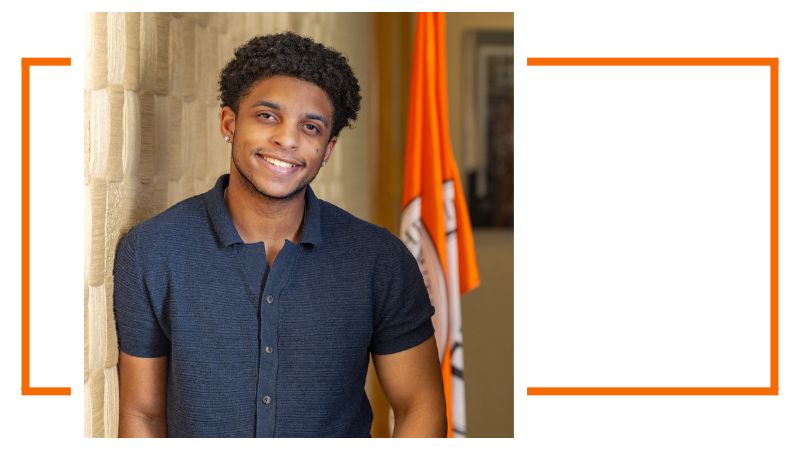
Starting at RIT as a first-year student from New Jersey, Romiere had a general vision for his college experience, but his focus only truly took shape after exploring courses outside his primary major. Supportive connections with faculty, hands-on research opportunities, and leadership roles soon fostered a newfound confidence and a broader, more selfless worldview.
Now, Romiere is prepared for the next step toward a career in forensic psychology. As he applies to Ph.D. programs in clinical psychology, he carries forward a finely honed research skill set and the deep expertise he gained across criminal justice, psychology, and experimental psychology.
Meet Romiere Horace
While at RIT, how were you able to combine majors, minors, immersions, and experiences to craft an education tailored to your goals and passions?
When I started at RIT, I was only majoring in psychology, and I didn't really have an idea of what I wanted to do with it yet. Early on, I took an online criminal justice class, just arbitrarily, but I remember thinking “Wow, this is really interesting. I would love to learn more about this.” And then I learned that I could and that doing a double major is very feasible, so I added a double major in criminal justice.
What was really special, though, was how amazing the faculty in the criminal justice department are. They were all so supportive that I wanted to do even more work with them. They gave me really great recommendations on how to combine these majors to pursue what I wanted to because I'm really interested in the intersection of psychology and law. They pushed me to take classes that were more focused on the sociological implications of criminal justice.
Honestly, the way that I was able to tailor my education to my goals and passions was because of the RIT faculty and staff. They were so instrumental in making those things come together. Even to this day, Professor Scott, who I had that online course with, connects with me to ask how I’m doing, and that really matters.
What was your favorite class and why?
My favorite class was one that I took with my current advisor, Dr. Rebecca Houston, called the Biological Bases of Mental Disorders. She is just such a wonderful professor that class was always so fun to go to, and I think that that course really exemplified how specialized the RIT psychology faculty are.
Here, you have many different options. You can get immersed in cognitive psychology, or social psychology, or biological psychology, and the faculty care so much about what they're teaching. You can tell that they're really passionate. That class was a smaller one, too, so you were able to really ask questions, work one-to-one with the professor, and talk about the material. It was just so interesting, and Dr. Houston is such an amazing professor that it all felt more like a fun activity rather than a class. She really cultivates that kind of environment.
What’s one thing that you did while at RIT that you’re really proud of?
As the president of Psi Chi, we're supposed to create and manage events throughout the course of the year. Me and the current president and vice president of the National Organization of Women came together to co-host an event, discussing things in light of issues that women face for Women's History Month.
It was just a really special moment for me because we were able to coordinate this really important and effective meeting for people who really needed it, especially during Women's History Month, which is an important time to reflect. I was really proud of leading this event with them, being able to just come together, put ideas together, see our ideas help people, and provide a space for them.
How has studying a liberal arts discipline at a technical university prepared you for your next steps?
When I first started at RIT, I knew I would be studying a smaller major within a smaller college, so I was a little unsure what I would be getting. But, looking back now, I don't think that any other institution or university could have prepared me as well as RIT did.
The faculty-to-student ratio, being able to really be seen by your professors, made it easy to be pushed in the right directions and prepared for what comes next. When I met with Dr. Houston for the first time, I was actually meeting with her because I was struggling in a class and wanted advice for how to approach studying. We had talked about that, and then she asked “Well, what do you want to do for the rest of your life?”
That conversation guided me in the right direction and is, honestly, why I've been able to focus on research. I feel that having really great faculty and a good faculty to student ratio has made it possible to interact with faculty more and propelled me in the right direction.
How has your time at RIT shaped who you are today?
RIT genuinely made me a more mature and a more selfless person. It’s incredibly special because it provides students with so many different communities and groups of people. I don't know any other place that is able to foster and hold so many different communities to coexist harmoniously.
Being involved in a lot of different events and cultures and communities has opened my eyes to so many different aspects of society and people. I grew so much as a person from that, and I think I inherently became a more selfless person because I adopted less of a “bubble view” of the world and more of a wider view. The world is a huge place, and there are so many people in so many different corners of the world, all with different experiences.
Also, I think it made me a more confident person because of those opportunities that I was given through research. I gave presentations at conferences, had a research paper published, and I grew confident in myself as a researcher and as a student.
Advice for younger you: If you go back in time and give your freshman self advice, what would you say?
Enjoy the small moments. I feel like sometimes in undergrad or grad school, we can get very caught up in focusing on papers and deadlines and big events and things like that, but there's so many great, beautiful moments that are just small things that happen from time to time, whether it's on campus or outside campus.
When I reflect now on my time at RIT, I find myself looking back more on those small exchanges and those small moments that eventually blossomed into much bigger things over time, whether it was joining a club or meeting a friend or going to some small event and then becoming a part of a bigger community.
I think taking those moments and really cherishing them, because we sometimes get caught up on our main goals and aspirations, but it's those little detours that are really important.
For supporting you along your RIT journey, is there anyone you’d like to thank?
This list could be endless! I’d love to thank: Dr. Rebecca Houston because I really would not be where I am today if it weren't for her; Lisa Dammeyer, who has been just the kindest, sweetest person (my commencement delegate speech was actually inspired by something that she said to me); Molly Pallocy for supporting me along my RIT journey; Dr. Stephanie Godleski—she's just a genius and the coolest person to talk to; Alison Fitch; Lilia Rissman; and Dustin Haraden. Dr. Baschnagel, honestly, the entire psychology department!
Also, Joe Williams in the criminal justice department; Nicholas Robertson; Irshad Altheimer; Jason Scott; and Tony Smith. Ting Zhang in the McNair program; Kate Torrey; and Megan Kalloo. They've all just given me a ton of opportunities with McNair and CSTEP.
And lastly, I’d like to thank my partner Jamie who graduated from RIT, my family, and all my friends from RIT (which would make this list pages long because there's so many amazing people I've met).
|
Program(s) of Study:
|
Co-Op/Internship: Summer Research Assistant, RIT Department of Psychology, through RIT’s McNair Scholars Program |
|
Research:
|
Leadership and Engagement:
|
|
Awards and Honors: |
Plans for after graduation:
|
More Featured Profiles and Work
Ryan Lamon